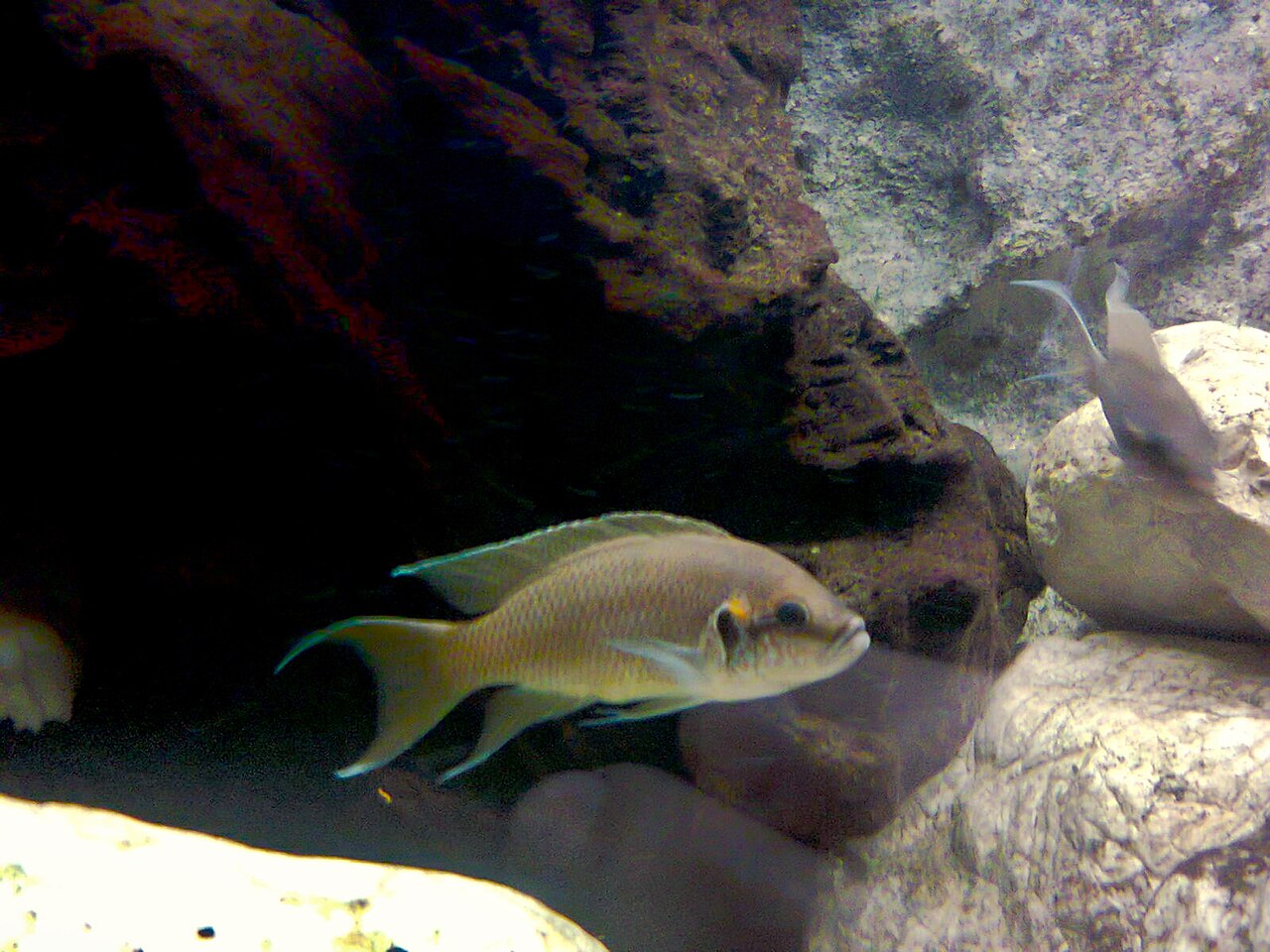
Most people with very hard, alkaline tap water spend years fighting it. They buy pH-down, they lug home jugs of RO, they pick soft-water fish and then wonder why the fish never look right. I did all of that before I worked out the obvious thing: somewhere on the planet there is a lake with water almost exactly like the stuff coming out of my kitchen tap, and it is stuffed with some of the most interesting fish in the hobby. That lake is Tanganyika, and building a tank around it is the single easiest fishkeeping I have ever done on my water.
My tap runs around 22 to 23 dGH, calcium heavy, pH about 7.2 out of the pipe and drifting higher in the tank. For a Tanganyikan tank that is not a problem to solve, it is a head start. This is how I put one together.
Free PDF
Free aquarium water cheat sheet (PDF)
Grab the one-page reference for your tank: target ranges for pH, hardness, ammonia, nitrite and nitrate, plus a plain walkthrough of the nitrogen cycle. No fluff, unsubscribe any time.
Free, unsubscribe any time. The download starts as soon as you sign up.
Why Tanganyika suits hard tap water
Lake Tanganyika sits at roughly pH 8.6 to 9.4 in the wild, with a general hardness around 16 to 18 °dGH and, unusually, a carbonate hardness (KH) that often sits higher than the general hardness. That last part matters: it means the water is heavily buffered and does not swing about. The fish that evolved there are built for stable, mineral-rich, alkaline conditions.
In the tank I aim a bit gentler than the wild lake, pH 8.0 to 8.5, because captive-bred stock has been raised at those numbers for generations and there is no sense chasing pH 9. My hard tap gets me most of the way there on its own. If your water is soft you would need to build this hardness up with salts, which is a faff and an ongoing cost; if it is hard like mine, the lake has done your shopping for you. For the background on what those numbers actually mean, I keep coming back to my GH and KH explainer.
The honest flip side: this is a bad plan on soft water unless you are willing to remineralise every water change. If that is you, my remineralise calculator will get you to a Tanganyikan target, but weigh up whether you would rather keep soft-water fish and stop fighting your own tap.
Tank size and shape
Footprint beats height for these fish. Almost everything in Tanganyika lives on or near the bottom, in sand, in rock or in shells, so what they want is floor space, not a tall show tank.
- Shell-dwellers only (multies, similis, ocellatus): a 45 to 60 litre tank with a long base works, and a colony of the smallest species will run happily in something that size. My colony write-up is over in keeping shell-dwelling cichlids.
- A mixed Tanganyikan tank with rock-dwellers and open-water fish as well: I would not go below 120 litres, and 200 litres or more makes the stocking far less fraught.
Work out what you are actually dealing with before you buy fish; my volume calculator turns your tank’s measurements into real litres, which is the number every stocking decision hangs off. When you get to fish, run the plan through the stocking calculator too, though with cichlids the bioload is only half the story and territory is the other half.
The book behind Lagonia
The Hard Water Aquarium
My practical guide to working with hard, alkaline tap water instead of fighting it: reading your water, choosing and setting up the tank, and keeping and breeding the fish that thrive in it, from livebearers to Rift Lake cichlids and shell-dwellers.
Ad · Amazon affiliate links. I earn a small commission on a purchase, at no extra cost to you.
Substrate: sand, and plenty of it
Use fine sand. Not gravel, not big grains, sand. Half the fish in this lake sift it through their gills, dig in it, or bury shells in it, and coarse substrate stops all of that. I run a bed around 4 to 5 cm deep so the shell-dwellers can excavate properly and bury a shell up to its lip.
There is a common tip to use aragonite or crushed coral sand to hold the pH and hardness up. On genuinely hard tap like mine that is belt-and-braces; my water is already buffered hard, so I use plain inert play sand and let the tap do the work. If your water is softer or your KH is low, an aragonite-based sand is a cheap, passive way to keep the buffer topped up. Either way, more on grain choice sits in my substrate guide.
Rock and shells: building the territories
This is where a Tanganyikan tank is really made or broken. These fish are territorial, and territory in this lake is physical: a crevice, a cave, a shell. Give them enough of it, well broken up, and aggression drops off a cliff. Give them a bare tank and they will pick a single spot and fight over it endlessly.
Rock. Build stable piles with caves and line-of-sight breaks, resting the bottom stones on the glass and sand rather than on each other where they can be undermined by digging. Any inert rock is fine; I like ordinary limestone or slate. Rockwork is the home for the rock specialists like Julidochromis and the brichardi group, so if those are on your list, build a proper wall of it. My hardscape notes cover stacking rock so it does not collapse.
Shells. For the shell-dwellers you need empty snail shells, one per fish at the very least and really two or three each so they have spares to argue over. Escargot shells from the supermarket are the classic choice. I have written a whole piece on picking and prepping shells because the details matter more than you would think.
A useful way to think about the layout is in zones. Sand and shells at the front and open middle for the shellies, a rock pile at one end or the back for the rock-dwellers, and the open water above for anything mid-column. Fish that occupy different zones barely compete, which is the whole trick to stocking one of these tanks.
Water, filtration and heat
Filtration. Nothing exotic. These fish come from clean, oxygen-rich water, so I want good turnover and low nitrate rather than a specific gadget. A decent sponge filter suits a shellie-only tank; a mixed tank does better with a bit more mechanical filtration behind it. Keep the flow honest but not a washing machine.
Heat. Aim for 24 to 26 °C. The lake is remarkably stable year round, so pick a sensible middle number and leave it there. Size the heater to the tank with my heater calculator so it holds temperature without cycling hard.
Water changes. This is the non-negotiable bit. I do 25 to 30% weekly. Stable, buffered, alkaline water is exactly what keeps these fish healthy, and letting nitrate climb undoes the whole point of choosing a hard-water lake in the first place. My routine and reasoning are in aquarium water changes. Match the new water’s temperature and, if you buffer with salts, mix to the same target every time so nothing swings.
Stocking a Tanganyikan tank
Pick fish that split the tank up between them rather than all wanting the same space.
- Shell zone: a colony of one shell-dweller. Neolamprologus multifasciatus is the classic starter, similis is its stripier cousin, and Lamprologus ocellatus is the bolder single-shell option. If you are torn between the first two, I compared them directly in multies vs similis.
- Rock zone: Julidochromis or the Neolamprologus brichardi group, both rock specialists that keep to their patch.
- Open water: a shoal of a mid-column Tanganyikan such as Cyprichromis if the tank is big enough, though these want real length and are a step up in demand.
A few honest cautions. Do not overstock; territory, not filter capacity, is your limiting factor. Watch what happens when a shellie colony starts breeding, because a pair on fry defends a surprising radius. And think hard before adding tankmates to a small shellie tank; I went into who actually works in multifasciatus tankmates, and the short version is that most community fish are the wrong call.
What not to do
Do not mix a Tanganyikan tank with soft-water community fish to “fill it out”. Tetras, most rasboras and the like come from the opposite kind of water, and you would be dragging them into conditions they hate to keep fish that are thriving. If you want to know which fish genuinely enjoy hard alkaline water beyond the Rift cichlids, I keep a running list in hard water fish.
And do not reach for pH-down or peat to soften a Tanganyikan tank. The entire appeal here is that you get to stop fighting your water. On hard tap, a Tanganyikan setup is the rare tank that gets easier the less you interfere with it, and after years of doing the opposite, that still feels like getting away with something.