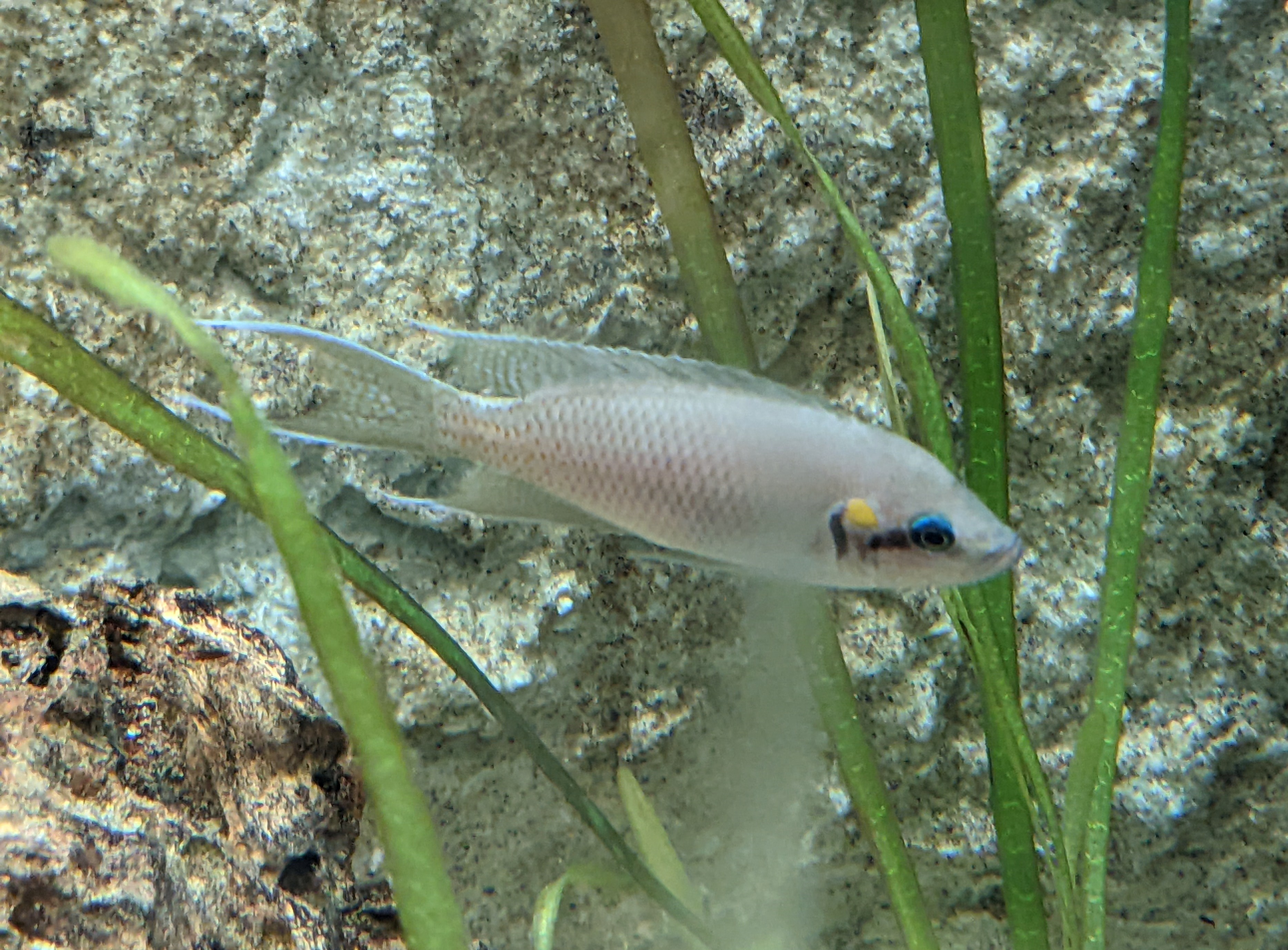
The fairy cichlid is one of those fish that fools people twice. First it fools you with the looks: a slender, tan body, trailing filament fins, a blue-lipped face and a little gold spot behind the eye, all of it delicate and elegant. Then it fools you with the temperament, because Neolamprologus brichardi is a stubborn, territorial fish that will square up to something three times its size and win. I keep them because they suit my hard tap water perfectly and because a colony is genuinely fascinating to watch, but I would never sell one as a gentle community fish. If you have hard, alkaline water and a tank you can give over to a single species, read on.
Free PDF
Free aquarium water cheat sheet (PDF)
Grab the one-page reference for your tank: target ranges for pH, hardness, ammonia, nitrite and nitrate, plus a plain walkthrough of the nitrogen cycle. No fluff, unsubscribe any time.
Free, unsubscribe any time. The download starts as soon as you sign up.
What a brichardi actually is
Neolamprologus brichardi comes from the rocky shores of Lake Tanganyika, and in the hobby it goes by the fairy cichlid or the princess of Burundi. It reaches around 9 to 10 cm, most of which is body; the trailing fins add length and drama without much bulk. The colour is subtle rather than showy, a soft grey-tan that catches the light, which is part of why a mature group looks so good against dark rock.
It sits in a knot of very similar species and regional forms, the brichardi and pulcher complex, and this matters more than it sounds. Many of them interbreed readily, so if you care about keeping a true line you keep one form on its own and do not mix brichardi with daffodils, pulcher or the various trade names floating around. Cross them and you get muddy, unidentifiable fry.
If you already keep Tanganyikans, think of brichardi as the open-water-adjacent cousin to the shell-dwellers: same lake, same hard water, but a fish that claims a whole rock pile rather than a single snail shell.
The dynasty: how the colony breeds itself
This is the reason to keep brichardi, and also the reason to think twice. They are one of the classic cooperative breeders in freshwater. A pair forms, claims a cave or crevice, and spawns on the rock. So far, ordinary cichlid stuff. What happens next is not.
The parents guard the eggs and fry, and then the fry from that first batch stay on. As the next spawn arrives, those older youngsters help defend the territory and shepherd the smaller fry, acting as babysitters for their own siblings. Over time you get a multi-generational family group, all descended from the founding pair, all working together to hold and defend one patch of the tank. Watching a colony operate, with fish of five or six different sizes all pulling in the same direction, is one of the best things in the hobby and something no amount of reading really prepares you for.
The flip side is that the colony never stops. A settled group in good water quietly produces fry more or less continuously, and the population climbs until the territory is full. You will end up netting fish out and finding homes for them, or accepting that the tank has a hard ceiling. Go in knowing that a brichardi colony is a commitment to managing numbers, not a set-and-forget display.
The book behind Lagonia
The Hard Water Aquarium
My practical guide to working with hard, alkaline tap water instead of fighting it: reading your water, choosing and setting up the tank, and keeping and breeding the fish that thrive in it, from livebearers to Rift Lake cichlids and shell-dwellers.
Ad · Amazon affiliate links. I earn a small commission on a purchase, at no extra cost to you.
Don’t be fooled by the fins
Those delicate filaments hide a serious attitude. Brichardi defend their territory with a persistence that is almost comic until you see it directed at a fish that cannot get away. They will chase, nip and harass anything that strays into the family patch, and a colony with fry to protect can turn a large fraction of the tank into a no-go zone for everyone else.
The aggression scales with the colony. A single young pair is manageable. An established group of a dozen fish, several of them holding fry, will dominate the whole aquarium and can bully tankmates into the corners until they stop eating. This is not a temperament problem you can train out; it is the same behaviour that makes the cooperative breeding work, just pointed at your other fish.
There is one more trap here. You cannot usually add a new brichardi to an established colony. The residents treat the newcomer as an intruder and can kill it. If you want a colony, you start with a small group of young fish and let them sort themselves out, the same way you would with Julies or a shellie group. Do not try to introduce adults to an existing family.
Water: hard and alkaline, which is my tap’s happy place
Lake Tanganyika is hard, alkaline and stable, and brichardi want the same. Aim for a pH around 8 to 9 and plenty of hardness. My tap runs about 22.5 dGH straight from the cold feed, which is if anything harder than the lake, and for a Tanganyikan that is exactly the right sort of problem to have.
The gap, as with most hard-water tap, is pH. Mine comes out nearer 7.2 to 7.6, and brichardi are happier higher. I close that gap with the substrate rather than chemicals: aragonite or coral sand slowly buffers the water and holds the pH up around 8, and a good pile of rock adds to it. No pH-up, no additives, nothing to crash. If the difference between hardness and pH is still fuzzy, my GH and KH guide untangles it, and brichardi belong firmly on the list of hard water fish that make life easy for keepers with water like mine.
Temperature-wise, 24 to 26 °C is the sweet spot. Keep it stable rather than chasing a precise number, and use the heater calculator if you are matching a heater to the tank. As with all Tanganyikans, they are sensitive to poor water quality, so a mature filter and a fully finished nitrogen cycle matter before any fish go in.
The tank and the rockwork
A pair can live in something around 75 litres, but a colony is the point of this fish, and a colony wants space. I would give a group at least 150 litres with a long footprint, and more is better. The extra room does not just house more fish; it lets you build several distinct territories, which lowers the constant friction.
Rock is everything. Build a tall, stable structure with caves, ledges and crevices from the sand to near the surface, and break up the sightlines so a defending fish cannot see the whole tank at once. Those visual barriers are the single most useful tool for keeping the aggression from boiling over. Set the rock on the base glass and bring the sand up around it, so nothing can be undermined by digging. On top of that, sand and aragonite for the buffering, and not much else. The volume calculator is handy once the rockwork is in, because a big Tanganyikan structure eats into your real water volume, and the stocking calculator is a useful reality check on how a self-breeding colony changes your numbers over time.
Feeding
Brichardi are omnivores that take small invertebrates and plankton in the wild, and they are undemanding in the tank. A quality cichlid flake or small pellet as the everyday food, with frozen or live brine shrimp, daphnia and cyclops a few times a week to keep condition and colour up. Feeding a colony is easy because there is always a fish willing to eat; the harder discipline is not overfeeding a heavily stocked, heavily rocked tank, since the waste has nowhere to go and nitrate creeps up fast. Small, frequent feeds and regular water changes keep it in check.
Tankmates, or the honest case for a species tank
My honest recommendation is to keep brichardi on their own. A colony is a complete, self-contained display that does not need company, and adding tankmates mostly creates victims. If you insist on a Tanganyikan community, choose tough cichlids that occupy a different zone, keep the tank large, and accept that the brichardi will still run the show. Do not mix them with soft-water community fish; the water is wrong for those species and the temperament is wronger.
Above all, do not house brichardi with close relatives from the pulcher and brichardi complex unless you are ready for hybrids and territorial wars. One form, one tank, is the clean answer.
Where people go wrong
The two mistakes I see most often are treating brichardi as a peaceful community fish because of the fins, and underestimating what a breeding colony does to a tank over a year. Neither is a flaw in the fish; both come from expecting a different animal than the one you actually bought.
Give a brichardi colony hard alkaline water, a big pile of stable rock, a tank of its own and a plan for the fry, and it rewards you with one of the most watchable social structures in freshwater. Drop a pair into a mixed community tank of soft-water fish and you get a fortnight of quiet followed by a slow-motion war. The fish is not difficult. It just needs to be kept as what it is.