Water changes are the least glamorous job in fishkeeping and the single most useful one. I have kept tanks for years, from heavily stocked cichlid setups to a lightly planted 60 litre that mostly runs itself, and if I could hand a new keeper only one habit, it would be this: pick a day, change a decent chunk of the water, and do it every week whether the tank looks like it needs it or not. Filters get all the attention because they are the expensive bit of kit, but a filter only converts waste from one form to another. It does not remove it. That job is yours, and it involves a bucket.
Free PDF
Free aquarium water cheat sheet (PDF)
Grab the one-page reference for your tank: target ranges for pH, hardness, ammonia, nitrite and nitrate, plus a plain walkthrough of the nitrogen cycle. No fluff, unsubscribe any time.
Free, unsubscribe any time. The download starts as soon as you sign up.
What a water change actually does
Your filter, once it has been through cycling, houses bacteria that convert ammonia into nitrite and then nitrite into nitrate. That process is essential, because ammonia and nitrite are acutely toxic. But it ends at nitrate. Nitrate does not evaporate, and in most tanks nothing consumes it fast enough to matter. Plants take up some, and a genuinely heavily planted tank can make a real dent, but the average community tank with a few crypts and an Amazon sword barely touches it. Nitrate simply accumulates, week after week, until you take it out.
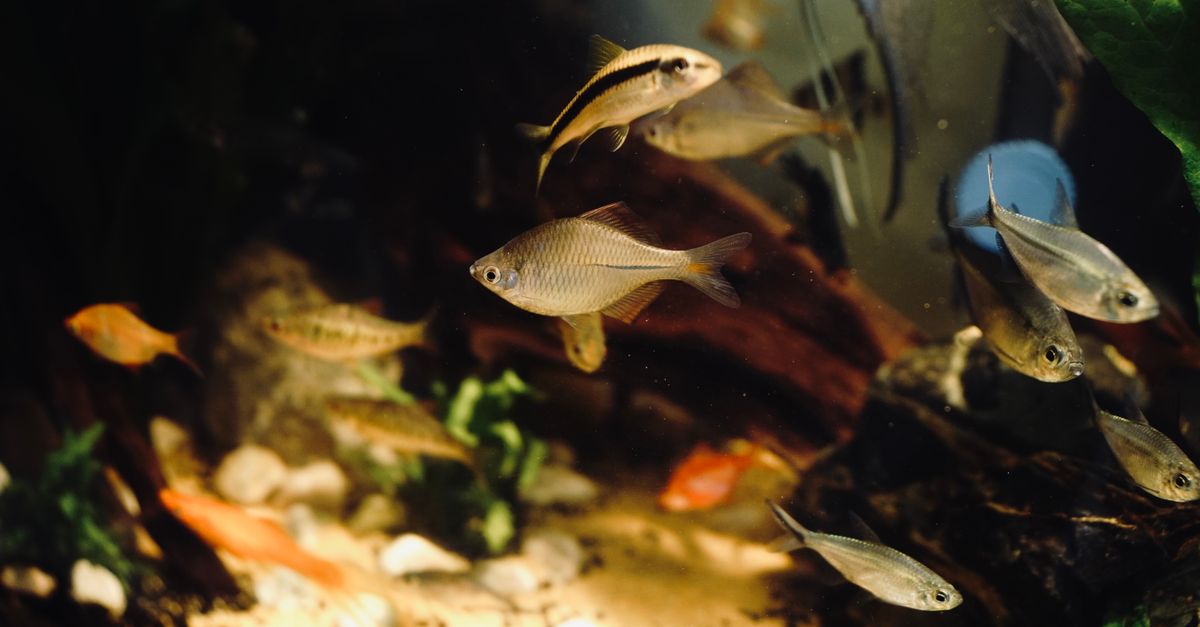
And nitrate is only the headline. Alongside it, every tank accumulates dissolved organic compounds, the vague soup of proteins, tannins and waste products that no test kit on your shelf measures. You can sometimes see it as a slight yellow tint against a white background, or a greasy film on the surface. Fish live in this soup, and long-term exposure to high dissolved organics is linked with poor colour, poor growth and reduced resistance to disease. I have seen it in my own fish. A tank that has drifted for a month perks up visibly after two or three proper water changes, and the difference is not my imagination.
The change works in the other direction too. Fish, plants, and snails constantly draw minerals out of the water. Calcium for bones and shells, carbonates that hold your pH stable, trace elements plants need. In a tank that only ever gets topped up to replace evaporation, these deplete while everything else concentrates. Evaporation top-ups are the worst of both worlds: pure water leaves, minerals and waste stay behind. Fresh tap water, whatever its faults, brings the minerals back. So the honest division of labour is this: the filter handles ammonia and nitrite, and water changes handle everything else.
How much, and how often
My standard answer is 25 to 50 per cent weekly, and where you sit in that range depends on how hard you push the tank.
A lightly stocked, well planted tank with a small feeding hand can live happily at 25 per cent a week. My shrimp tank runs that way and the nitrate barely climbs between changes. A heavily stocked tank, or one with big messy eaters, needs 50 per cent weekly and sometimes more. When I was growing out young cichlids I changed half the water twice a week, because the nitrate test told me anything less was losing the race. If you are not sure which camp your tank falls into, the stocking calculator will give you a sense of how hard your bioload is working, and your nitrate test kit will confirm it. Test just before a change for a few weeks. If nitrate keeps ratcheting upward from one week to the next, your changes are not keeping pace, so change more or feed less.
The number matters less than the rhythm. A reliable 30 per cent every Sunday beats a heroic 60 per cent whenever guilt strikes, which in practice means every five weeks. Fish tolerate stable conditions and dislike swings, and irregular large changes after long neglect are exactly the swing you want to avoid. Consistency also keeps the job small. A weekly change on a maintained tank takes me twenty minutes. A rescue job on a neglected one takes an afternoon and several rounds.
One more honest point: there is no schedule that suits every tank, because tanks differ wildly in stocking, feeding, and plant mass. The routine above is a starting point. Your test kit tells you whether to adjust it.
The book behind Lagonia
The Hard Water Aquarium
My practical guide to working with hard, alkaline tap water instead of fighting it: reading your water, choosing and setting up the tank, and keeping and breeding the fish that thrive in it, from livebearers to Rift Lake cichlids and shell-dwellers.
Ad · Amazon affiliate links. I earn a small commission on a purchase, at no extra cost to you.
Doing it properly
The mechanics are simple, but a few details matter enormously.
Dechlorinate the new water, every time. Tap water carries chlorine or, increasingly, chloramine, and both are there specifically to kill microorganisms. Your fish are harmed directly, and your filter bacteria are exactly the microorganisms the treatment works against. Chloramine is the nastier of the two because it does not gas off if you leave a bucket standing overnight, which is why that old trick is no longer reliable. A bottle of dechlorinator costs little, treats hundreds of litres, and neutralises both. Dose the bucket before the water goes in the tank, or if you fill directly with a hose, dose the tank for the full volume first. I have done the hose method for years without trouble, but only with the dechlorinator already in.
Match the temperature roughly. You do not need a thermometer ceremony. Run the tap until it feels about the same as the tank to your hand, or mix hot and cold in the bucket until it does. A degree or two either way is nothing; most fish experience bigger swings in nature overnight. What you want to avoid is tipping ten litres of properly cold water into a small heated tank in one go.
Siphon the substrate while you drain. A gravel vacuum turns the removal of water into the removal of waste. Push it into the gravel, let the muck lift and the gravel fall back, move along. Waste that sits in the substrate breaks down into exactly the dissolved organics you are trying to dilute, so pulling it out physically is the change earning double. In a planted tank, hover over the surface between plants rather than digging into rooted areas. You will not get every corner every week, and you do not need to. Rotate around the tank.
Never rinse filter media under the tap. This is where most beginner crashes come from. The bacteria you spent weeks growing during cycling live in the filter media, and tap water kills them for the reasons above. When the filter needs cleaning, and it does now and then when flow drops, swish the sponges in a bucket of the old tank water you have just drained. The water turns a horrifying brown, the bacteria stay put, and the filter goes back on none the worse. Old tank water is free and already the right temperature. There is no reason to ever hold media under a running tap.
Know your source water
Before you settle into a routine, test your tap water itself. Two things are worth knowing.
First, nitrate. Some supplies, particularly in agricultural areas, come out of the tap with 10 to 20 ppm already in them. Mine does. That does not make water changes pointless, it just resets your baseline. If your tap reads 15 ppm, then 15 ppm is the floor your tank can be diluted towards, and your target range shifts accordingly. It is still far better than the 80 ppm a neglected tank drifts to.
Second, hardness. If you live on limestone and your water comes out liquid rock, the practical move is to keep fish that thrive in it rather than fighting your supply with RO units and remineralisers. Livebearers, rift lake cichlids and many rainbowfish positively enjoy hard alkaline water, and matching fish to tap makes water changes a five minute job instead of a chemistry project. I have written more on this in the hard water guide. Soft water keepers have the same logic in reverse.
Myths worth burying
“A big water change will crash my cycle.” No. The nitrifying bacteria live attached to surfaces, overwhelmingly in your filter media and to a lesser degree on substrate and decor. They are not floating in the water column in any meaningful number. You can change 80 per cent of the water and the cycle carries on untouched, provided the new water is dechlorinated. The crashes people attribute to big changes almost always trace back to untreated tap water hitting the filter.
“Big changes shock fish.” Only if the new water differs sharply from the old in temperature or chemistry. Dechlorinated, roughly temperature-matched water from the same tap the tank was filled from is not a shock, it is relief. Where this myth has a grain of truth is in neglected tanks, where the old water has drifted so far from tap that a sudden large change genuinely is a big swing. The answer there is several moderate changes over a week, not permanent avoidance of proper ones.
“10 per cent weekly is fine.” Rarely. Run the arithmetic: if your tank generates 10 ppm of nitrate a week and you remove 10 per cent of it, the level climbs relentlessly and settles somewhere very high. Tiny changes feel virtuous but mostly move water around. Under about 25 per cent, you are doing the work without getting the result.
“My nitrate reads zero, so I can skip changes.” A zero reading in a stocked tank usually means heavy planting is consuming it, or the kit has expired, or the regent bottle was not shaken hard enough, which is a famous flaw of the common liquid tests. Even when the zero is real, nitrate is only the measurable proxy for everything else accumulating: the dissolved organics, the mineral depletion, the general drift. Changes are still doing work your kit cannot see.
Routine changes versus emergency ones
Everything above describes maintenance. An emergency is different. If you test and find ammonia or nitrite at any measurable level in a stocked tank, perhaps after a filter failure, a dead fish gone unnoticed, or an overenthusiastic clean, water changes become your immediate treatment. Change 50 per cent straight away, retest, and change again as needed, even twice in a day. Dilution is the fastest way to get a toxin below dangerous levels while the filter catches up. Dechlorinate and temperature-match exactly as always; urgency is no excuse for skipping the basics, since chlorinated water would kill the very bacteria you need to recover. Keep at it daily until ammonia and nitrite hold at zero, then return to your normal weekly rhythm.
That rhythm is the whole game. Same day, same bucket, same twenty minutes. It is dull, and it is the difference between a tank that limps along and one where the fish colour up, breed, and grow old.