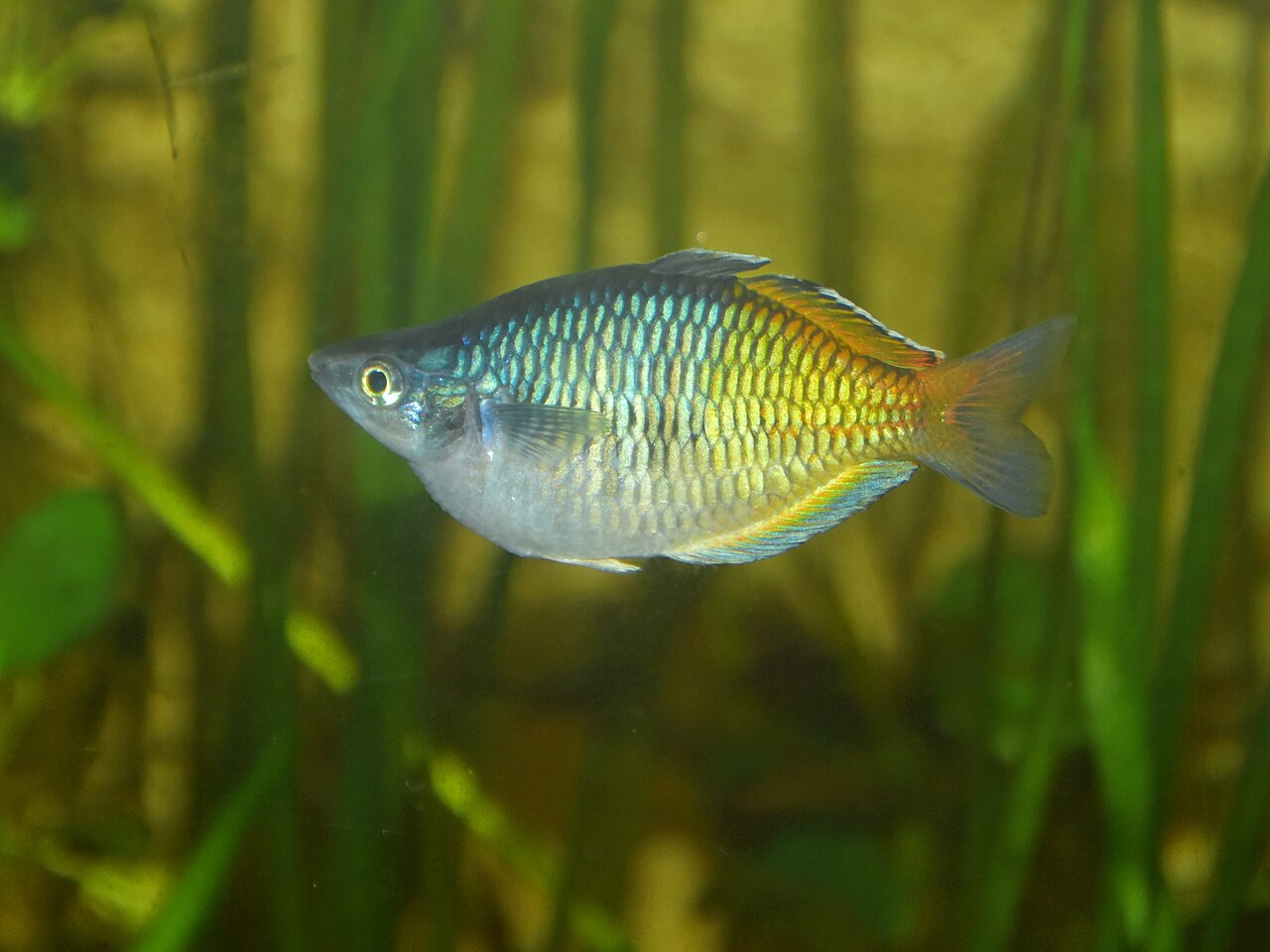
If you keep hard, alkaline tap water and you have ever felt short-changed on colour, rainbowfish are the fish I wish more people knew about. Nearly all the bright community fish shops push, the tetras and the rasboras, are soft-water species that never quite settle in my water. Rainbowfish are the opposite. They come from hard, alkaline lakes, so my rock-hard tap is not a compromise for them, it is what they were built for. A mature shoal moving through a well-lit tank, males flashing colour at each other, is one of the best sights in the hobby, and I get it without touching my water chemistry.
Most of what follows leans on the Boeseman’s rainbow, Melanotaenia boesemani, because it is the one most people meet first, but the general approach fits the other common Melanotaenia rainbows too.
Free PDF
Free aquarium water cheat sheet (PDF)
Grab the one-page reference for your tank: target ranges for pH, hardness, ammonia, nitrite and nitrate, plus a plain walkthrough of the nitrogen cycle. No fluff, unsubscribe any time.
Free, unsubscribe any time. The download starts as soon as you sign up.
What rainbowfish are
Rainbowfish are a family of active, shoaling fish from Australia, New Guinea and nearby islands. The ones we keep are mostly in the genus Melanotaenia, and the star is Boeseman’s rainbow: a fish split down the middle, blue-grey at the front and burning orange at the back, at least on a good male. Females and young fish are plainer silver, which trips up a lot of first-time buyers who see a tank of drab juveniles and walk past the very fish that will look spectacular in a year.
That slow burn is the single most important thing to understand about them. Boeseman’s rainbows colour up over many months, sometimes a full year, and they do it properly only in a group, in good water, with decent food. Buy six pale youngsters, be patient, and feed them well, and you are rewarded. Expect instant colour from a shop juvenile and you will be disappointed.
They are not small. A male Boeseman’s reaches around 10 to 11 cm, females a little less, so this is a fish for a proper tank rather than a nano.
Why they suit hard water
This is the part that matters for keepers like me. The lakes Boeseman’s rainbows come from are hard and alkaline, with a pH often up around 8 to 9. My cold tap runs about 22.5 dGH, calcium-heavy, pH 7.2 to 7.6 out of the wall and drifting up in the tank. For a soft-water tetra that is a lifelong struggle. For a rainbowfish it is close to home water.
The rough targets I aim for: hardness anywhere from about 8 dGH upward, so my 22.5 is comfortably fine; pH on the neutral-to-alkaline side, roughly 7.0 to 8.0; and a temperature of 25 to 28 °C, a touch warmer than a lot of community fish want. There is no additive to buy and no softening to do. If you have hard tap and have been quietly told your water is wrong for everything nice, rainbowfish are proof it is not. They belong on the same hard water fish list as my Rift Lake cichlids, and they save you the cost and faff of RO water. If the hardness numbers are still confusing, my GH and KH guide explains what dGH actually means.
The one thing they are fussy about is not hardness but cleanliness. Rainbowfish like their nitrate low and their water fresh, so they reward regular water changes. This is a fish that shows you when your maintenance has slipped.
The book behind Lagonia
The Hard Water Aquarium
My practical guide to working with hard, alkaline tap water instead of fighting it: reading your water, choosing and setting up the tank, and keeping and breeding the fish that thrive in it, from livebearers to Rift Lake cichlids and shell-dwellers.
Ad · Amazon affiliate links. I earn a small commission on a purchase, at no extra cost to you.
The tank and shoal
Give them length. These are fast, restless swimmers that cover the whole tank, and a short tank cramps that. For Boeseman’s I would treat a 120 cm tank, something around 110 to 150 litres, as a sensible minimum, and more is genuinely better. Smaller rainbow species can go in less, but the big colourful ones need room to move.
Keep them in a group. Six is the floor, eight or more is better, and a larger shoal is where the behaviour comes alive: males display and spar with each other constantly, flaring colour to settle who is boss, and none of it turns into real damage. In too small a group they are nervier and the colour suffers. A good mix of males and females spreads the displaying around and keeps any single fish from being picked on.
The best colour I ever see is first thing in the morning, when the tank light comes on. The dominant males light up almost immediately and start posturing at each other along the front glass, and for the first half hour of the day they are at their most intense. If a shoal looks a little washed out to you by evening, that is normal; check them again at breakfast before you decide they are dull.
They are peaceful with other fish, almost to a fault, but that speed can unsettle shy, slow tankmates. They also jump, so a well-fitted lid is not optional. Work out your true volume before you stock with the volume calculator, check the bioload of an active, well-fed shoal with the stocking calculator, and match a heater to the tank with the heater calculator. A planted tank with open swimming space down the middle suits them perfectly, and hard water need not limit your planting; see my hard water aquarium plants guide for species that cope with our chemistry.
Tankmates
Rainbowfish sit nicely with other sturdy, similarly sized community fish that share their taste for harder water. In my setups they go well with larger livebearers such as mollies, platies and swordtails, all of which also thrive on hard tap. Peaceful bottom dwellers and larger, hardy catfish work too, provided the tank is big enough for everyone.
What I would avoid is anything tiny and slow, or long-finned and placid. Rainbowfish are not aggressive, but a shoal of them tearing about can badly stress a lone betta or a nervous pygmy species, and very small fish risk being outcompeted at feeding time. Match them with fish that can keep up.
Feeding for colour
Rainbowfish are easy eaters and that is exactly why their colour so often disappoints. They will live on cheap flake, but they will not glow on it. Mine get a varied diet: a good quality flake or small pellet as the base, plus regular frozen or live foods such as brine shrimp, daphnia and bloodworm. The live and frozen foods are what bring the orange and blue up to full strength, especially while young males are maturing.
Feed a couple of small meals a day rather than one big one, and vary it. A rainbowfish that eats well, in clean hard water, in a decent shoal, is a genuinely stunning fish. One kept on autopilot flake in a dirty tank is the drab silver thing people walk past in the shop, and they are the same species.
Are they worth it?
For anyone with hard, alkaline water who wants real colour and movement, I think rainbowfish are one of the best options going, and one of the most overlooked. They ask for space, a group, clean water and a bit of patience, and in return they give you a shoal that gets better every month for a year. If your tap is hard and you have been steered towards soft-water fish that never quite thrive, this is the family to try. For the broader picture of what your water suits, my rundown of hard water fish covers the rest of the options.
Treat the parameters here as starting points rather than strict rules; tanks, test kits and individual fish all vary, so watch your own fish and adjust.