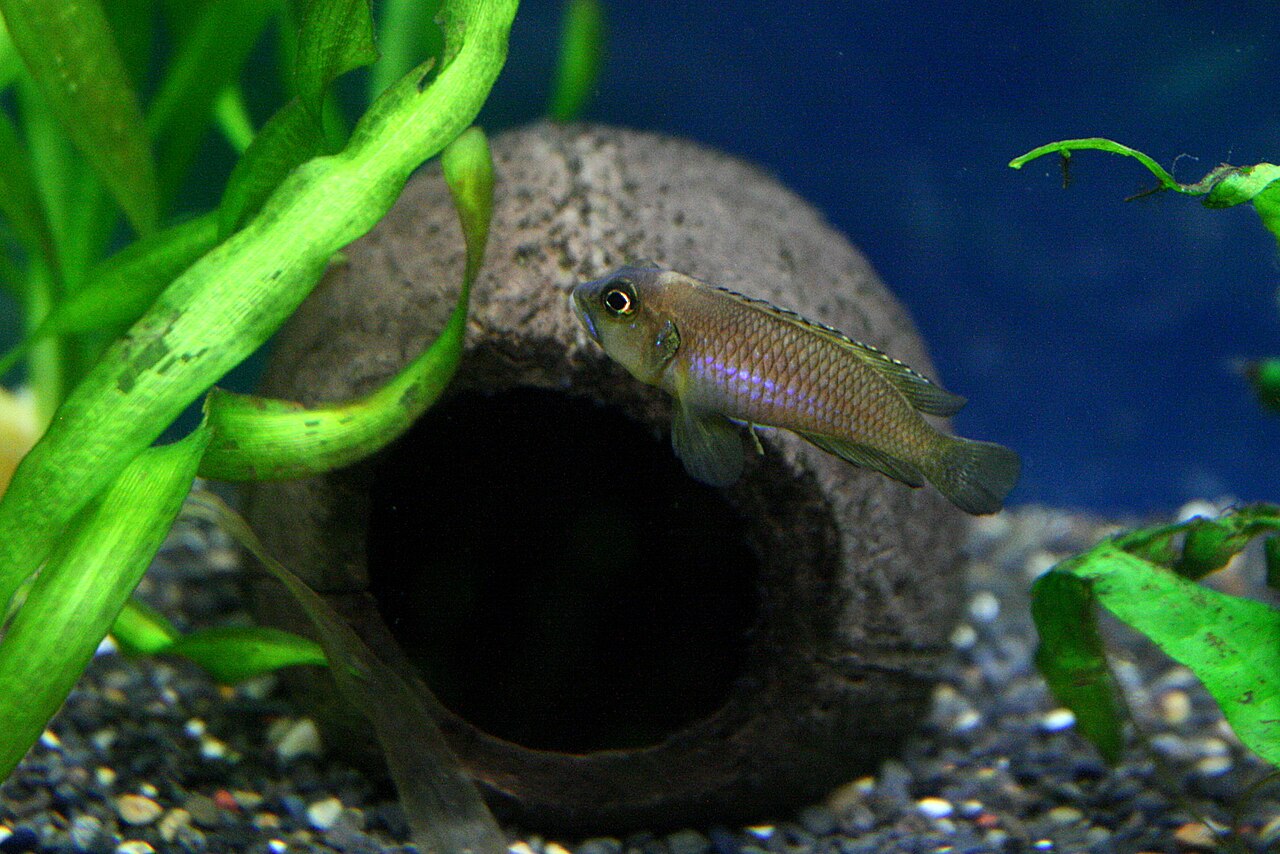
If you want a shell-dweller but the idea of running a whole colony feels like a lot, the gold ocellatus is the one I point people towards. It is a single fish with an enormous personality, it fits in a tank most people would call too small, and it treats my rock-hard tap water as home rather than something to be corrected. I keep mostly Tanganyikans, and of all of them this is the one that makes visitors laugh out loud, usually because a fish the length of a thumb has just squared up to their finger through the glass.
Below is how I actually keep Lamprologus ocellatus, what the books get right, and the couple of things that catch people out.
Free PDF
Free aquarium water cheat sheet (PDF)
Grab the one-page reference for your tank: target ranges for pH, hardness, ammonia, nitrite and nitrate, plus a plain walkthrough of the nitrogen cycle. No fluff, unsubscribe any time.
Free, unsubscribe any time. The download starts as soon as you sign up.
What the gold occie actually is
Lamprologus ocellatus comes from the sandy floor of Lake Tanganyika, where it lives in and around the empty shells of a large water snail. You will see it sold as the gold ocellatus, gold occie, or sometimes under the older name Neolamprologus ocellatus; they are all the same fish. There is a gold form, which is the common one in shops, and blue and orange forms that turn up less often. The gold is the one I keep and the one most people mean.
It is small even by shell-dweller standards. Males top out around 6 cm, females closer to 3.5 cm, and a lot of that length is attitude rather than body. Against pale sand the gold sheen and the ringed eye that gives the fish its name really stand out. If you have ever been unsure whether a shellie was an ocellatus or the similar Lamprologus brevis, the quick tell is the flanks: ocellatus has no vertical barring, brevis does.
Unlike multies, which live as a sprawling colony where the young stay home, ocellatus is far more of a loner. One fish, one shell, one small patch of sand it considers a kingdom. That changes how you stock it, which I will come to.
Why it loves my hard water
My cold tap runs about 22.5 dGH straight from the wall, calcium-heavy, with a pH around 7.2 to 7.6. For the soft-water fish shops love to sell beginners, that is a daily fight. For a Tanganyikan it is close to a gift. Lake Tanganyika is hard, alkaline and mineral-rich, and ocellatus is built for exactly that.
The numbers I aim for: hardness anywhere from about 10 dGH upward, and my 22.5 does no harm whatsoever; pH from 7.5 to 9.0, so on the alkaline side of neutral; and a temperature of 24 to 26 °C. The only gap between my tap and the lake is pH, and I never close it with bottled pH-up, which crashes the day you forget to dose. Instead I let an aragonite or coral sand substrate and a pile of shells do the buffering. They release carbonate slowly and hold the pH up around 8, steady, for months. If the difference between GH and KH still feels fuzzy, my GH and KH guide untangles it. And if you are wondering whether you need to soften anything at all, you almost certainly do not: see do you need RO water. The occie sits firmly on the list of hard water fish that turn awkward tap into an advantage.
The book behind Lagonia
The Hard Water Aquarium
My practical guide to working with hard, alkaline tap water instead of fighting it: reading your water, choosing and setting up the tank, and keeping and breeding the fish that thrive in it, from livebearers to Rift Lake cichlids and shell-dwellers.
Ad · Amazon affiliate links. I earn a small commission on a purchase, at no extra cost to you.
The tank: footprint beats volume
Shell-dwellers live on the floor, so what matters is the area of sand, not the number of litres. A single male with two or three females does well on a footprint of about 45 by 30 cm, which is roughly 40 litres. You can absolutely give them more, and a longer tank lets you keep more fish, but you do not need a big tank to keep this species properly. That is a large part of the appeal.
Two things are non-negotiable. First, a soft sand bed at least 5 cm deep. Ocellatus digs constantly, shovelling mouthfuls of sand to shape the ground around its shell, and it cannot do that on gravel. Play sand or a fine aragonite sand both work. Second, shells, and more of them than you have fish. Empty escargot shells are the classic choice; the fish wants one it can just wriggle into and turn around in. Give each fish a choice of two or three and space them out, because an occie that cannot find a spare shell is a stressed occie. I go into sizing and sourcing in more detail in the best shells for shell-dwellers.
A word of warning from my own tanks: they will bury shells they do not like, dig pits that expose the base glass, and happily undermine any plant you try to root in the sand. Weigh down decor, and if you want greenery, tie something like anubias or java fern to rock rather than planting it. Work out your real volume for dosing and stocking with the volume calculator, and size a small heater with the heater calculator.
Stocking: one fish, big attitude
Here is where ocellatus differs from the colony shellies. A lone male will hold a shell perfectly happily, and honestly a single fish in a nano tank is a valid and entertaining way to keep one. If you want breeding, the usual setup is one male with two or three females, each with her own shell in her own corner. What you cannot do is keep two males in a small tank. They will fight over territory until one is worn down into a corner, and in a 40 litre footprint there is nowhere for the loser to go.
The bites are not just for other fish. When I have my hand in the tank rearranging shells, the resident male comes out and pecks my fingers with genuine conviction. It does not hurt, but the sheer nerve of it never gets old. This is a fish that thinks it is much bigger than it is.
On tankmates, keep it simple. In a small Tanganyikan tank the honest answer is often nothing else at all; the floor is the occie’s and it wants it that way. In a longer tank you can add an open-water or upper-level species that stays out of the sand, but do the maths on bioload first with the stocking calculator and read what actually works with shellies before you buy. Anything that wants to sit on the bottom is asking for trouble.
Feeding
Ocellatus is an easy eater. In the wild it picks tiny invertebrates out of the sand, so it does best on small meaty foods. Mine get frozen cyclops, baby brine shrimp and finely crushed flake, with the occasional live treat. They will take good dried food readily, so you do not have to run a live culture, but a bit of frozen or live food keeps colour and condition up and, if you are hoping for fry, gets the females into breeding shape.
Feed small amounts and watch it disappear into the sand. Overfeeding a nano tank is one of the quickest ways to foul the water, and shell-dwellers do not need much.
Breeding, which mostly means leaving them alone
If the water is right and the female is well fed, breeding tends to happen on its own. She lays her eggs deep inside her shell and does all the parenting from there; the male’s job is guarding the wider territory. Eggs hatch in around three days, and the fry become free-swimming and start venturing to the shell mouth by about day ten. You will often notice you have fry before you notice anything else, a few specks of movement over the sand near a shell.
The fry are tiny but not difficult. They take baby brine shrimp and microworms, and in a species tank with plenty of spare shells they can grow up alongside the parents rather than needing to be stripped out. This is very close to how multies raise their young, except that ocellatus does not form the same big multi-generation colony; each pairing keeps to its own patch. If you are weighing occies against other beginner shellies, my multies versus similis comparison and the Neolamprologus similis care guide cover the colony alternatives.
Is it the right shellie for you?
I would put ocellatus at the top of the list for anyone who wants a single characterful fish in a small, hard-water tank and does not fancy managing a colony. It is hardy in the water most of us are told is a problem, it stays small, it breeds without fuss, and it has more presence than fish ten times the size. The trade-offs are honest ones: it is territorial, it rearranges the tank to suit itself, and it does not really want flatmates. Give it sand, shells and your hard tap water, and it will give you years of entertainment for very little space.
As with any livestock, treat the numbers here as starting points rather than rules; tanks, test kits and individual fish all vary.