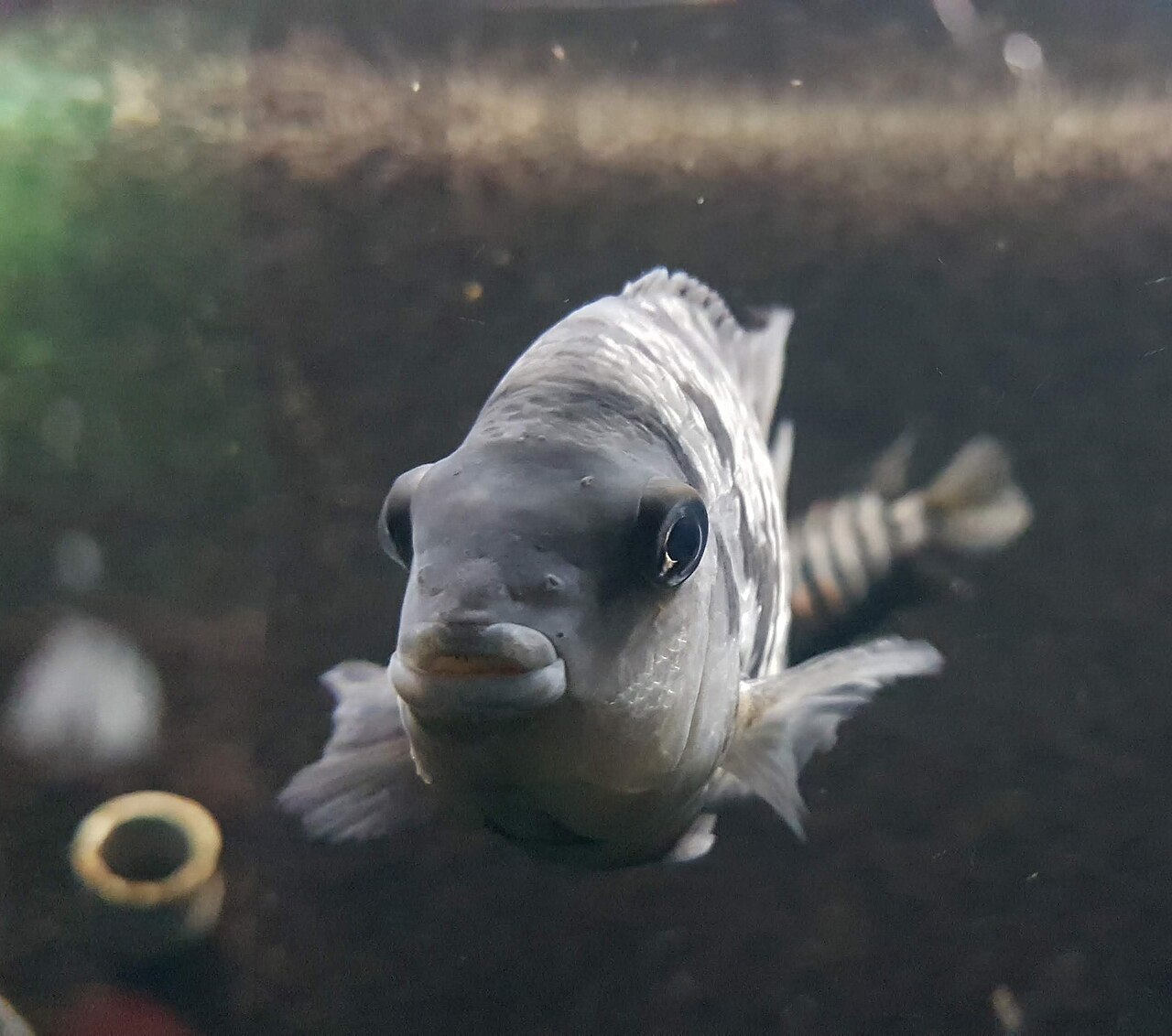
If you want a cichlid with real character, a fish that watches you across the room and rearranges its tank to suit itself, and you happen to have hard alkaline tap water, the convict is one of the easiest recommendations I can make. It is cheap, it is tough, it breeds at the drop of a hat, and it could not care less that your water is liquid rock. The catch, and there is always a catch, is temperament. A breeding pair of convicts is one of the most aggressive things you can put in a home aquarium relative to their size, and going in without a plan for that is how people end up with a tank of shredded fins.
I have kept convicts on and off for years on water that reads about 22 dGH, and they have never so much as blinked at it. Here is the honest picture.
Free PDF
Free aquarium water cheat sheet (PDF)
Grab the one-page reference for your tank: target ranges for pH, hardness, ammonia, nitrite and nitrate, plus a plain walkthrough of the nitrogen cycle. No fluff, unsubscribe any time.
Free, unsubscribe any time. The download starts as soon as you sign up.
Why convicts suit hard water
Convict cichlids (Amatitlania nigrofasciata) come from Central America, from streams and lakes that tend to run hard and alkaline. They are famously adaptable and are usually quoted as happy anywhere from around pH 6.5 to 8, but the part that matters for anyone reading this site is that the top of that range, hard and alkaline, is exactly where they are most at home. My tap water at roughly 22 dGH and a pH that drifts above 7.5 in the tank is well within their comfort zone, and I have never needed to touch the chemistry.
That makes them a genuine hard-water fish rather than a fish that merely tolerates it. If you want the wider list of species that actively suit water like this, I keep one in hard water fish. Convicts sit near the top of it for sheer hardiness.
Tank size and setup
Convicts are small by cichlid standards. Males reach about 15 cm, females stay smaller at around 10 cm, and a nuchal hump develops on older males. They are not small in attitude, though, and that is what drives the tank size.
For a single fish or a mated pair I would not go below 150 litres, and more floor space is always better because it lets you break up sightlines. A pair squeezed into a small tank has nowhere to get away from each other, and that is where the injuries start. Work out what your tank actually holds with the volume calculator before you decide what to keep in it, because “40 gallons” on a box and the real swimming volume are rarely the same number.
Setup is simple. Give them:
- A sandy or fine-gravel base they can dig, because dig they will.
- Rockwork and caves, or an upturned plant pot, to provide territory and a breeding site. My hardscape notes cover stacking rock so it survives their landscaping.
- Tough or floating plants only. Anything rooted and delicate gets uprooted; I gave up on planting convict tanks and leaned into rock instead.
Filtration wants to be solid, since these are messy, hungry fish. Aim for good turnover and stay on top of nitrate. A heater set to 24 to 26 °C keeps them comfortable; size it with the heater calculator so it holds steady.
The book behind Lagonia
The Hard Water Aquarium
My practical guide to working with hard, alkaline tap water instead of fighting it: reading your water, choosing and setting up the tank, and keeping and breeding the fish that thrive in it, from livebearers to Rift Lake cichlids and shell-dwellers.
Ad · Amazon affiliate links. I earn a small commission on a purchase, at no extra cost to you.
Feeding
Easy. Convicts are omnivores and will eat almost anything you offer. I feed a good-quality cichlid pellet as the staple, with frozen foods like bloodworm and brine shrimp a couple of times a week, and the odd bit of blanched vegetable. Do not overfeed, because they will happily take more than they need and the extra just becomes nitrate. My general approach is in feeding aquarium fish; convicts are the last fish you will ever struggle to feed.
Sexing convicts
This is one of the few cichlids where telling males from females is genuinely straightforward once they mature.
- Females develop an orange or reddish patch on the belly and lower flanks. It is the giveaway, and a mature female with that colour is unmistakable.
- Males grow larger, develop longer, more pointed dorsal and anal fins, and often a pronounced nuchal hump on the forehead with age.
If you are buying young fish and want a pair, the belly colour on the females is the thing to look for as they grow. Buying a group of juveniles and letting a pair form naturally works, but see the warning below about what happens to the ones that do not pair up.
Breeding, and being careful what you wish for
Convicts are the classic “my first cichlid to breed” fish for a reason. Give a pair stable water and a cave, and they will spawn. And spawn again. They are prolific, they are excellent parents, and a healthy pair can produce broods every few weeks in good conditions. That is brilliant the first time and a genuine problem by the third.
Two honest things to plan for before you let them breed:
Aggression goes through the roof. A pair guarding eggs or fry will attack anything in the tank, regardless of size, including fish twice their length. I have watched a breeding pair back a much bigger fish into a corner and keep it there. If there are other fish present when a pair spawns, you need a plan to separate them or a tank big enough that the others can genuinely stay out of the way.
You will run out of homes for the fry. A single successful spawn can be dozens of fish, and they grow. Convicts are so easy to breed that shops are rarely short of them, so rehoming a constant supply is harder than producing it. Do not start breeding convicts unless you have thought about where the babies go. It is not fair on the fish, or the shop, to churn out broods with no plan.
If you are new to raising fry in general, the mechanics are the same as for livebearers and my breeding livebearers piece covers the basics of feeding and growing them on.
Tank mates
Cautiously, and never during breeding. Convicts can share a tank with other hardy cichlids and tough fish of similar size and temperament in a large enough setup, but they are not community fish in the usual sense. Peaceful, soft-water shoalers are exactly the wrong choice; they will be bullied and they will not enjoy the hard water anyway.
Honestly, the setup I would recommend to most people is a single pair, or even a single fish, in a species tank. You lose nothing, because convicts are entertaining enough on their own, and you sidestep the entire aggression problem. If you do want to build a mixed hard-water cichlid tank, plan the territories carefully; my Tanganyika tank setup piece is about African cichlids rather than Central American ones, but the principle of splitting a tank into zones so nobody competes for the same spot carries straight across. Run any stocking idea through the stocking calculator as a sanity check on bioload, remembering that with cichlids, territory limits you long before the filter does.
Are convicts a good beginner cichlid?
Yes, with one asterisk. For hardiness, adaptability to hard water, feeding and general toughness, they are close to bombproof and a superb first cichlid. The asterisk is that their breeding behaviour and aggression can catch out someone expecting a placid community fish. Go in knowing they are pugnacious little things that will breed enthusiastically, plan the tank around that, and a convict will give you years of personality. They commonly live 8 to 10 years, so it is a real commitment, not a passing fish.
Every number here, the pH ranges, the tank sizes, the temperatures, is a sensible guide rather than a law; tanks and test kits vary, and part of the fun is learning what your own fish actually want. With convicts, on hard water, that learning curve is about as gentle as cichlids get.