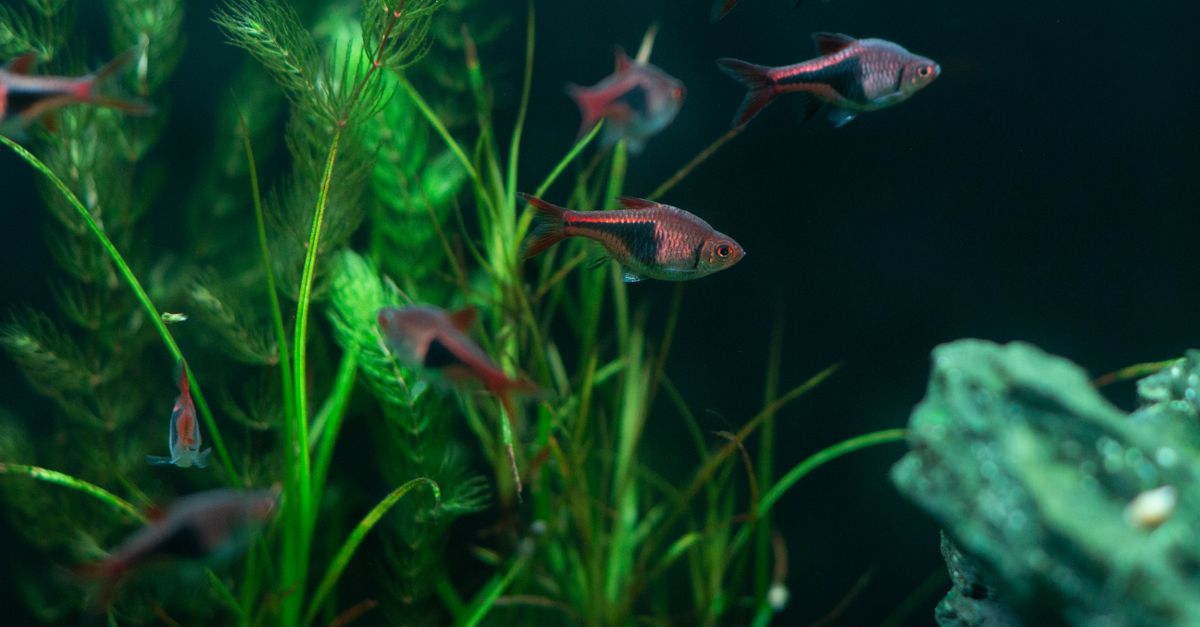
My tap water comes out of the mains at somewhere between 22 and 23 degrees of German hardness, mostly calcium, with a pH of about 7.2 and even a little nitrate already in it, around 15 ppm before it ever touches a tank. By any honest definition that is very hard water. When I started keeping fish I assumed, as most beginners do, that this was a problem to be fixed, and that somewhere out there was a bottle or a filter that would turn my liquid limestone into an Amazon blackwater stream. It took me a while to realise the truth, which is that my water was never the problem. My stocking list was. Once I started choosing fish that actually come from hard, alkaline water, everything got easier. No chemicals, no remineralising, no weekly fight with test kits. The fish breed, the snails have glossy shells, and water changes are just water changes. This article is the one I wish I had read at the start.
Free PDF
Free aquarium water cheat sheet (PDF)
Grab the one-page reference for your tank: target ranges for pH, hardness, ammonia, nitrite and nitrate, plus a plain walkthrough of the nitrogen cycle. No fluff, unsubscribe any time.
Free, unsubscribe any time. The download starts as soon as you sign up.
GH and KH, explained without the fog
The two numbers that matter here get muddled constantly, so let us separate them properly.
GH is general hardness. It measures the dissolved calcium and magnesium in your water, and it is the number your fish physically care about. Fish are constantly managing the flow of water and salts across their gills and skin, a process called osmoregulation, and the mineral content they evolved with shapes how their bodies expect to do that job. A molly from a Mexican limestone spring and a cardinal tetra from a mineral-starved forest stream are built for very different water, and GH is the measure of that difference.
KH is carbonate hardness, sometimes called alkalinity or buffering capacity. It measures carbonates and bicarbonates, and its job in your tank is to act as a shock absorber for pH. Every aquarium produces acid over time, from fish waste, from the nitrogen cycle, from decaying plant matter. In water with low KH, that acid steadily drags the pH down, sometimes to the point of a sudden crash. In water with high KH, the buffer soaks the acid up and the pH barely moves.
Here is the reframing that matters. High KH means stability. My tanks sit at almost exactly the same pH month after month, through heavy feeding, through missed water changes, through summer heat. Fish are far more stressed by a swinging pH than by a stable pH that is a bit higher than some care sheet suggests. If your water is hard and well buffered, you have been handed one of the most forgiving starting points in the hobby. That is an advantage, not a fault to be corrected.
Actually finding out what you have
Do not guess, and do not rely on paper dip strips, which are vague at best. A liquid GH and KH test kit costs little and lasts for years. They work by counting drops: you add reagent to a small sample one drop at a time until the colour changes, and the number of drops is your hardness in degrees. It is pleasingly low tech and quite accurate. Test your tap water, not just your tank, because the tap is your baseline and everything else follows from it.
Your water company also publishes a water quality report for your supply zone, usually free on their website, and it is worth reading. That is how I know my water is calcium dominant rather than magnesium heavy, and it is how I found out about the nitrate. Around 15 ppm of nitrate straight from the tap sounds alarming until you understand it, but it does mean my “clean” water change water is not a blank slate, so I keep tanks well planted and do not let nitrate creep much beyond that between changes. If you have never looked up your own report, do it before you buy a single fish. It tells you more about your future in this hobby than any shop assistant will.
One conversion note, since brands love to disagree: some kits and reports use degrees of German hardness (dGH or dKH), others use ppm of calcium carbonate. One German degree is roughly 17.9 ppm, so my 22 to 23 dGH is around 400 ppm. Whatever the units, anything above about 12 dGH is properly hard, and mine is comfortably beyond that.
The book behind Lagonia
The Hard Water Aquarium
My practical guide to working with hard, alkaline tap water instead of fighting it: reading your water, choosing and setting up the tank, and keeping and breeding the fish that thrive in it, from livebearers to Rift Lake cichlids and shell-dwellers.
Ad · Amazon affiliate links. I earn a small commission on a purchase, at no extra cost to you.
The mistake that kills more fish than hard water ever will
The classic beginner arc goes like this. You fall for a fish that wants soft, acidic water. You read that your pH should be 6.5, yours is 7.6, so you buy a bottle of pH-down and start dosing. For a day or two the number obliges. Then your KH, which exists precisely to resist this sort of thing, buffers the acid away and the pH climbs straight back up. So you dose more. Eventually one of two things happens: either you give up, or you finally overwhelm the buffer entirely, at which point there is nothing left holding the pH up and it plunges. A tank that swings from 7.6 to 6.0 and back is vastly more dangerous than a tank that sits calmly at 7.6 forever. Fish that would have coped fine with the wrong number die from the moving one.
The same trap exists in gentler form with people cutting tap water with RO by eye, changing the ratio from one water change to the next. Every change becomes a small chemistry event. Stability beats a perfect number, every single time. The fish do not read the care sheets. They read the consistency.
If you take one sentence from this article, take this one: never chase pH with chemicals in a buffered tank. Either commit properly to reconstituting RO water, which is a genuine ongoing discipline, or accept your tap water and stock accordingly. The second option is cheaper, safer and far less work.
The fish that genuinely love this water
This is where hard water stops being a limitation and starts looking like a menu.
Livebearers are the obvious first stop, because hard, alkaline, mineral-rich water is exactly what guppies, endlers, platies, swordtails and mollies evolved in. Mollies in particular sulk and get shimmies in soft water but are bulletproof in mine. I keep a line of endler and guppy hybrids that breed so freely in this water that population control is the actual husbandry challenge. Livebearer tanks fill up from the inside, so it is worth running the numbers on what a tank can really carry with the stocking calculator and checking the true volume with the volume calculator before you start. If you want an easy, colourful, self-sustaining tank on hard tap water, livebearers are almost cheating.
Then there are the Rift Lake cichlids of Africa. Lake Tanganyika and Lake Malawi are enormous, ancient, mineral-saturated lakes, and their fish want water very like mine straight from the tap. Tanganyikans are my personal favourites. I keep a colony of Neolamprologus brichardi, whose extended family group behaviour is unlike anything else in freshwater, and a tank of shell-dwellers, Neolamprologus multifasciatus, tiny cichlids that live and breed inside empty snail shells and are, for my money, the perfect hard-water species for a smaller tank. They colonised their shells and started producing fry with no intervention from me beyond food and water changes.
Many rainbowfish also suit hard, alkaline water well, and they are criminally underrated as active, peaceful, glittering shoal fish for larger tanks.
Finally, spare a thought for the invertebrates. Snail shells are built from calcium carbonate, and in soft water they slowly erode and pit. In hard water, ramshorns, nerites and Malaysian trumpet snails grow thick, glossy, healthy shells. Neocaridina shrimp, the cherry shrimp and all their colour variants, moult cleanly and breed readily in hard water too. My hard-water shrimp colonies have never needed a single mineral supplement. If you are wondering about numbers, I have set out the ideal GH for shrimp separately.
Whatever you choose, the nitrogen cycle works exactly the same in hard water as in soft, and if anything the stable KH makes cycling smoother. If you are setting up your first tank, read up on how to cycle a new aquarium before any fish go in.
The fish to admire in other people’s tanks
Honesty matters more than optimism here. Some fish are a poor fit for water like mine, and pretending otherwise leads to shortened lives and disappointment.
Most wild-type South American characins, including cardinal tetras and many of the more delicate tetras, come from extremely soft, acidic water. Farm-bred neons and similar tank-raised strains are more adaptable and often manage in moderately hard water, but at 22 dGH you are asking a lot, and breeding them is off the table. Dwarf cichlids such as Apistogramma are even less forgiving; they may survive, but they rarely thrive, colour up or spawn in liquid rock. Most Corydoras catfish also prefer softer water, and while the common farmed species tolerate a fair bit, very hard water is not where they do best. And Caridina shrimp, the crystal reds and bee shrimp, are simply the wrong project for hard tap water; they want soft, acidic conditions and will fail slowly in anything else. Stick to Neocaridina, which are just as pretty and actually suited to the job.
None of this means these species are forbidden forever. It means they are an advanced project with a real cost attached, which brings us to RO.
When RO water actually earns its keep
Reverse osmosis units strip your water back to nearly nothing, and you then rebuild it with remineralising salts to exactly the profile you want. Done properly it works. It is also a permanent commitment: every water change, forever, involves producing, storing and reconstituting water, and the unit itself wastes several litres of tap water for every litre it produces.
That effort is genuinely justified in a few cases. Breeding soft-water species that will not spawn otherwise. Keeping wild-caught fish whose bodies never adapted to captivity chemistry. Serious Caridina shrimp keeping. If one of those is truly your passion, buy the RO unit with open eyes and do it properly, with consistent remineralisation and a KH pen or test kit in regular use. The RO mix calculator takes the guesswork out of blending RO and tap to a target hardness, which is the difference between a stable soft-water tank and a chemistry experiment that lurches every week.
For everyone else, and I mean the large majority of hobbyists, RO is money and effort spent making your tanks more fragile. You trade a stable, self-buffering system for one where you are personally responsible for every parameter. I looked hard at RO in my first year and I am glad I never bought the unit.
Match the fish to the water
Somewhere along the way, the hobby absorbed the idea that soft, acidic water is the default and everything else needs correcting. It is not true. Hard water is not a compromise, it is a habitat, and some of the most interesting fish in the world live in it. My tanks run on untreated tap water that many care sheets would call unusable, and they are full of breeding shell-dwellers, swarming livebearer fry and snails with shells like polished stone. Test your tap water once, read your water report, then choose fish that call that chemistry home. Do that and the weekly battle most beginners fight simply never starts. The easiest tank you will ever keep is the one your tap was always trying to give you.