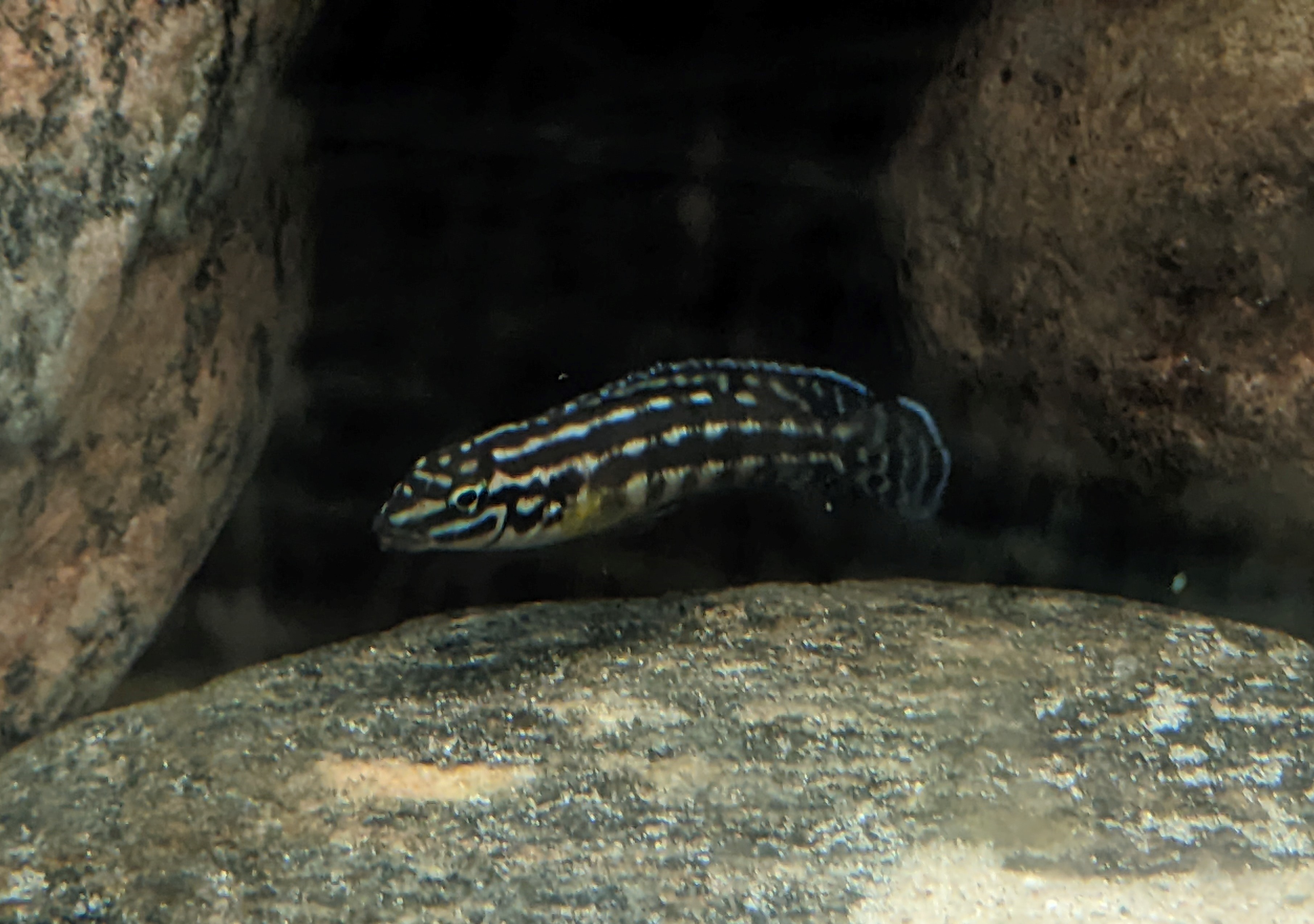
If you have hard, alkaline tap water and you want a cichlid with real character in a tank you can actually fit in a room, a Julie is one of the first fish I would point you at. Julidochromis are slow, deliberate rock-dwellers from Lake Tanganyika, they pair up and defend a patch of rock like a tiny elderly couple, and they thrive in exactly the water that makes soft-water fish miserable. The catch, and there is one, is the pairing. Get that right and a Julie pair will sit happily in a small tank for years. Get it wrong and one fish kills the other. I have watched both happen, so let me save you the second version.
Free PDF
Free aquarium water cheat sheet (PDF)
Grab the one-page reference for your tank: target ranges for pH, hardness, ammonia, nitrite and nitrate, plus a plain walkthrough of the nitrogen cycle. No fluff, unsubscribe any time.
Free, unsubscribe any time. The download starts as soon as you sign up.
Meet the Julies
There are six described species of Julidochromis, and they split neatly into two size groups, which matters more than the names when you are choosing a tank.
The small ones are Julidochromis transcriptus (the masked Julie) and Julidochromis ornatus (the golden Julie). These top out around 6 to 7 cm and a pair is perfectly happy in something like 45 to 60 litres. The larger ones are Julidochromis regani, Julidochromis marlieri and, in the middle, Julidochromis dickfeldi. Regani and marlieri reach roughly 12 to 15 cm in a tank, which is a very different animal, and you will see wild figures quoted online of 20 cm or more; treat those as outliers, most aquarium fish never get near that. Dickfeldi sits in between at around 8 to 9 cm.
All of them share the same body plan: a torpedo shape, horizontal stripes and a habit of hugging rock rather than swimming in open water. They are the sort of fish that reverses out of a crevice head-first when it wants a better look at you. If you have kept shell-dwellers, a Julie is the rock-face equivalent, and the two make natural companions in a Tanganyikan setup.
Why hard water suits them
This is the part the wider hobby underplays. Lake Tanganyika is a huge, ancient body of very hard, alkaline water, and the fish evolved to match it. Julies want a pH up around 8 to 9 and plenty of general and carbonate hardness. My tap runs about 22.5 dGH, which is harder than the lake itself, and that is a gift here rather than a problem to correct.
The one thing tap water like mine does not always give you is a high enough pH. Straight from the tap mine sits nearer 7.2 to 7.6, and Julies are happier a good deal higher. The fix is in the substrate rather than a bottle: I run aragonite or coral sand, and the calcium carbonate slowly dissolves and holds the pH up near 8 without any dosing. Add the rockwork on top of that and a mature Julie tank settles into the alkaline range on its own. If you want to understand why hardness and pH are related but not the same thing, my guide to GH and KH walks through it, and there is more on the wider list of species that suit water like this in hard water fish.
What you should not do is chase soft-water numbers. Julies do not need peat, RO water or pH-down, and using them just makes the tank unstable. Work with the hard water, do not fight it.
The book behind Lagonia
The Hard Water Aquarium
My practical guide to working with hard, alkaline tap water instead of fighting it: reading your water, choosing and setting up the tank, and keeping and breeding the fish that thrive in it, from livebearers to Rift Lake cichlids and shell-dwellers.
Ad · Amazon affiliate links. I earn a small commission on a purchase, at no extra cost to you.
The tank they actually want
Footprint beats volume for a Julie, the same way it does for shellies. These are territorial fish that measure the world in floor space and vertical rock, not litres. A long, low tank with a big rock pile beats a tall cube of the same volume every time.
Build the rockwork so it reaches from the sand to near the surface, with plenty of caves, crevices and dead ends. Julies spawn inside those gaps and they need the visual barriers to break up sightlines when they get territorial. I stack flat rocks like a drystone wall, wedge in a few clay caves, and make sure nothing can topple onto the fish or the glass. Sit the rock on the base glass and add sand around it, not the other way around; a big cichlid digging under a loose stack is how tanks get cracked.
Sand on the bottom, aragonite for the buffering I mentioned, and honestly not much else. Plants are optional and mostly ignored; if you want greenery, tough hard-water species like Anubias or Java fern tied to rock will survive, but a Julie tank is really about stone.
If you are not sure what your rock pile has done to your usable water volume, the volume calculator is worth a minute, and the stocking calculator will keep you honest about how few fish a Tanganyikan tank actually wants.
The pairing problem
Here is the bit that goes wrong. Julies are cave-spawning, monogamous fish that form a strong bond, and that bond is the whole game. You cannot simply buy a male and a female and drop them in together; two adult strangers will often fight, sometimes to the death, because they have not chosen each other.
What works is buying a group of four to six juveniles and letting them grow up together. A pair forms on its own, claims a territory, and starts pushing the others out. Once that happens you usually need to rehome the extras, because the pair will make their lives miserable. I learned this the slow way, with a “sexed pair” from a shop that spent a fortnight destroying each other before I separated them. The home-grown pair I raised from juveniles has been solid for three years.
Even a settled pair can turn. If something disrupts the bond, a big water change that resets the tank chemistry, a bereavement, a move, the dominant fish can suddenly treat its partner as an intruder. If you see one Julie relentlessly pinning the other into a corner with no let-up, that is not squabbling, and you need to intervene before you lose a fish. It is uncommon, but it is real, and it is the single thing I would want a first-time Julie keeper to know.
Feeding
Julies are omnivores that lean towards the small stuff: in the lake they pick invertebrates and biofilm off the rocks. In the tank they are easy. A good cichlid flake or small pellet as the staple, spirulina or other veg content in the mix, and frozen or live treats like brine shrimp, daphnia and cyclops a couple of times a week. They are not greedy show-offs at feeding time; they take food deliberately, so make sure the faster fish in a mixed tank are not stripping the water column before the Julies get any.
Feed small amounts and keep an eye on waste. Tanganyikan tanks live and die on water quality, and overfeeding a heavily rocked tank just feeds a nitrate problem you cannot easily vacuum out from under the stones.
Tankmates
Julies are peaceful towards fish that leave their rock alone and fierce towards anything that does not, which makes tankmate choice a Tanganyikan question, not a community one. They are a poor fit with livebearers, tetras or anything from soft acidic water; the water is wrong for those fish anyway.
In a Tanganyikan tank they pair beautifully with shell-dwellers, because Julies work the rock and shellies work the sand, so the two rarely compete. My multies and a pair of Julies share a tank with almost no friction. Avoid mixing Julies with other rock-dwelling cichlids that want the same crevices, and be careful with anything from the same genus, as related species can hybridise or fight over identical territory. There is more on the general logic in my piece on shell-dweller tankmates, and most of it carries straight across.
Breeding, which mostly means doing nothing
Once you have a bonded pair in hard, alkaline water with good rockwork, breeding tends to happen without any input from you. The pair chooses a crevice, lays a small clutch of eggs on the cave roof or wall, and both parents guard it fiercely. Clutches are small, often just a dozen or two, and Julies breed at a low, steady drip rather than in big broods.
The parents usually tolerate previous fry hanging around the territory, so a pair slowly builds a small extended family in one corner of the tank. You rarely need to move eggs or fry. The main thing to watch is that the pair does not decide the whole tank is theirs and start bullying tankmates once they have young to defend. In a tank that is too small, that is exactly what happens.
Is a Julie right for you?
If your tap is hard and alkaline, you want a characterful cichlid without needing a huge tank, and you are happy to raise a group and let a pair form, a Julie is one of the most rewarding fish you can keep. Go in expecting to buy a rock-shaped fish and a magic sexed pair, and you will probably lose one. Raise them from juveniles, give them stone to argue over, keep the water hard and the pH up around 8, and a Julie pair will quietly run its corner of the tank for years.