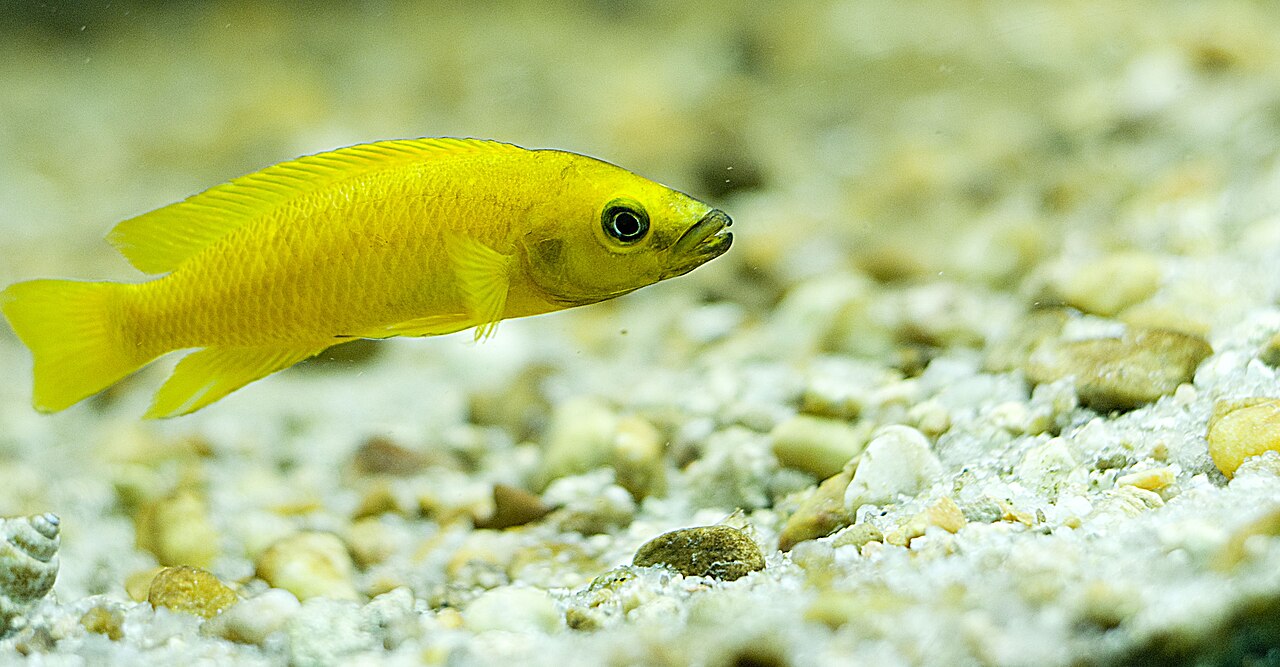
If you have hard, alkaline tap water and you want a splash of solid yellow that is not a Malawi mbuna, the lemon cichlid is one of the best fish you can put in it. Neolamprologus leleupi is a small rock-dwelling cichlid from Lake Tanganyika, the colour of a ripe lemon from nose to tail, and it wants exactly the mineral-heavy water that comes out of my tap. I keep mine in a Tanganyikan tank alongside shell-dwellers, and once you understand its one real quirk, its temper with its own kind, it is a straightforward, long-lived fish.
Free PDF
Free aquarium water cheat sheet (PDF)
Grab the one-page reference for your tank: target ranges for pH, hardness, ammonia, nitrite and nitrate, plus a plain walkthrough of the nitrogen cycle. No fluff, unsubscribe any time.
Free, unsubscribe any time. The download starts as soon as you sign up.
Leleupi at a glance
Leleupi comes from the rocky southern shorelines of Lake Tanganyika, where it threads through piles of stone hunting small invertebrates. A good male reaches about 10 cm, females a little less, so this is a proper cichlid with presence rather than a thumbnail-sized shellie. The body is slender and slightly built for slipping into crevices, and the colour runs from deep orange-yellow to a clean lemon depending on the population and the food.
There is more than one form. The standard bright yellow is what most shops sell, but a darker brown variant (often labelled N. l. melas) and a rarer pale, almost silvery form turn up too. They are the same fish behaviourally. Buy for the colour you like and feed it well, because a leleupi fed a flat beige diet fades, and one fed carotenoid-rich food holds that postbox yellow.
Why hard water suits it
This is a Rift Lake cichlid, and Lake Tanganyika is about as hard and alkaline as freshwater gets. The published range for leleupi is a pH of 7.5 to 9.0 and a hardness anywhere from 8 to 25 dGH, which means my liquid-limestone tap at roughly 22.5 dGH sits comfortably inside it with nothing to add. If you have soft, acidic water you would be buffering every change forever, so this is a fish that rewards hard-water keepers and punishes everyone else. The wider case for working with your water rather than against it is in my guide to keeping fish in hard water, and the numbers behind the hardness readings are unpicked in GH and KH explained.
One honest caveat about my own water. My tap pH sits around 7.2, which is just below where leleupi is happiest, and that is lower than you would expect for water this hard because of dissolved carbon dioxide. In a Tanganyikan tank the rockwork and substrate do most of the lifting: aragonite sand and a few handfuls of crushed coral in the filter nudge the pH up into the high sevens and, more importantly, hold it there. I would not chase a pH of 9 with chemicals. Stability in the right region matters far more than hitting a magic number, and the practical way to get there is covered in my piece on buffering hard water for Rift Lake tanks. Temperature wants to sit at 24 to 26 degrees; size the heater to the tank with the heater calculator rather than guessing.
The book behind Lagonia
The Hard Water Aquarium
My practical guide to working with hard, alkaline tap water instead of fighting it: reading your water, choosing and setting up the tank, and keeping and breeding the fish that thrive in it, from livebearers to Rift Lake cichlids and shell-dwellers.
Ad · Amazon affiliate links. I earn a small commission on a purchase, at no extra cost to you.
Tank size and setup
A single pair can live in a 70 to 100 litre tank, but I would give them more if you want any tankmates, because floor space and sightline breaks are what keep the peace. If you are not sure what your tank actually holds once rock and sand are in, run the numbers through the aquarium volume calculator; the glass dimensions lie once the scape goes in.
The setup is pure Tanganyikan rockwork. I use a bed of fine sand two or three centimetres deep and build stable piles of stone into caves and overhangs, stacked so nothing shifts if a fish digs at the base. Leleupi are cave fish by instinct. They want a dark hole to claim, retreat into and eventually spawn in, and a tank with open rock but no real caves leaves them nervy. Sand rather than gravel, always, both because it suits the biotope and because the aragonite kind helps hold the hardness. If you are weighing substrates, I went through the options in the substrate guide.
Filtration should be steady but not a torrent. These are not a fast-water fish, and a sponge filter or a modest internal or external unit is plenty. What you are after is clean, well-oxygenated water with gentle movement, not a current that pins the fish against the glass.
The single most important rule: one pair
Here is the thing that trips people up. Leleupi are peaceful enough towards fish that keep to themselves, but they are genuinely vicious to their own kind. In anything short of a very large tank, you keep one pair and no more. Two males will fight until one is dead, and even a bonded pair has a weak, temporary bond that lasts only through a spawn. Between broods the male often turns on the female, which is exactly why you need caves at opposite ends so she has somewhere to sit out his moods.
The reliable way to get a pair is to buy a group of six young fish, grow them on together and let a pair form naturally, then rehome the spare adults before the bullying starts. Trying to introduce two random adults and hoping they pair rarely ends well. Do not be tempted to add a second pair to “balance” the tank either, because with leleupi, two pairs in a normal tank is just four fish fighting over the same rocks.
Tankmates
The trick with any Tanganyikan community is to stack fish by the level they live at, so nobody is competing for the same patch. Leleupi own the rocks and the lower midwater, so I pair them with things that occupy other zones. Shell-dwellers down on the sand work well, because a multifasciatus colony lives in a different world a few centimetres below the leleupi and the two barely interact. Open-water schoolers like Cyprichromis leptosoma fill the top of the tank and are ignored entirely.
What I would avoid is other rock-dwelling cichlids that want the same caves, and anything small enough to read as food, because leleupi are predators of small invertebrates and will treat tiny fish or shrimp accordingly. Keep the stocking sensible rather than cramming the tank to dilute aggression, which works with mbuna but not here. The stocking calculator is a useful reality check before you buy.
Leleupi versus the electric yellow
People often cross-shop the lemon cichlid against the electric yellow, Labidochromis caeruleus, because both are famous for being a bright, solid yellow cichlid that likes hard water. They are not interchangeable. The electric yellow is a Malawi mbuna, a grazer you keep in a boisterous group, and it is far more forgiving of being kept several to a tank. Leleupi is a Tanganyikan predator you keep as a single pair. If you want a shoal of yellow in a busy African tank, the electric yellow is your fish. If you want one or two characterful yellow cichlids in a quieter Tanganyikan setup with shellies and open-water species, leleupi is the better pick, and to my eye the colour is richer and the behaviour more interesting.
Feeding
Leleupi are insectivores in the lake, so the diet leans towards protein. I feed a good cichlid pellet or flake as the staple and lean hard on frozen and live foods, cyclops, mysis, chopped bloodworm and the odd bit of baby brine shrimp, which is also what keeps the yellow strong. A little spirulina or other vegetable matter rounds it out but should not dominate. Feed small amounts once or twice a day and keep an eye on waste; the general principles are in feeding aquarium fish. One warning worth repeating for all Tanganyikans: go easy on fatty red foods like excessive bloodworm, which these fish do not handle well in quantity and which is a common trigger for the bloat that plagues Rift Lake cichlids. I wrote up that problem in African cichlid bloat.
Breeding
If a pair settles and the water is right, breeding tends to happen on its own. Leleupi are bi-parental cave spawners. The female lays her eggs, up to 150 in a good spawn but often far fewer, on the roof or wall of a chosen cave, and both parents guard the site. Eggs hatch in three to four days and the fry are free-swimming at around eight to ten days, at which point you will see a cloud of tiny yellow specks hanging near the cave mouth under the watchful eye of the parents.
The fry are easy to feed. Baby brine shrimp and finely crushed food work from the start, and the parents will defend them for weeks until the next spawn looms. The practical constraint is space. A tank with a guarded brood plus growing juveniles plus a male whose patience with the female is running out gets crowded fast, so have a plan for moving fry on. If you fancy hatching your own brine shrimp for them, it is simpler than it sounds and I covered it in hatching baby brine shrimp.
The honest verdict
Leleupi is one of my favourite fish to recommend to someone with hard tap water who has outgrown livebearers and fancies a proper cichlid without committing to a big aggressive Malawi tank. It is colourful, long-lived, full of character and perfectly matched to the water that makes soft-water fishkeepers miserable. Respect the one-pair rule, give it caves and good food, and it will reward you for years. Ignore that rule, and you will be fishing a loser out of the tank inside a fortnight.