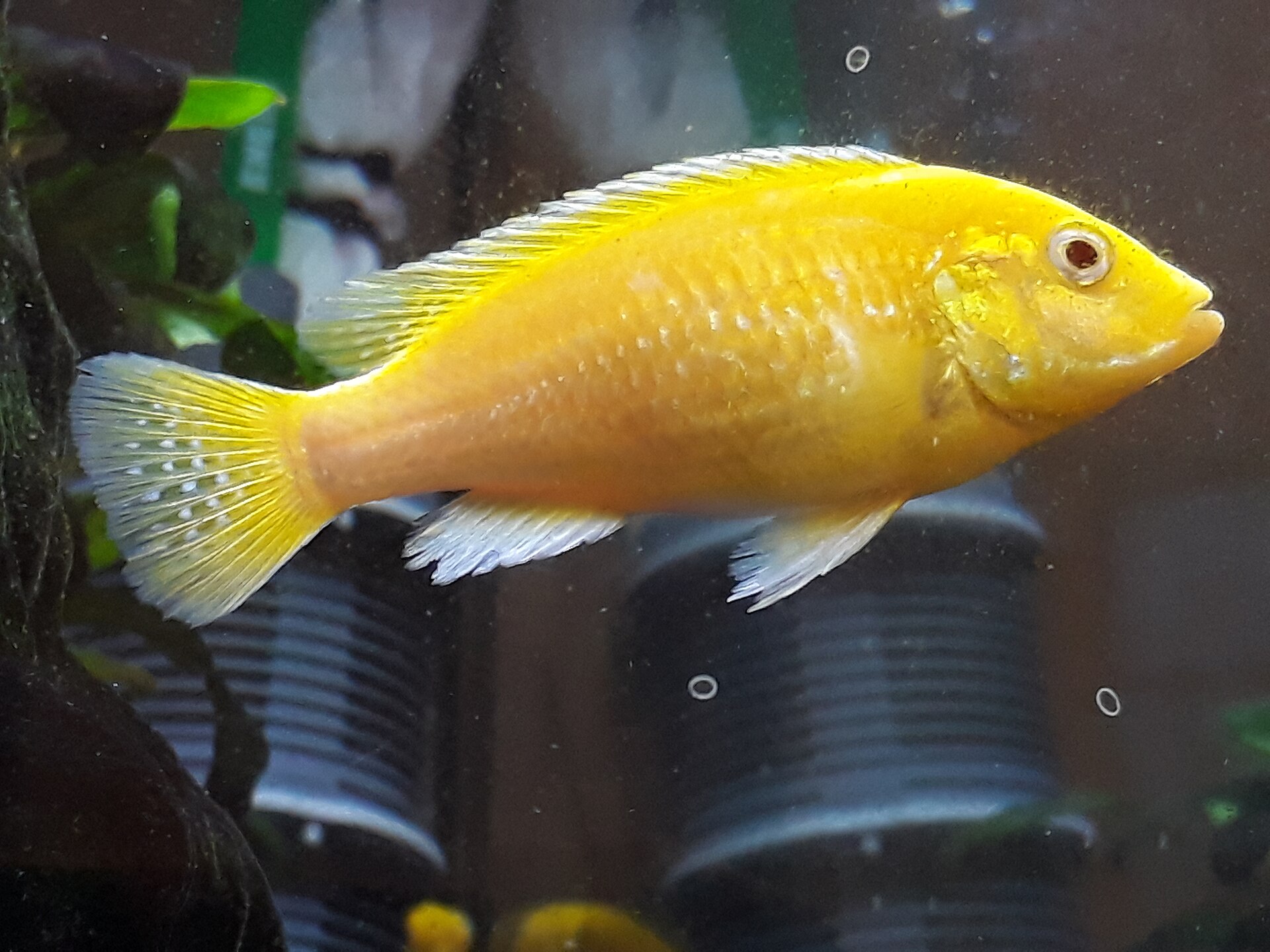
If you have hard, alkaline tap water and you fancy a cichlid with real colour, the electric yellow is the one I steer people towards first. Labidochromis caeruleus is a Lake Malawi mbuna, which normally means aggression and a species tank full of scraps, but the yellow lab is the gentlest of that rowdy family and it takes to my rock-hard tap without a single additive. I keep mostly Tanganyikans, so this is the Malawi fish that snuck into my heart: a banana-yellow body with jet-black fin edges, out in the open all day, and none of the sulking you get from soft-water fish stuck in the wrong water. There is a catch or two, mostly around feeding, and I will be straight about those.
Free PDF
Free aquarium water cheat sheet (PDF)
Grab the one-page reference for your tank: target ranges for pH, hardness, ammonia, nitrite and nitrate, plus a plain walkthrough of the nitrogen cycle. No fluff, unsubscribe any time.
Free, unsubscribe any time. The download starts as soon as you sign up.
What the electric yellow actually is
The electric yellow, yellow lab, or electric yellow lab all mean the same fish, Labidochromis caeruleus in its yellow form. It comes from the rocky coastline of Lake Malawi in East Africa, part of the group of rock-dwelling cichlids the hobby calls mbuna. Most specimens settle around 8 to 10 cm in the tank, with the odd big male pushing towards 12 cm. Males show the boldest black in the dorsal and pelvic fins; females are a softer, cleaner yellow.
The colour is the draw, and it holds up. Plenty of fish look stunning in the shop and fade at home, but a well-fed yellow lab in the right water stays that electric banana shade for years. Against dark rock it looks almost artificial, in the best way.
Here is the part that matters for keepers like me. Lake Malawi is hard and alkaline, and it barely moves. The fish that evolved there want exactly the water my tap hands me for free. Where a soft-water tetra fights my chemistry every day, a yellow lab thrives in it.
Why it suits hard water so well
My cold tap runs about 22.5 dGH, calcium-heavy, straight out of the wall. For most of the fish shops push at beginners that is a problem to be corrected with reverse osmosis and remineralising. For a Malawi mbuna it is close to ideal. Malawi water sits high in hardness and pH, and the yellow lab is built for it.
The one gap, as always with hard tap, is pH. Malawi cichlids want a pH up around 7.8 to 8.6, and my tap comes out closer to 7.2 to 7.6. I never touch that gap with bottled pH-up, which crashes the moment you stop dosing. Instead I let the tank do it: an aragonite or coral sand substrate and a big pile of rock slowly buffer the water and hold it up around 8, steady, for months at a time. If the difference between hardness and pH still feels muddy, my GH and KH guide sorts it out. The yellow lab belongs firmly on the list of hard water fish that turn difficult tap into an asset.
For hardness, anything from about 10 dGH upward is fine, and my 22.5 does no harm at all. What the fish really wants is a solid carbonate buffer (KH) so the pH stays put; hard tap usually brings that for free. Temperature-wise, aim for 24 to 26 °C and keep it stable rather than chasing an exact figure. The heater calculator will match a heater to your tank size.
The book behind Lagonia
The Hard Water Aquarium
My practical guide to working with hard, alkaline tap water instead of fighting it: reading your water, choosing and setting up the tank, and keeping and breeding the fish that thrive in it, from livebearers to Rift Lake cichlids and shell-dwellers.
Ad · Amazon affiliate links. I earn a small commission on a purchase, at no extra cost to you.
Temperament: the calm one, not a calm one
The yellow lab has a reputation as a peaceful mbuna, and that is fair as far as it goes, but read it carefully. It is peaceful for an mbuna, and mbuna are a scrappy bunch. Compared with a rasbora it is a bruiser; compared with a mob of other Malawi rock cichlids it is a diplomat.
In practice that means males hold territory and will see off rivals, and two males in a small tank will bicker until one is worn down. The standard fix is the one that works across most mbuna: keep one male to a group of several females, and keep the group large enough that no single fish becomes the target. I would not keep fewer than six, and more spreads the aggression thinner. A lone pair in a small tank tends to end with a stressed female hiding in a corner.
They are far less likely than most mbuna to shred a tankmate, but they are not community fish in the tropical-shop sense. Do not mix them with soft-water fish; the water is wrong and the pace is wrong. If you want tankmates, look to other peaceful Malawi rock-dwellers of similar size and let the group buffer the tension. This is the same principle I use with my Tanganyikans, where a settled group of Julies is calmer than a single anxious pair.
Tank and rockwork
A group wants space and structure. I would give six or so yellow labs at least 150 litres with a long footprint, and more is better; 200 litres plus makes life easier and lets you build several territories so no fish can dominate the whole floor. Use the volume calculator once your rock is in, because a serious rockpile eats into real water volume, and the stocking calculator is a sensible reality check before you add a group of active, hard-water cichlids.
Build the tank around rock. Stack stable caves, ledges and crevices from the sand up, and break the sightlines so a territorial male cannot survey the whole tank at once. Those visual barriers are the single most useful tool for keeping the peace. Set the rock on the base glass, not on the sand, and bring the substrate up around it so nothing collapses when the fish dig, because they will dig. Sand plus aragonite or coral for the buffering, plenty of rock, and not a lot else. Plants are mostly wasted here; anything soft gets uprooted or nibbled, and the look these fish belong in is stone anyway.
A mature filter and a fully finished nitrogen cycle are non-negotiable before any fish go in. Mbuna are messy eaters in a hard-scaped tank with nowhere for waste to hide, so I run generous filtration and keep up regular water changes.
Feeding, and the Malawi bloat trap
This is where good intentions kill yellow labs, so pay attention here. In the wild Labidochromis picks small invertebrates off the rocks, so it is more of an omnivore than the strict algae-grazers it lives beside. That tempts people to feed it like a carnivore, and that is the mistake.
Mbuna have long guts built for a low-protein, high-roughage diet, and a steady stream of rich, fatty or high-protein food brings on Malawi bloat, a gut condition that is often fatal by the time you notice it. The yellow lab tolerates a bit more protein than a pure grazer, but “a bit more” is the whole point; it is not a licence to pour in bloodworm.
What I actually feed: a good spirulina or vegetable-based cichlid flake or pellet as the daily staple, with the occasional small feed of brine shrimp or a similar protein food a couple of times a week, no more. Blanched vegetables like deshelled peas or a slice of cucumber go down well and suit their digestion. I feed small amounts, and I would rather underfeed slightly than risk bloat. Skipping a day now and then does a mbuna no harm at all.
Avoid rich beef-heart mixes, heavy bloodworm feeding and anything marketed as a high-protein “growth” food. If a yellow lab stops eating, hangs near the bottom, breathes hard and passes stringy white waste, treat that as suspected bloat and act fast, because it moves quickly.
Breeding: a mouth full of fry
Give a group good water and let them settle, and the yellow lab breeds readily. It is a maternal mouthbrooder. The female lays a small clutch of eggs, picks them straight up into her mouth, collects the male’s milt so they fertilise in there, and then carries the developing eggs and fry in her mouth for around three weeks, not eating the whole time.
You can spot a holding female by her swollen throat and the way she stops feeding and keeps to herself. If you want to save fry, the usual routes are to strip her gently after a couple of weeks or move her to a separate box before release, because in a busy tank the fry get eaten fast once she spits them out. Left in a well-rocked tank, a few will survive on their own by hiding in the crevices, which is honestly how I let it happen most of the time. Feed fry a fine powdered version of the same veggie-based food; they do not need a special high-protein diet, whatever you read.
Where people go wrong
Two mistakes account for most dead yellow labs. The first is water: buying one for a soft-water community tank, where the pH is too low and the fish never really thrives. If that is your tap, this is not your fish, and the honesty cuts both ways, because on my hard tap it is one of the easiest cichlids going. The second is diet: feeding it like a carnivore and losing it to bloat. Get the water and the food right and the electric yellow is close to bombproof, a genuinely beginner-friendly cichlid that happens to glow.
If your tap is hard and alkaline like mine, the electric yellow is one of the most rewarding colourful fish you can keep, and one of the few that actively wants the water most keepers spend money trying to soften. Match the water it evolved for, feed it green, keep a proper group, and it rewards you with years of that ridiculous, cheerful yellow.