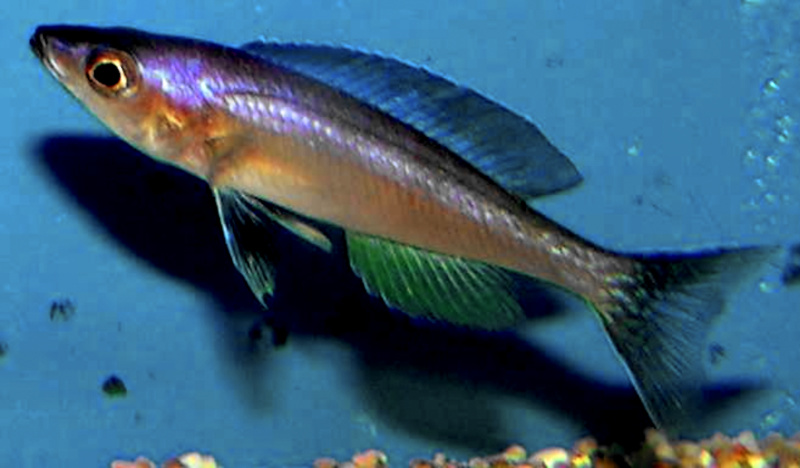
Look at most Tanganyikan tanks and you will notice the same thing: all the action is on the floor. Shell-dwellers digging, gobies perched on rocks, cichlids holding territory in the bottom third of the glass, and above them a great empty box of water doing nothing. Cyprichromis leptosoma is the fish that fills it. It is a peaceful, open-water shoaler that spends its whole life drifting and darting in the top two-thirds of the tank, and it is one of the few Rift Lake fish that genuinely wants the space my shell-dwellers ignore.
I run mine over a shell bed on the same rock-hard tap I use for everything, roughly 22 to 23 dGH, pH about 7.2 from the pipe and higher in the tank. For a lake fish that lives in open, alkaline, mineral-heavy water, that is a good start. This is not an easy first fish, and I will be honest about why further down, but as the upper storey of an established Tanganyikan tank there is very little else like it.
Free PDF
Free aquarium water cheat sheet (PDF)
Grab the one-page reference for your tank: target ranges for pH, hardness, ammonia, nitrite and nitrate, plus a plain walkthrough of the nitrogen cycle. No fluff, unsubscribe any time.
Free, unsubscribe any time. The download starts as soon as you sign up.
What Cyprichromis leptosoma is
Cyprichromis leptosoma is a slender, torpedo-shaped cichlid from Lake Tanganyika, sometimes sold as the sardine cichlid, which tells you exactly how it looks and moves. In the lake it lives in enormous shoals, thousands of fish, drifting over the intermediate zone where rock gives way to sand, picking zooplankton out of the open water. It almost never touches the bottom. Everything about the fish is built for hanging in mid-water.
Adults reach around 10 cm, with the “jumbo” forms a little larger and the true leptosoma a touch smaller. The males are the reason people keep them. In a settled group the dominant males colour up into blues, yellows and near-electric tail patterns depending on the collection location, and they display in the water column with their fins spread while the females and lesser males shoal around them in plainer silver. A tank of these in full colour, all facing into a gentle current, is a genuinely different sight from the usual cichlid stand-off.
They belong above shell-dwellers, not instead of them
This is the pairing I want people to understand, because it is where Cyprichromis earns its place on a hard-water site.
Cyprichromis are very peaceful. They hold no bottom territory, they take no interest in shells or sand, and they leave other fish alone. That makes them close to perfect above a colony of multies or a pair of brevis: the shellies own the floor, the Cyprichromis own the open water, and the two groups barely acknowledge each other. They also mix well with peaceful rock-dwellers such as Julidochromis and with the predatory-but-slow Altolamprologus, so a full-height Tanganyikan tank can run shellies at the bottom, Julies on the rock and Cyprichromis up top without anyone treading on anyone.
There is a bonus for the keeper, too. Timid shell-dwellers relax when there are calm fish swimming confidently up top, because in the wild open water above them usually means no predator is about. My multies sit out in the open more, and colour up better, with a Cyprichromis shoal cruising overhead. If you want the full picture of what goes with shellies, I have written that up separately in shell-dweller tankmates; Cyprichromis is one of the standout options in it.
The book behind Lagonia
The Hard Water Aquarium
My practical guide to working with hard, alkaline tap water instead of fighting it: reading your water, choosing and setting up the tank, and keeping and breeding the fish that thrive in it, from livebearers to Rift Lake cichlids and shell-dwellers.
Ad · Amazon affiliate links. I earn a small commission on a purchase, at no extra cost to you.
Water: hard and alkaline, which is the easy part
On the chemistry, Cyprichromis want the same Rift Lake conditions as everything else in a Tanganyikan tank:
- Temperature: 24 to 27 °C. I keep mine at 25 to 26 °C.
- pH: 7.8 to 9.0. Mine sit around 8.0 to 8.5.
- Hardness: roughly 10 to 25 dGH. My 22 to 23 dGH tap is well inside that.
If you already keep hard-water Tanganyikans, you have nothing to change here. My tap does most of the work, and a substrate that adds carbonate hardness keeps the pH up and stable, which matters more than the exact number. The GH and KH explainer covers why a well-buffered tank does not swing. On soft water this is a harder fish to justify, because you would be remineralising every change to hold these numbers; the remineralise calculator will get you there, but weigh the ongoing effort honestly first.
Tank size, and why length and a lid both matter
Cyprichromis need room to shoal, and that means a long tank, not a tall thin one. I would treat a 120 cm tank, something in the region of 200 to 250 litres, as the sensible home for a proper group, and I would not go below a 90 cm, roughly 110 to 130 litre, footprint for a small one. This is a swimming fish; a short tank makes them nervous and dull, and nervous Cyprichromis stay grey. Use the volume calculator to check what your tank actually holds, and the stocking calculator to keep the bioload sensible once you add a shoal of ten-centimetre fish to whatever is already below them.
Now the part people learn the hard way: Cyprichromis jump, and they jump hard. Males in particular launch themselves during spawning displays, and an open-topped tank will cost you fish, usually your best-coloured male, dried on the floor one morning. A tight-fitting lid or cover glass across the whole top is not optional with this species. I lost a stunning male to a two-centimetre gap behind a heater cable before I sealed my lids properly, and I have been fanatical about it since.
Group size: more is genuinely better
Do not keep a handful. Cyprichromis are shoaling fish and they behave, and colour, according to how secure they feel. Kept in twos and threes they hide, stay pale and often waste away. The floor is eight, and I would rather see twelve or more. In a bigger group the dominant males can display without constantly harassing one another, subordinate fish have somewhere to blend in, and the whole shoal settles into the confident, drifting behaviour that makes them worth keeping. If budget or tank size means you can only manage six, buy a different fish; this is not one to keep short.
Feeding a zooplankton picker
In the lake these are zooplankton feeders with small mouths, and that shapes how you feed them. The bulk of the diet should be small live and frozen foods: cyclops, baby brine shrimp, daphnia, small mysis. They will learn to take good quality flake and small granules, and mine do daily, but I would not run them on dry food alone; the condition and colour drop off if you do. Feed a little and often rather than one big meal, matching the way they graze constantly in open water. The general feeding guide holds here, with the one caveat that a big pellet is simply too large for their mouths.
Breeding, which happens in mid-water
Cyprichromis are mouthbrooders, but not like the substrate-spawning cichlids most people picture. There is no pair bond and no nest. A male sets up a loose, three-dimensional territory in the open water and displays; a female spawns with him in mid-water, then takes the eggs into her mouth and broods them there for around three to four weeks, carrying five to twenty fry until they are released fully formed. It all happens up in the column, which is fascinating to watch and slightly maddening to manage, because there is no obvious moment to intervene.
If you want fry to survive, a brooding female can be gently moved to a quiet tank to release, though the stress of catching her costs some broods. Honestly, in a busy community most eggs and fry become food, and that is fine; a stable, colourful adult shoal is the reason to keep this fish, not a fry production line. Wild-collected Cyprichromis also carry the usual Tanganyikan health risks, so quarantine new arrivals and acclimatise them slowly, because they do not travel or ship well and often arrive stressed.
The honest catch
I love these fish, so let me be straight about the downside. Cyprichromis are sensitive to poor handling and to being moved. Freshly imported stock, especially wild fish, can arrive thin and jumpy and then fade over the following weeks if the water is not stable or the group is too small. They are not a fish to add to a tank that is still finding its feet. My advice is to get the tank mature and stable first, ideally with the shell-dwellers already settled, buy the largest healthy group you can, seal the lid, and add them as the last piece of the puzzle. Do that on hard, alkaline water and they are not difficult to keep; get it wrong and they are unforgiving. As the fish that finally fills the empty top half of a Rift tank, though, nothing else quite does the job.