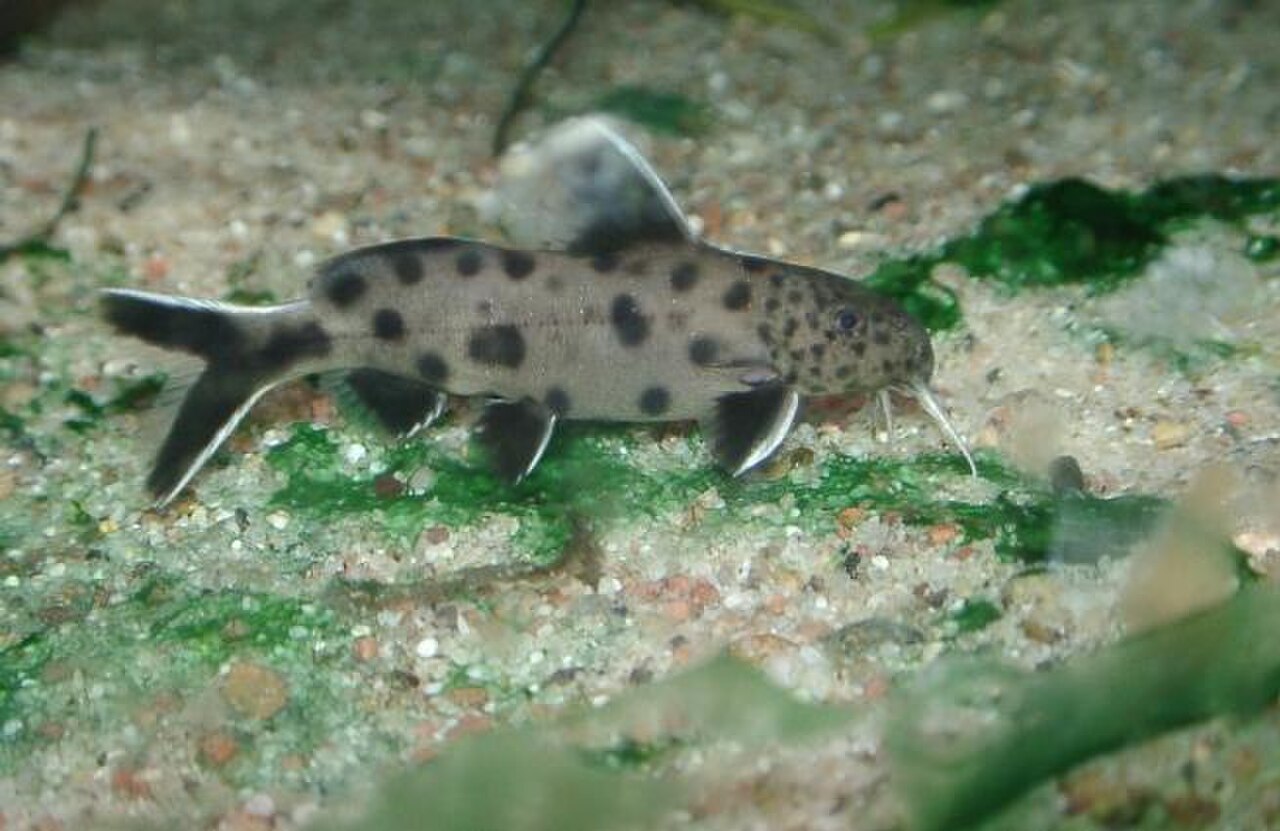
If you keep a Tanganyikan tank on hard tap water and you want a catfish that actually belongs in it, Synodontis petricola is the one I reach for. It is a small, spotted, whiskery bottom-dweller from Lake Tanganyika, it stays sociable in a group, and it wants the same mineral-heavy, alkaline water that makes my shell-dwellers thrive. I have kept a little shoal of them under a colony of multies for years, and they are one of the least demanding fish in the house once you get two things right: the water and the diet.
Free PDF
Free aquarium water cheat sheet (PDF)
Grab the one-page reference for your tank: target ranges for pH, hardness, ammonia, nitrite and nitrate, plus a plain walkthrough of the nitrogen cycle. No fluff, unsubscribe any time.
Free, unsubscribe any time. The download starts as soon as you sign up.
Petricola at a glance
Petricola comes from the rocky shallows of Lake Tanganyika, where it works along the stone picking at snails, insect larvae and whatever else the lake offers. It is often sold as a dwarf Synodontis, and compared with the brutes the genus can throw up that is fair, but do not expect it to stay tiny. A well-fed adult reaches around 11 to 12 cm, and the published maximum runs closer to 14.5 cm. It is a slow grower, so the 4 cm youngster in the shop bag has years of gentle filling-out ahead of it.
The body is pale grey to buff, scattered with dark spots, and the fins carry neat white or cream edges that catch the light when the fish is active. Long sensory barbels sweep the substrate in front of its mouth, which matters when you choose what it lives on. Petricola is largely nocturnal by instinct, but a settled group in a quiet tank is out and about in daylight far more than the books suggest, especially around feeding time.
Why hard water suits it
This is a Rift Lake fish, and Lake Tanganyika is one of the hardest, most alkaline bodies of freshwater on the planet. The care range most sources give is a pH of about 7.8 to 8.8 and a hardness of roughly 15 to 25 dGH, and hard alkaline conditions are not optional for it. My liquid-limestone tap sits at around 22.5 dGH, which drops it squarely inside that band with nothing to dose. If your water is soft and acidic, this is a fish that will have you buffering every water change forever, so it rewards hard-water keepers and quietly punishes everyone else. The wider argument for working with your water rather than against it is in my guide to keeping fish in hard water, and the readings behind the hardness numbers are unpicked in GH and KH explained.
One honest wrinkle with my own supply. My tap pH reads around 7.2, lower than you would expect for water this hard, because of dissolved carbon dioxide that gasses off once the water is moving in the tank. In a Tanganyikan setup the rock and substrate carry the pH up into the high sevens and, more usefully, hold it there. Aragonite sand plus a few handfuls of crushed coral in the filter does the job without chasing a pH of 9 with chemicals. Stability in the right region beats hitting a magic figure, and the practical method is in my piece on buffering hard water for Rift Lake tanks. Temperature wants to sit at 24 to 26 degrees; size the heater to the tank with the heater calculator rather than guessing.
The book behind Lagonia
The Hard Water Aquarium
My practical guide to working with hard, alkaline tap water instead of fighting it: reading your water, choosing and setting up the tank, and keeping and breeding the fish that thrive in it, from livebearers to Rift Lake cichlids and shell-dwellers.
Ad · Amazon affiliate links. I earn a small commission on a purchase, at no extra cost to you.
Keep them in a group
The single biggest mistake with petricola is buying one. These are gregarious, shoaling catfish, and a solitary specimen spends its life wedged under a rock, nervy and rarely seen. Kept in a group they relax, forage in the open, and develop a loose pecking order that is fascinating to watch rather than aggressive. I would never keep fewer than three, and a group of five or six is where they really come alive. There is squabbling over the best caves, but it is bluster, barbel-waving and the odd shove, not the serious damage you see from territorial cichlids.
Tank size and setup
A group of five is comfortable in a tank of around 110 to 120 litres or more, and crucially it wants floor length rather than height, because this is a fish that patrols the bottom. A footprint of 80 cm or longer gives them room to spread out and sidestep each other. If you are not sure what your tank actually holds once the rockwork and sand are in, the glass dimensions overstate it; run the real numbers through the aquarium volume calculator.
Two features are non-negotiable. The first is a soft sand bed. Those long barbels are delicate sensory organs, and sharp gravel wears them down over time until the fish cannot forage properly, so fine sand is the only sensible choice here. It suits the biotope and, in its aragonite form, helps hold the hardness; I went through the options in the substrate guide. The second is rock. Petricola wants a reef of stable stone with caves, overhangs and shaded crevices to claim and retreat into. Stack rock so it sits on the glass or a base layer, not on the sand where a digging fish can undermine it. Filtration should be steady and well-oxygenated without being a torrent; a decent external or a pair of sponge filters is plenty.
Feeding without triggering bloat
Petricola is an omnivorous scavenger, so the diet is easy as long as you respect one limit. I feed a good sinking catfish pellet or granule as the staple, because floating food is wrong for a fish built to feed off the bottom, and rotate in frozen meaty foods such as mysis, cyclops and the occasional bloodworm, plus some vegetable matter like a slice of blanched courgette, shelled peas or an algae wafer. The warning that matters for every Rift Lake fish applies here too: these are prone to bloat, and overfeeding, especially heavy fatty foods like too much bloodworm, is a common trigger. Feed modest amounts, let the group hoover the bottom clean, and do not treat the catfish as a bin that mops up leftovers; that habit is exactly what makes them ill. The general principles are in feeding aquarium fish, and I wrote up the condition itself in African cichlid bloat.
Tankmates
This is where petricola earns its place. It is peaceful towards anything too big to swallow and completely uninterested in claiming territory from cichlids, which makes it the ideal catfish for a Tanganyikan community. I keep mine beneath a multifasciatus colony, and the two occupy different worlds a few centimetres apart with no friction. It works just as happily under open-water Cyprichromis leptosoma, alongside rock-dwellers like Neolamprologus leleupi, or in a bigger tank with frontosa.
The one caution is size. Petricola is an opportunist that will eat anything small enough to fit in its mouth, so newly hatched fry and very small fish are fair game overnight, even if the catfish ignores the adults entirely. Keep tankmates above roughly 3 cm and you will have no trouble. As ever, run the plan through the stocking calculator before you buy rather than after.
Telling petricola from lucipinnis
Here is something the shops rarely mention. A large share of fish sold as Synodontis petricola are actually Synodontis lucipinnis, a very similar dwarf species from the same lake that stays smaller, often not much over 8 cm. The two are almost impossible to separate as juveniles, which is how the mix-up persists. The clearest marker on an adult is a tiny axillary pore just behind the gill cover, present in petricola and absent in lucipinnis, and lucipinnis tends to show a pale window at the base of the anal and pelvic fins that petricola lacks. For most keepers it honestly does not matter; both want identical hard, alkaline water, the same sand and caves, the same group life and the same careful feeding. I mention it only so you are not surprised when your dwarf catfish either stays small or grows larger than the label promised.
Does it really breed like the cuckoo catfish?
Petricola has a reputation tangled up with its famous cousin, Synodontis multipunctatus, the true cuckoo catfish that slips its eggs into the broods of mouthbrooding cichlids so the host raises its young. Petricola has been recorded doing something similar in the lake, but in the aquarium it breeds far more straightforwardly, scattering eggs among the rockwork and in caves without needing a host cichlid at all. Spawning is reported as reasonably achievable in a mature group kept in good hard water, with eggs hatching within about a day and fry becoming free-swimming a couple of days later. The sticking point is survival: in a busy community the eggs and tiny fry rarely last the night, so if you genuinely want to raise them you move the eggs or a settled pair to a separate tank. For most of us the catfish is a characterful, long-lived resident rather than a breeding project, and that is reason enough to keep it.
The honest verdict
Synodontis petricola is on my short list of fish I recommend without hesitation to anyone building a Tanganyikan tank on hard tap water. It is sociable, peaceful, endlessly busy along the bottom, and genuinely suited to the mineral-rich water that frustrates soft-water keepers. Give it a group of its own kind, a sand floor, a pile of stable rock and a sensible diet that does not tip it into bloat, and it will potter about your tank for a decade. Keep one on its own over gravel and overfeed it, and you will wonder why your expensive catfish hides and sulks.