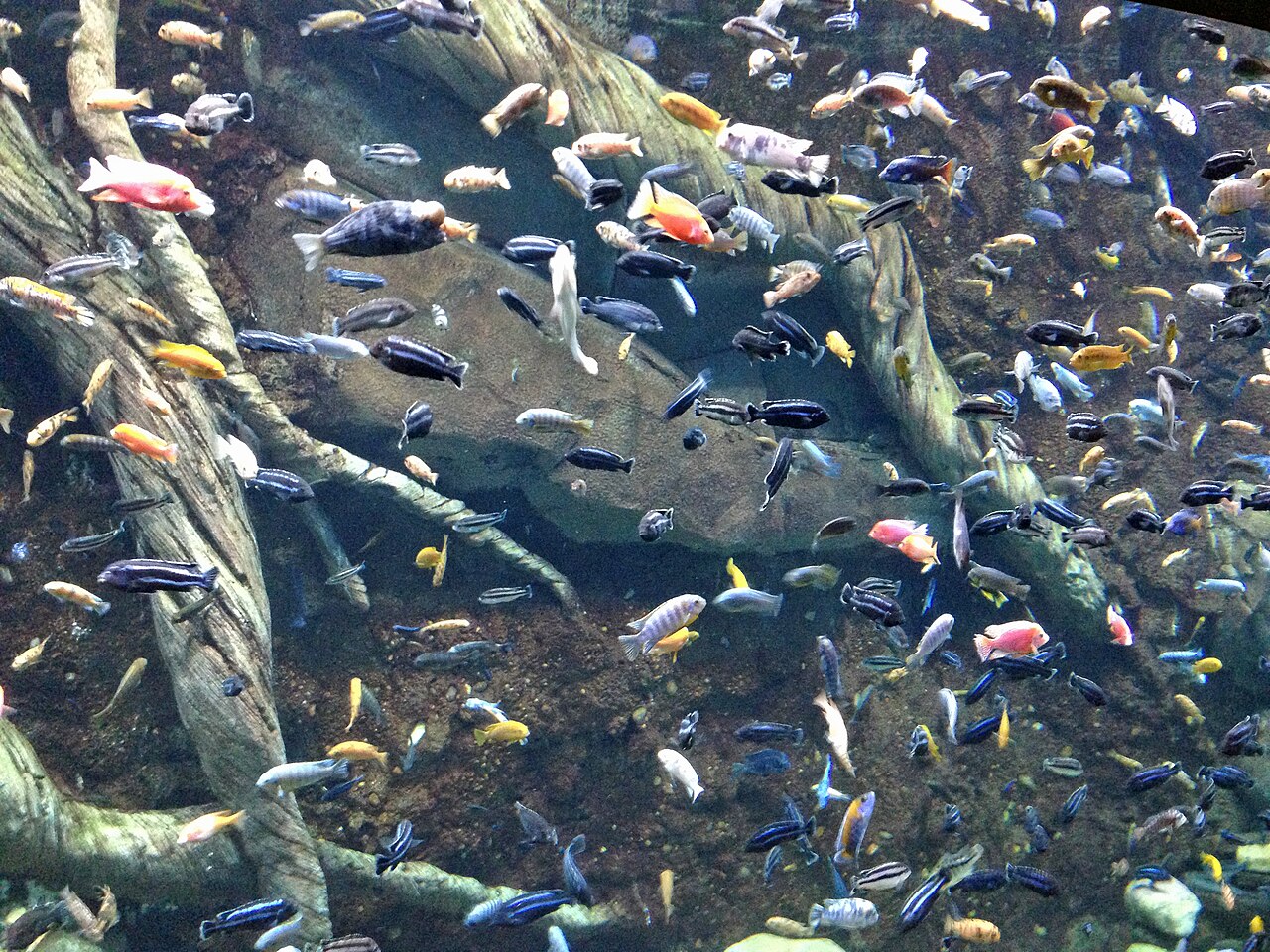
The short answer is that you can, but most of the time you should not, and the reason has nothing to do with water. People ask me this all the time because both lakes give you hard, alkaline, colourful African cichlids, and it seems obvious they should share a tank. The water chemistry really does line up. Everything else pulls them apart. I have kept both lakes, in separate tanks, for years, and this is the honest version of why that separation exists.
Free PDF
Free aquarium water cheat sheet (PDF)
Grab the one-page reference for your tank: target ranges for pH, hardness, ammonia, nitrite and nitrate, plus a plain walkthrough of the nitrogen cycle. No fluff, unsubscribe any time.
Free, unsubscribe any time. The download starts as soon as you sign up.
The one thing that is not the problem: water
Let me clear this up first, because it is the part everyone worries about and the part that matters least. Lake Malawi and Lake Tanganyika are both hard and alkaline, sitting in roughly the same ballpark of a pH in the high sevens to low eights and a hardness comfortably into the high teens or twenties of dGH. A tank buffered for one is fine for the other. On my liquid-limestone tap at around 22.5 dGH I can set up for either lake and the fish from both are happy with the numbers, as I cover in keeping fish in hard water and the readings behind it in GH and KH explained. The way you hold that chemistry steady, aragonite sand and crushed coral rather than chasing it with liquids, is the same for both lakes and is in my piece on buffering hard water.
So if someone tells you the lakes cannot mix because of water, they have it backwards. Water is the one thing that works. The problems are behaviour, activity and food.
Problem one: temperament and activity
Malawi mbuna are, to put it kindly, thugs. They are fast, relentlessly territorial algae-grazers that evolved in a crowded rocky shoreline where constant squabbling over turf is normal life. You keep them by overstocking slightly so aggression spreads thin, an approach I describe in the mbuna tank setup guide, and even then there is a lot of chasing.
Now drop that energy into a tank with Tanganyikan fish that live at a different pace. A multifasciatus colony is a gentle little society down in the shells; open-water Cyprichromis leptosoma hang in calm midwater and spook easily. Put boisterous mbuna in with either and the Tanganyikans spend their lives hiding, too stressed to feed properly or breed, slowly fading rather than dying outright. Stress like that does not always show as a torn fin. Often it shows as a fish that simply stops being a fish. The mismatch in sheer activity level does as much harm here as any single aggressive encounter.
The book behind Lagonia
The Hard Water Aquarium
My practical guide to working with hard, alkaline tap water instead of fighting it: reading your water, choosing and setting up the tank, and keeping and breeding the fish that thrive in it, from livebearers to Rift Lake cichlids and shell-dwellers.
Ad · Amazon affiliate links. I earn a small commission on a purchase, at no extra cost to you.
Problem two: diet, and the bloat it causes
This is the one that quietly kills fish, so it deserves more attention than it usually gets. Mbuna are herbivores. Their guts are built to process algae and vegetable matter, and feeding them a rich, protein-heavy diet is a well-known trigger for Malawi bloat, the condition I wrote up in African cichlid bloat. So an mbuna tank is fed a vegetable-led diet: spirulina, algae wafers, greens, very little meat.
Most Tanganyikans want the opposite. The shell-dwellers, the predatory rock-dwellers, the open-water cyps, these are largely carnivores and micro-predators that need a meatier menu to stay in condition. You cannot feed one tank in a way that suits both. Lean vegetable to protect the mbuna and your Tanganyikan carnivores slowly run down. Add the protein your Tanganyikans need and your mbuna bloat. There is no single feeding routine that keeps both groups right, and that, more than the fighting, is why mixed Rift Lake tanks so often end in a slow trickle of deaths the keeper cannot explain.
The combinations that can actually work
I am not going to pretend it is never done. In a large tank, with care, some pairings hold together.
- Tropheus with mbuna. This is the classic exception. Tropheus are Tanganyikan but they graze like mbuna and share that herbivorous, bloat-prone gut, so the diet lines up and the temperament is in the same rough weight class. It is the one Tanganyikan I would consider in a Malawi-style tank, though Tropheus are a demanding, colony-minded fish in their own right and not a casual add-on.
- A catfish that ignores lake boundaries. Synodontis catfish sit on the bottom, eat their own food and do not care which lake their tankmates came from. A group of Synodontis petricola is as at home under Malawi cichlids as under Tanganyikans, which makes it the one genuinely easy cross-lake resident.
- A big tank, tough species, all-male or carefully sexed. Some keepers run large mixed tanks with the sturdier Tanganyikans, a bold Julidochromis or an adult group that can hold its own, picking boisterous species on both sides so nobody is the perpetual victim. This works for experienced keepers with the water volume to dilute aggression. It is a project, not a shortcut.
What does not work, whatever the tank size, is mixing delicate Tanganyikans with mbuna. Shell-dwellers, cyps, calvus and the gentler Neolamprologus simply get steamrollered.
What I actually do
I learned this the way I learn most things, by getting it wrong first. Years ago, before I knew better, I dropped a trio of young multies into a mbuna tank because the water was already right and it seemed a waste to set up a second tank. Within a fortnight the shellies were living permanently inside two shells in the corner, bolting out for a mouthful at feeding time and vanishing again. They never dug, never squabbled among themselves, never did any of the things that make shell-dwellers worth keeping. They were alive but they were not living. I moved them to their own tank and watched them turn back into fish within days. That memory is why I am firm about this now.
So I keep the lakes apart, and I would suggest you do too unless you have a specific, researched plan and the tank to back it. My Tanganyikan tanks are quieter, sand-and-shell affairs built around shell-dwellers and a few rock species, fed a meatier diet. If I want the brash colour and energy of Malawi, that goes in its own tank set up the mbuna way. Each lake has a look and a rhythm, and I think you get a better tank by committing to one than by blending two into a compromise that serves neither well. The Tanganyika tank setup and mbuna tank setup guides lay out how differently the two are actually run.
If you are set on mixing, go in with your eyes open. Buy the biggest tank you can, pick tough species that share a diet, stock heavily enough to spread aggression but not so heavily that your filter and your water changes cannot keep up, and watch for the fish that is always hiding, because that one is telling you the experiment is not working for it. A reality check on numbers before you buy is worth more than any amount of rearranging afterwards, so run your plan through the stocking calculator and read how many fish can I keep first.
The honest verdict
Can you mix Malawi and Tanganyikan cichlids? Technically yes, because the water they need is the same. In practice the differences in temperament, activity and diet mean that for most keepers it ends in stressed, hiding Tanganyikans and bloated mbuna. The exceptions are real but narrow: Tropheus, Synodontis catfish, and a handful of hardy species in a big tank run by someone who knows what they are doing. For everyone else, the better tank, and the happier fish, come from picking one lake and doing it properly.