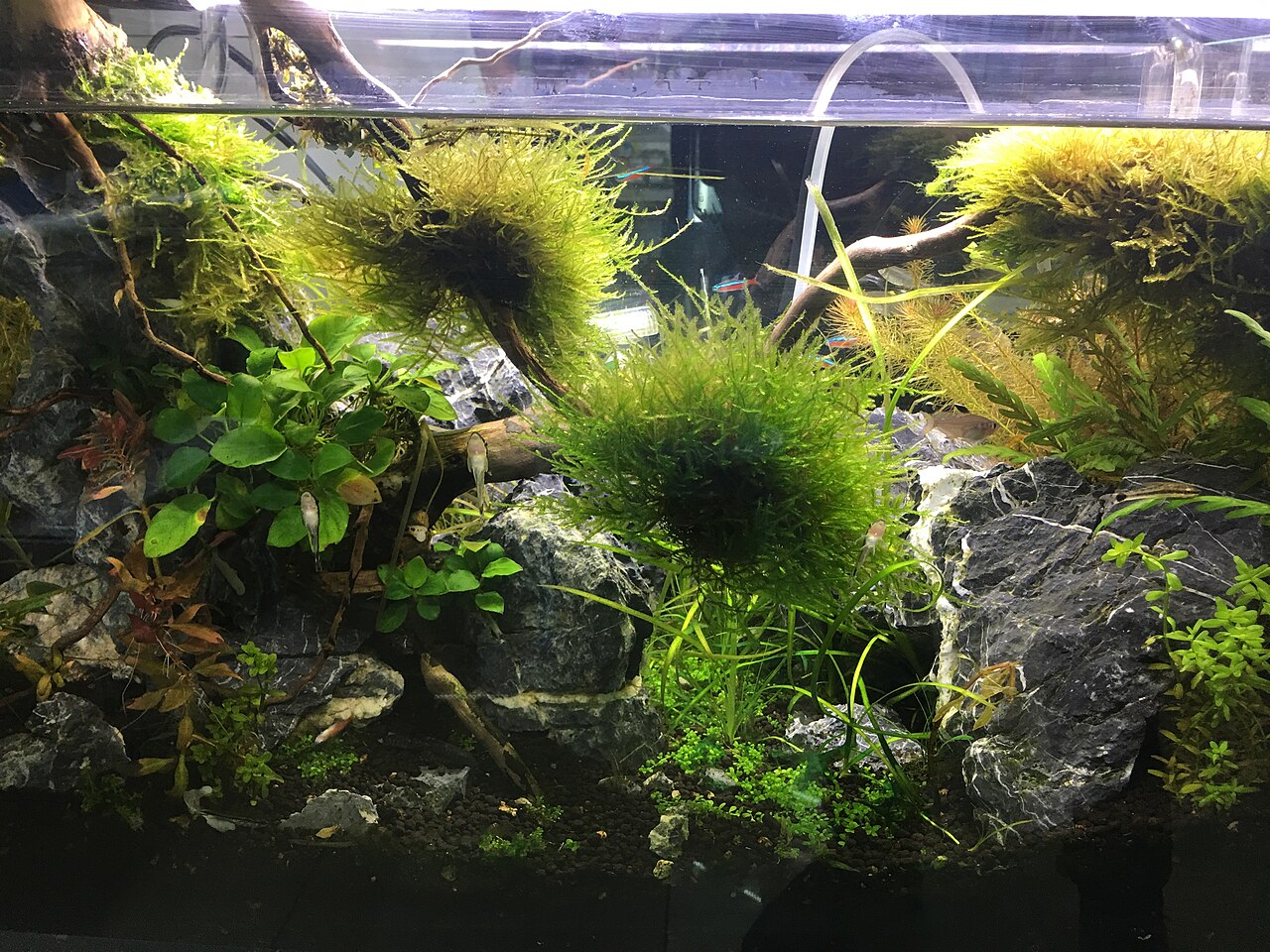
It is the question every new keeper asks, and the honest answer annoys people because it is not a number. How many fish you can keep depends on which fish, how big they get, the shape of the tank, the filter you run and how often you are prepared to pick up a bucket. What I can do is give you a way of thinking that keeps you out of trouble, and steer you away from the rule that causes most of the overstocked, struggling tanks I get asked to rescue.
Free PDF
Free aquarium water cheat sheet (PDF)
Grab the one-page reference for your tank: target ranges for pH, hardness, ammonia, nitrite and nitrate, plus a plain walkthrough of the nitrogen cycle. No fluff, unsubscribe any time.
Free, unsubscribe any time. The download starts as soon as you sign up.
The inch-per-gallon rule is worse than useless
You will read everywhere that you can keep one inch of fish per gallon of water. It sounds tidy, and it is wrong often enough to be dangerous. The problem is that fish are not lengths of string. A fish is a three-dimensional animal, and its waste output scales roughly with its body mass, not its length.
Picture two tanks that both hold the rule’s neat total of ten inches of fish. One has ten slim one-inch tetras. The other has a single ten-inch fish, say a large goldfish or a small cichlid. The single large fish has vastly more body volume than the ten little ones combined, eats far more and produces many times the waste. The rule says they are equal. Your filter and your fish know they are not. Follow inch-per-gallon with anything chunky and you will overstock badly without realising it, which is exactly how people end up with a tank they cannot keep clean.
Think in adult size, not shop size
The second trap is buying by the size of the fish in the shop tank. Almost everything sold is a juvenile, and some of the most tempting fish are babies of species that grow large. A common pleco is a couple of inches in the bag and comfortably reaches a foot and a half. A bala shark looks like a lively little dither fish and turns into a thirty-centimetre torpedo that needs a shoal and a very big tank.
Before you buy anything, look up its adult size and plan the tank around that, not around the cute version in front of you. If a fish will outgrow what you can house, the kind thing is to admire it and walk away. Deciding this at the point of purchase saves a great deal of heartache later, and it is worth reading up on a species properly first; my care guides, like the one on bristlenose pleco care, exist partly so you know the adult reality before you commit.
The book behind Lagonia
The Hard Water Aquarium
My practical guide to working with hard, alkaline tap water instead of fighting it: reading your water, choosing and setting up the tank, and keeping and breeding the fish that thrive in it, from livebearers to Rift Lake cichlids and shell-dwellers.
Ad · Amazon affiliate links. I earn a small commission on a purchase, at no extra cost to you.
Surface area matters as much as volume
Here is a factor the volume rules ignore entirely. Fish breathe oxygen dissolved in the water, and that oxygen enters almost exclusively at the surface, where water meets air. So the area of that surface sets a real ceiling on how many gill-breathing animals the tank can support.
This is why a tall, narrow tank holds fewer fish than a long, low one of the same volume. Two tanks might both be 100 litres, but the long shallow one has far more surface for gas exchange and will comfortably carry more fish. It is also why decent water movement and a bit of surface agitation from your filter outlet help: they constantly renew the air-water boundary. If you are choosing a tank, this is a genuine reason to favour the wide footprint over the tall showpiece, a point I make in choosing your first aquarium.
The real limits are your filter and your bucket
Once you set aside the myths, stocking comes down to two things you control. The first is biological filtration. Every fish adds to the ammonia load, and your filter’s colony of bacteria has to convert all of it; if you have not met these bacteria yet, my piece on the nitrogen cycle explains what they do. A bigger bioload needs more mature media and more flow to keep up, and no filter processes an unlimited load.
The second is you. Nitrate, the end product of the cycle, is not removed by any filter in a normal tank; you export it with water changes. The more heavily you stock, the faster nitrate climbs and the more often you must change water to hold it down. A lightly stocked tank forgives a missed week. A packed one punishes it fast. So the practical question is not only what the tank can hold in theory, but what you will actually maintain week in, week out. Be honest with yourself there and the fish will be healthier for it.
A sensible way to reach a number
Given all that, here is how I actually plan a tank. Start with the true volume, not the box’s advertised figure, because rock, substrate and the gap below the rim all reduce it; the volume calculator will give you the real litres. Then choose species by adult size and temperament, group the shoaling ones in proper numbers, and stock conservatively rather than to some theoretical maximum. Leaving headroom is not wasted space. It buys you a buffer against a filter hiccup, a heatwave that lowers oxygen, or the day you forget a water change.
Numbers alone do not settle it, though, because behaviour eats into your capacity too. Shoaling fish like tetras, rasboras and Corydoras are not decorations you buy one at a time; kept in twos and threes they turn nervy, hide and often waste away, so a proper group of six or more is the minimum, and that group counts as a block in your planning. Territorial fish pull the other way. A single male shell-dweller or a pair of kribensis will claim a patch of the substrate and defend it, which means the usable space is smaller than the tank suggests and you cannot simply pack more bodies in around them. Read up on temperament before you mix species, and count a shoal as one decision rather than a running tally.
To turn that into an actual figure, our stocking calculator does the heavy lifting. If you just want a fast estimate, the simpler aquarium stocking calculator works from your volume and the combined adult length of your fish. It works from species and adult size rather than a crude length rule, and it factors in the filtration you tell it about, which is a far better guide than any rule of thumb you can do in your head. Treat its answer as a well-informed starting point and lean towards the cautious end of it.
What suits hard water here
One more thing worth folding into your plan, because it shapes which fish belong in the tank in the first place. If you are on hard, alkaline tap water like ours, around 22.5 degrees dGH, some of the most beginner-friendly and forgiving fish are the ones that positively thrive in it. Livebearers such as guppies, platies and mollies, most Rift Lake cichlids, and the little shell-dwelling cichlids I am so fond of all do well without you touching the water chemistry. My round-up of hard water aquarium fish goes through the strong candidates.
Stocking well is easier when you pick fish that are already happy in your water, because a comfortable fish is a hardier fish, and a hardier fish forgives the odd mistake while you learn. Trying to keep soft-water species in liquid rock is a slower, sadder version of overstocking: the numbers might look fine on paper, but the animals are quietly struggling the whole time. Choose fish that suit the water, stock them with a bit of room to spare, keep the filter mature and the bucket handy, and the exact headcount stops mattering nearly as much as the question first suggested.