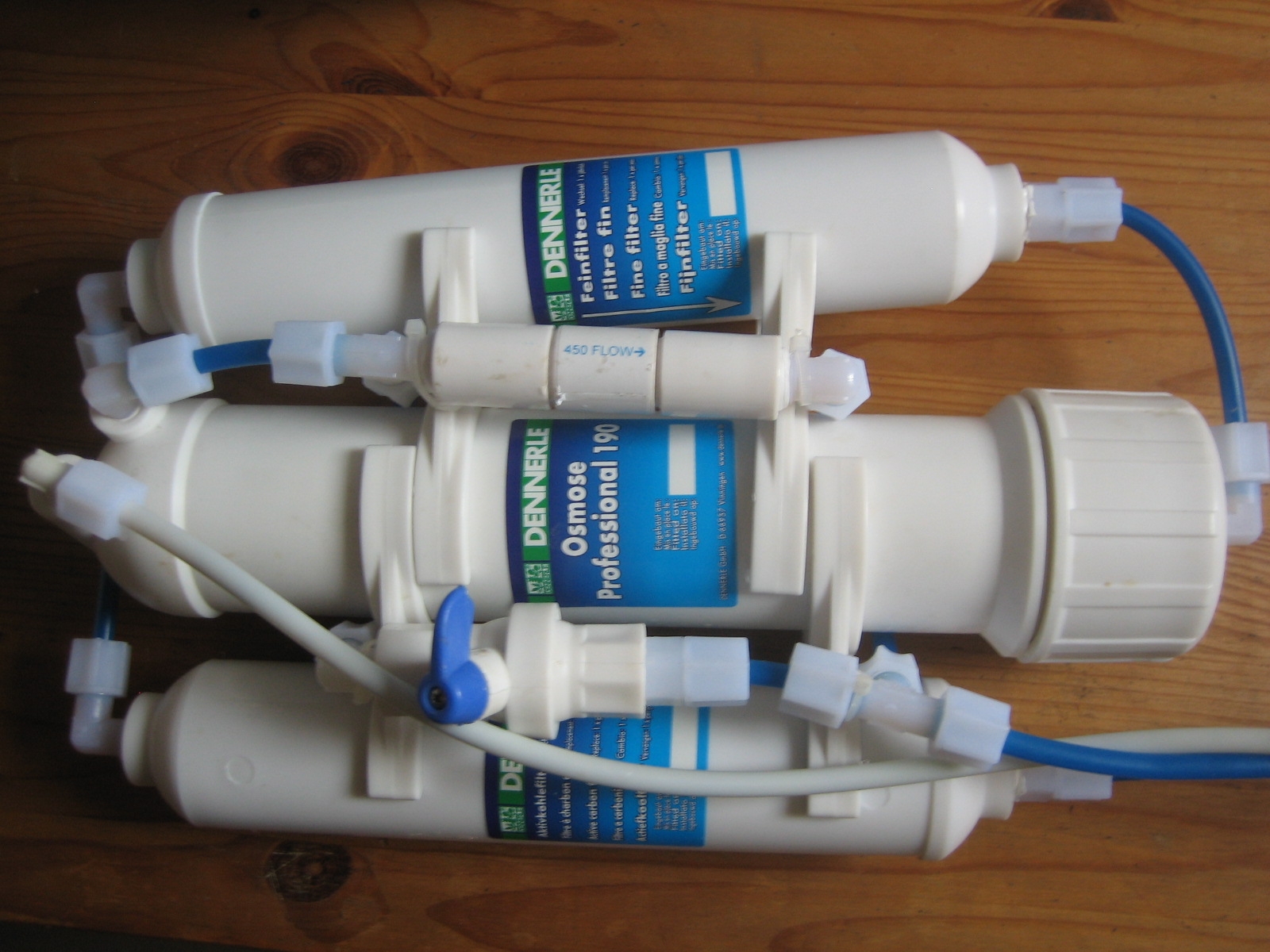
Most fishkeepers do not need reverse osmosis water, and a good number who buy a unit end up barely using it. That is the honest starting point, and it goes against a lot of the advice you will read. RO strips your tap water down to almost nothing, minerals, buffering and all, so you can rebuild it to whatever you like. That is genuinely useful for a narrow set of fish and a narrow set of tap water. For everyone else it is an expensive, wasteful answer to a question they do not actually have. I keep hard-water fish on hard tap water, and my RO membrane spends most of the year dry. Let me explain how I decide, so you can work out whether you are in the group that needs it or the much larger group that does not.
Free PDF
Free aquarium water cheat sheet (PDF)
Grab the one-page reference for your tank: target ranges for pH, hardness, ammonia, nitrite and nitrate, plus a plain walkthrough of the nitrogen cycle. No fluff, unsubscribe any time.
Free, unsubscribe any time. The download starts as soon as you sign up.
What RO water actually is
A reverse osmosis unit pushes your tap water through a fine membrane under pressure and separates it into two streams: pure water on one side, and a concentrated waste stream carrying the minerals, nitrate and everything else on the other. What comes out of the pure side is close to distilled: almost no general hardness, no carbonate buffer, a total dissolved solids reading near zero.
The important thing that catches people out is that this pure water is not usable on its own. With no minerals and no buffer, its pH is unstable, your fish cannot osmoregulate properly in it, and even your filter bacteria work less well. Pure RO water is a blank canvas, not a finished product. You always mix it back up, either by cutting it with some tap water or by adding a remineralising salt, before it goes near a fish. Anyone who tells you to just fill the tank with RO has skipped the only step that makes it safe.
The real question is your water and your fish, not your ambition
RO is not a quality upgrade. It is a tool for one job: getting soft, mineral-poor, low-pH water when your tap does not give you that. So the decision comes down to two things, and neither of them is how serious a hobbyist you are.
First, what does your tap actually give you? Test it before you spend a penny. If you do not know your numbers, my guide to GH and KH walks through a five-minute test, and it is the single most useful thing you can do here. Second, what do the fish you want actually need? Match those two together honestly and the answer usually falls out on its own.
The fish that genuinely need soft water are a real but limited list: wild-caught Amazonian species like many tetras and dwarf cichlids, discus and altum angelfish, chocolate gouramis, some killifish, and Caridina “bee” shrimp. These come from water so soft and acidic that hard tap simply will not do, and for breeding them the requirement gets stricter still. If that is your heart’s desire and your tap is hard, RO is not optional, it is the price of entry, and I would not pretend otherwise.
Everyone else has more room than the forums suggest. Plenty of adult fish live perfectly well across a wide range of hardness as long as the water is stable and clean. The mistake I see most often is someone with unremarkable tap water buying an RO unit to hit some ideal pH number they read online, then fighting an unstable tank forever because they have swapped stable, mineral-rich water for a blank slate they now have to manage by hand. Chasing a pH figure is almost always the wrong instinct; a stable community pH matters far more than an exact one.
The book behind Lagonia
The Hard Water Aquarium
My practical guide to working with hard, alkaline tap water instead of fighting it: reading your water, choosing and setting up the tank, and keeping and breeding the fish that thrive in it, from livebearers to Rift Lake cichlids and shell-dwellers.
Ad · Amazon affiliate links. I earn a small commission on a purchase, at no extra cost to you.
Why I almost never use it on hard water
My tap runs at roughly 22 to 23 °dH, hard and alkaline, with a pH around 7.2 and some nitrate already in it before it reaches a tank. For years I assumed I would eventually “need” RO like everyone said. In practice I stock the tanks that suit the water, and the water does the work for free.
Shell-dwellers, Rift Lake cichlids and livebearers actively want hard, alkaline, mineral-rich water. My multi colony, my similis, my guppies and platies all get exactly what they need out of the cold tap, no treatment beyond dechlorinator, no remineralising, no RO. Fighting my water to keep soft-water fish would mean running an RO unit for every water change on every tank, forever, and I decided long ago that a beautiful tank of the wrong fish is a worse hobby than a thriving tank of the right ones. If your water is like mine, the honest move is to lean into it. My guide to fish for hard water is the whole case for that, and there are more of these fish than people expect.
There is one job hard-water RO does earn its keep for even in my fishroom, and that is a dedicated Caridina shrimp tank, where you genuinely cannot fudge the water. For that I would run RO and remineralise it to a precise, low GH. Everything else in the house runs on tap.
The costs nobody mentions until you own one
If you are still weighing it up, price in the parts of RO that do not show up in the sticker price.
- Waste water. A typical domestic RO unit throws away several litres of waste for every litre of pure water it makes, often three or four to one, sometimes worse if your pressure is low. That water goes down the drain. Over a year of water changes it adds up, both on your bill and on your conscience if you live somewhere dry.
- You still have to remineralise. Pure RO needs minerals added back before use, which means buying a remineralising salt and mixing every batch to a target. It is not hard, but it is a permanent extra step at every water change. The remineralise calculator and the RO mix calculator take the arithmetic out of it, telling you how much salt to add or how much tap to cut back in to hit the GH you want.
- Storage and time. RO trickles out slowly. You need containers to make and store it ahead of a water change, and space to keep them. For a big tank that is a real logistical commitment.
- Membrane upkeep. The membrane and pre-filters wear out and need replacing, and a neglected unit quietly makes worse water while you assume it is fine.
None of this is a reason never to buy one. It is a reason to be sure the fish you want actually need it before you take on the running cost and the routine.
A simple way to decide
Work through it in this order and the answer is usually obvious.
- Test your tap. Get your GH, KH and pH. Guessing is how people end up with a unit they do not need.
- Pick the fish, then check their needs. If they are hard-water or adaptable species and your tap suits them, stop here. You do not need RO, and buying it would make your tank harder to keep, not easier.
- If your fish genuinely need soft water and your tap is hard, RO is the tool. Buy the unit, remineralise every batch to a sensible target, and accept the waste and the routine as the cost of keeping those fish honestly.
- If it is one demanding tank in a hard-water house, keep it contained. Run RO for the shrimp or the wild tetras, and leave the hard-water tanks on tap where they are happiest.
The unglamorous truth is that the best water for your tank is usually the water that needs the least fiddling to keep your chosen fish stable, and for a great many of us that is the tap we already have. If yours is hard, that is not a limitation to engineer around; it is a whole category of wonderful fish handed to you for the cost of a bottle of dechlorinator. Match the fish to the water first, and the RO question tends to answer itself.