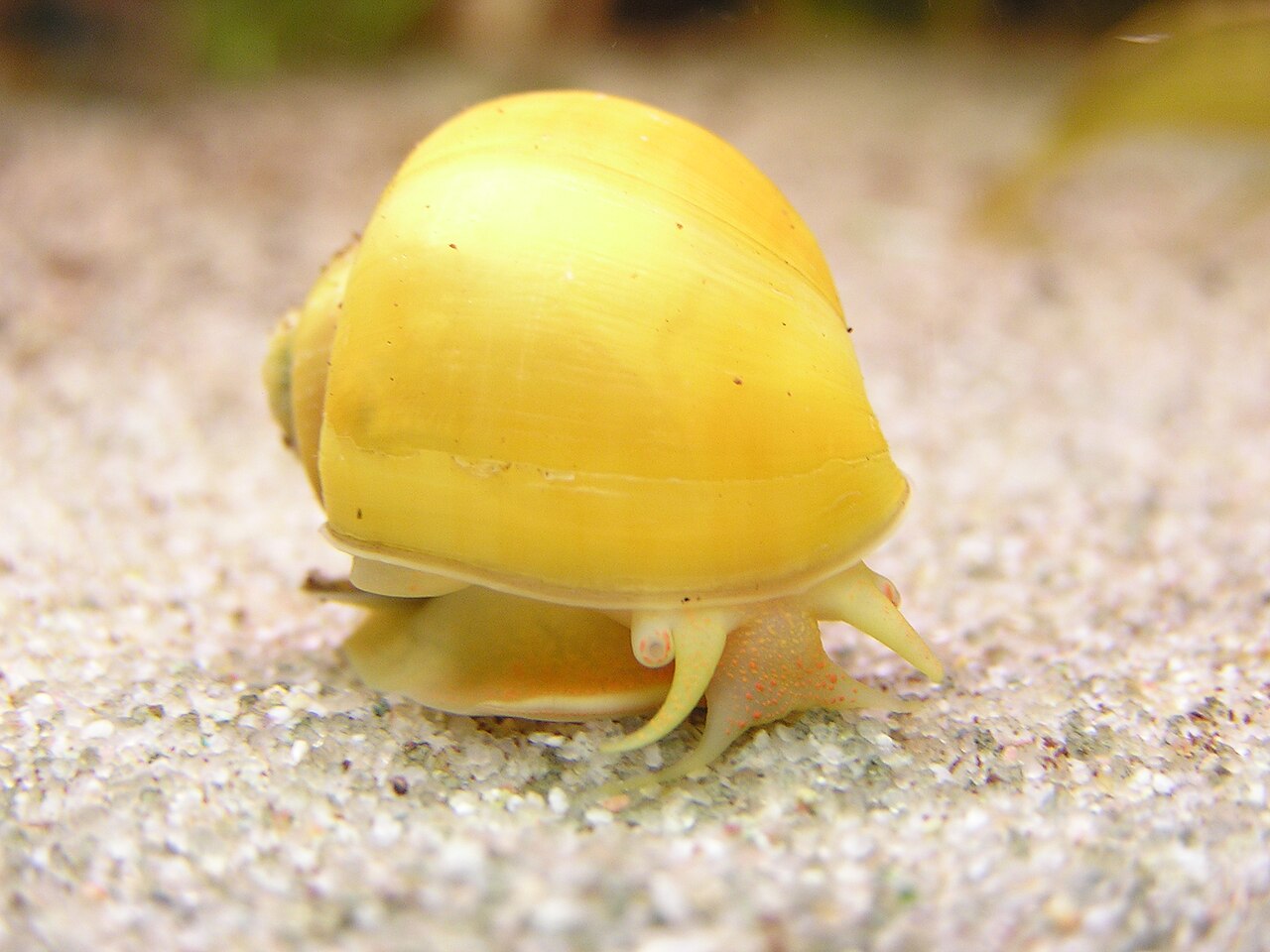
If your tap water is hard, and mine runs about 22.5 dGH, a mystery snail is one of the easiest and most satisfying things you can add to a tank. Most livestock in this hobby wants softer water than my tap gives; the mystery snail is the happy exception, because a shell is made of calcium carbonate and my water is dripping with the calcium to build one. I have kept these big, unbothered snails alongside my livebearers for years, and other than remembering to feed them properly they ask for almost nothing. This is a snail you actively want, not one you fight to get rid of, and that distinction is the whole point.
Free PDF
Free aquarium water cheat sheet (PDF)
Grab the one-page reference for your tank: target ranges for pH, hardness, ammonia, nitrite and nitrate, plus a plain walkthrough of the nitrogen cycle. No fluff, unsubscribe any time.
Free, unsubscribe any time. The download starts as soon as you sign up.
What a mystery snail is (and is not)
The mystery snail is Pomacea bridgesii, also sold as the gold inca snail, and it comes in a run of colours: gold, ivory, blue, black, magenta and more, all the same species. It grows to a decent size, a shell around 4 to 5 cm across when mature, so this is a proper animal you can watch, not a speck on the glass. The foot and body colour vary with the shell, and a pale snail with a bright yellow body cruising the front glass is a genuinely cheerful sight.
The important thing to get straight up front: a mystery snail is not a pest snail. Bladder and pond snails, the ones that arrive as hitchhikers on plants and breed until they coat the glass, are a different animal entirely. Mystery snails cannot do that, for a reason I will come to, and confusing the two is why some people wrongly fear adding one. If you have ever asked why your tank is suddenly full of snails, that was almost certainly not a mystery snail.
Why hard water is their happy place
A snail shell is roughly 95 percent calcium carbonate, and the snail builds and repairs that shell using calcium pulled from its food and from the water around it. In soft, acidic water two things go wrong: there is little calcium to draw on, and the low pH actively dissolves the shell faster than the snail can rebuild it. Keepers on soft water end up with pitted, cracking, thin shells and white eroded patches near the tip, and eventually a snail that cannot protect itself.
On my hard tap this problem simply does not exist. The water carries plenty of dissolved calcium, the pH sits comfortably on the alkaline side, and the shells come up thick, smooth and glossy. This is the same reason my livebearers and Rift Lake cichlids do well: the water that frustrates soft-water keepers is exactly what a shell-builder needs. If your tap is hard, you are already most of the way to a healthy snail. If yours is soft, a mystery snail is a fair reason to look at whether you need to adjust your water, or at least to add calcium deliberately.
For target numbers: a pH from about 7.2 to 8.4 suits them, and hardness on the higher side is a positive, not a problem. Aim for a stable temperature between roughly 20 and 26 °C. They cope with a wide band, but they dislike sudden swings, so match new water to the tank on changes.
The book behind Lagonia
The Hard Water Aquarium
My practical guide to working with hard, alkaline tap water instead of fighting it: reading your water, choosing and setting up the tank, and keeping and breeding the fish that thrive in it, from livebearers to Rift Lake cichlids and shell-dwellers.
Ad · Amazon affiliate links. I earn a small commission on a purchase, at no extra cost to you.
Feeding: they are hungrier than people think
The commonest mistake I see is assuming a snail lives on leftovers and algae alone. It does not. A mystery snail is a big animal with a real appetite, and a hungry one will start rasping at your plants or simply waste away. They do graze algae and clear up uneaten food, which makes them useful, but that is a supplement, not a diet.
I feed mine directly. Sinking algae wafers and a good quality snail or bottom-feeder pellet form the base, and I add blanched vegetables regularly: a slice of courgette, a bit of cucumber, deshelled peas, a leaf of spinach dropped in for a day. Calcium-rich greens do double duty, feeding the snail and topping up shell-building minerals. Take out whatever they have not finished after a day so it does not foul the water.
One honest note: despite the reputation, Pomacea bridgesii mostly leaves healthy live plants alone and prefers softer, decaying leaves and the food you give it. If yours starts eating your plants, read it as a sign it is underfed, not as the snail’s nature.
The tank, and the lid you must not forget
Mystery snails are undemanding on space; a single snail is happy in something around 20 litres, and they slot easily into a stocked community tank, so a group of them scales up from there. What they add is a real bioload, more than a small snail looks like it should, so count them in your numbers. The stocking calculator helps if your tank is already busy, and the volume calculator will pin down your real water volume.
Two details matter more than tank size. First, they breathe air. A mystery snail has a lung as well as a gill, and it extends a long siphon like a snorkel up to the surface to gulp atmospheric air. That is normal behaviour, not distress, so do not panic when you see it reaching up. It does mean they want well-oxygenated water and easy access to the surface.
Second, and this is the one people learn the hard way: keep a lid on the tank, and leave a gap of air between the water and the lid. Mystery snails climb, and a determined one will haul itself out over the rim and end up dry and dead on the floor by morning. A covered tank with a few centimetres of air space above the waterline solves both the escape risk and the breeding behaviour I will explain next.
Breeding, and why they never plague a tank
Here is the reason a mystery snail cannot overrun your tank the way pest snails do. They are not self-cloning; you need a male and a female, and crucially the female lays her eggs above the waterline, not in the water. She climbs up out of the tank, deposits a firm pink clutch of eggs on the glass or under the lid in the air, and there it sits.
That single quirk hands you complete control. No mate, no eggs. One snail, no eggs. And even with a breeding pair, every clutch is stuck to the glass in plain sight above the water, so if you do not want babies you scrape it off and bin it, done. Compare that with a bladder snail quietly laying fertile eggs all over the tank underwater and breeding whether you like it or not. This is exactly why a mystery snail is a pet and pest snails are a chore.
If you do want to raise them, leave a clutch in place in the humid air above the waterline and it will hatch in a couple of weeks, at which point the tiny snails drop into the water. They need the same calcium-rich conditions and feeding as the adults, and hard water gives the youngsters strong shells from the start.
Tankmates and the honest catch
Mystery snails are peaceful and pair well with most calm community fish, shrimp and other snails. They mix nicely with cherry shrimp, small livebearers and other gentle species. The catch is at both ends of the tank. Avoid known snail-eaters and fin-nippers: loaches, pufferfish and some larger cichlids will attack them, and a nipped-out siphon or eyestalk is a bad day for a snail. My Rift Lake cichlid tanks are no place for one; those fish would treat it as a snack.
The other honest point is lifespan. Even kept well, mystery snails do not live long, commonly around one year and sometimes up to two or three. That is the species, not something you did wrong, so do not read a natural death at a year as a failure. Buying a young, active snail with a clean, undamaged shell, rather than one that has been sitting a long time in a shop tank, gives you the best run.
Get the calcium, the food and the lid right, and a mystery snail is about as close to a no-fuss pet as this hobby offers, and it is one of the few animals that treats very hard tap water as a gift rather than an obstacle. For anyone battling hard water, that alone makes it worth a spot on the glass.