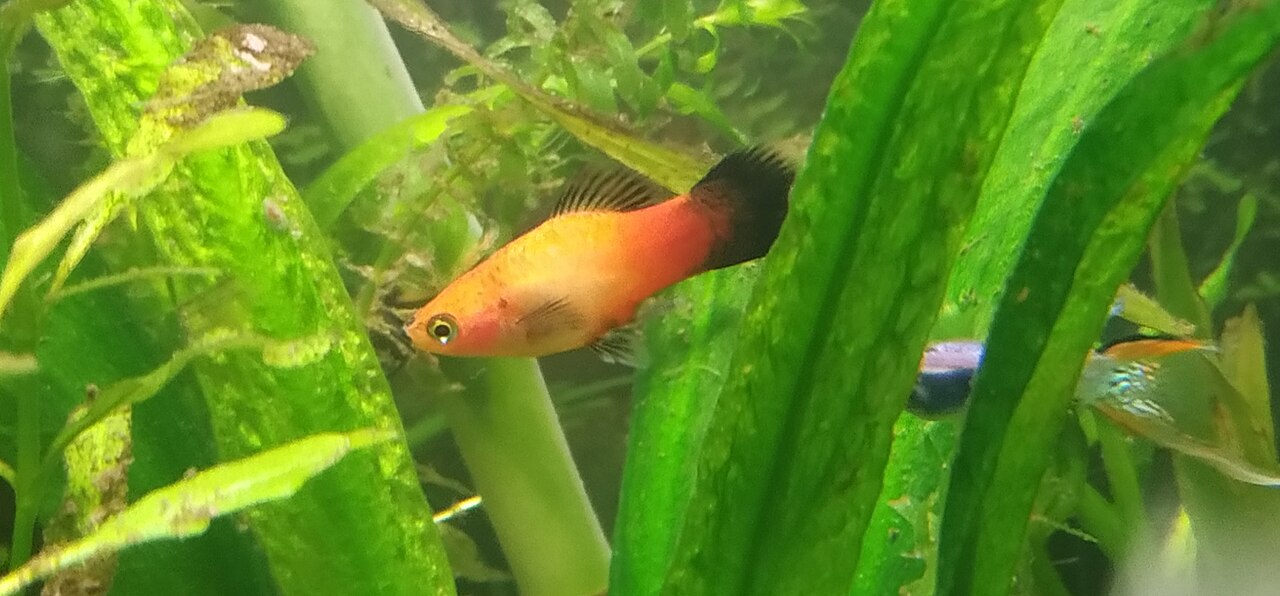
If you have hard, alkaline tap water and you want a fish that looks like a boiled sweet and behaves like it has somewhere to be, the platy is hard to beat. It sits alongside the guppy as one of the two livebearers I recommend most often to people starting out with water like mine, and in some ways I prefer it. Platies are a touch chunkier, a little calmer, and they come in colours that seem almost unreasonable for a fish you can buy for the price of a coffee. I have kept them for years, usually as the middle layer of a community tank, and they ask for very little in return.
Free PDF
Free aquarium water cheat sheet (PDF)
Grab the one-page reference for your tank: target ranges for pH, hardness, ammonia, nitrite and nitrate, plus a plain walkthrough of the nitrogen cycle. No fluff, unsubscribe any time.
Free, unsubscribe any time. The download starts as soon as you sign up.
Why platies suit hard water
Platies are members of the family Poeciliidae, the same broad group that gives us guppies, mollies and swordtails. They come from Central America, from waters that run over limestone and mineral-rich ground, so they arrive pre-adapted to exactly the conditions that frustrate so many soft-water fish. Most sources put their comfortable range at pH 6.8 to 8.0 and a general hardness of roughly 10 to 28 dGH. My tap water sits around 22.5 dGH and comfortably alkaline, which lands squarely inside that band. There is no remineralising, no RO mixing, no chasing numbers. I fill a bucket from the kitchen tap, treat it for chlorine, and the platies are perfectly happy.
That is the whole appeal of building a stocking list around your water rather than against it. If you want the reasoning in full, I go into it in the guide to fish that actually like hard water. Platies are near the top of that list for good reason.
Tank size and setup
A single platy is small, an inch and a half or so for a male and a little over two inches for a female, but they are sociable and active, and they do best in a small group. For a starter group of five or six I would not go below about 60 litres, roughly a standard 60cm tank. That gives them swimming room and, just as importantly, dilutes the waste, because platies eat well and produce accordingly. If you are unsure what your tank actually holds once rock and substrate are accounted for, the volume calculator will give you a real figure to plan around.
They are not fussy about aquascaping. A layer of gravel or sand, a few plants, and some open water to cruise in suits them fine. They graze on soft algae and appreciate cover, so plants earn their place twice over. Hard water can be awkward for some plants, but plenty thrive in it; I have paired platies with Java fern, Anubias and Vallisneria without any trouble, and there is a fuller list in my piece on plants for hard water.
Temperature is where people sometimes overheat their platies. The comfortable range is about 22 to 25 degrees C, and I would not push much past 26. Warmer water speeds their metabolism and shortens their lives, so a modest, well-sized heater set to the low twenties is ideal. The heater calculator will match a heater to your tank volume so you are not guessing.
The book behind Lagonia
The Hard Water Aquarium
My practical guide to working with hard, alkaline tap water instead of fighting it: reading your water, choosing and setting up the tank, and keeping and breeding the fish that thrive in it, from livebearers to Rift Lake cichlids and shell-dwellers.
Ad · Amazon affiliate links. I earn a small commission on a purchase, at no extra cost to you.
Water quality matters more than parameters
Here is the thing that trips up beginners: platies are so hardy that people assume they are indestructible, then lose them to something entirely avoidable. It is rarely the hardness or the pH that kills a platy. It is ammonia and nitrite in a tank that was never properly cycled, or nitrate creeping up in a tank that never gets a water change. Before any fish go in, the tank needs to be matured through the fishless cycle, and after that a weekly change of around a quarter of the volume keeps things stable. The water change calculator takes the maths out of it.
If you want to understand what each reading on your test kit is telling you, I wrote a full breakdown of aquarium water parameters. For platies specifically, the numbers to watch are ammonia and nitrite at zero, always, and nitrate kept down with regular changes. Get those right and the hardness looks after itself.
Feeding
Platies are omnivores with a real appetite for greens. In the wild a good part of their diet is algae and plant matter, so a quality flake or small pellet as the staple, topped up with the odd vegetable and some frozen or live treats, keeps them in good colour and good health. Mine get flake most days, a blanched courgette slice or a bit of cucumber now and then, and frozen daphnia or brine shrimp a couple of times a week. The plant matter is not optional garnish; it helps their digestion and keeps them from stripping your softer plants out of boredom and hunger.
Feed small amounts, once or twice a day, only what they clear in a minute or two. Overfeeding is the quiet cause of most water quality problems, and platies will happily beg as though they have never been fed in their lives. There is more on getting portions right in my post on feeding aquarium fish.
Telling males from females
Sexing platies is straightforward once you know the trick, and you will want to, because it decides how much breeding you are in for. The give-away is the anal fin. On a male it is rolled into a narrow, pointed rod called the gonopodium, which he uses to fertilise the female. On a female the anal fin stays fan-shaped and ordinary. Females are also noticeably larger and rounder, and a mature female usually shows a darker patch near the vent called the gravid spot, which is a sign she is carrying young.
If you would rather not deal with a constant stream of fry, keep males only. They still colour up beautifully and there is no risk of a population explosion. A single-sex group gets on fine.
Breeding, whether you plan to or not
Buy a mixed group and you will get babies. Platies are livebearers, so the female gives birth to free-swimming fry rather than laying eggs, and after a single mating she can produce brood after brood for months from stored sperm. Gestation runs about four to six weeks, and a healthy female might drop twenty to forty fry at a time. I cover the general approach in my guide to breeding livebearers, but the short version is that platies need no encouragement at all.
The fry are large enough to eat crushed flake straight away, and in a well-planted tank a few will survive on their own by hiding in the vegetation. Adult platies, including the parents, will eat any fry they catch in open water, so dense planting or a separate rearing space is what tips the balance if you want to raise a good number. Left to their own devices in a community tank, the population tends to find a rough equilibrium as most fry become a snack.
That runaway maths is exactly why stocking discipline matters. Before you add the adults, and long before the fry arrive, work out a sensible number with the stocking calculator, and lean towards the cautious end. An overstocked tank is the fastest route to poor water and sick fish. I go into the whole question in how many fish can I keep.
Tank mates
Platies are peaceful and get on with most calm community fish. In hard water they make natural companions for guppies, mollies and other livebearers, and they also do well with many of the smaller, hardy egg-layers. I keep a group alongside zebra danios and a few Corydoras with no friction at all. Avoid anything large enough to see them as food, and steer clear of known fin-nippers, though platies themselves are not tempting targets since their fins are short.
One sensible habit whatever you stock: quarantine new arrivals before they join the main tank. Platies are tough, but they can still carry in white spot or other problems from a shop tank, and a couple of weeks of observation saves a lot of grief. I set out the routine in quarantining new fish, and if white spot does appear there is a full treatment plan in my post on treating ich.
The honest verdict
Platies are among the best fish I can recommend for hard alkaline water. They are colourful, cheap, forgiving of a beginner’s early mistakes, and genuinely suited to the water that comes out of the tap in areas like mine. The only real catch is the breeding, and even that is easily managed by keeping a single sex. If you are setting up a first community tank and your water is hard, a small group of platies is close to a guaranteed success, and a very pretty one at that.