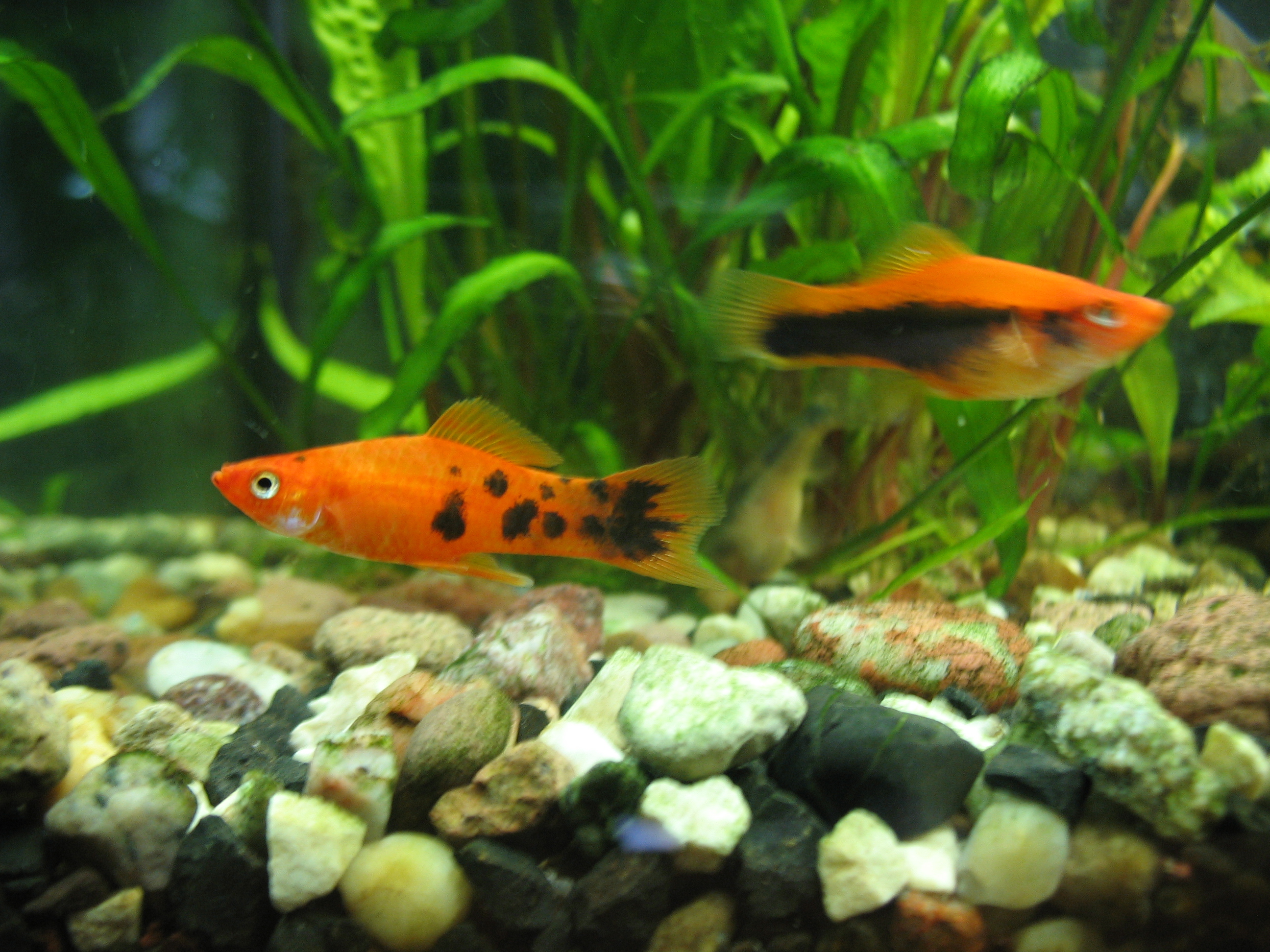
Swordtails were one of the first fish I kept that felt like they had actual personalities. Where a shoal of tetras drifts around as a single nervous cloud, a group of swordtails will stake out territory, chase each other about, and come barrelling to the front glass the second you walk past. The males carry that unmistakable sword trailing from the bottom of the tail, and a mature red male against a dark background is a genuinely striking thing. Best of all for anyone reading this site, they want exactly the water that comes out of my tap. If you keep hard alkaline water and you want something with a bit more presence than a guppy, swordtails deserve a serious look. Here is how I keep mine.
Free PDF
Free aquarium water cheat sheet (PDF)
Grab the one-page reference for your tank: target ranges for pH, hardness, ammonia, nitrite and nitrate, plus a plain walkthrough of the nitrogen cycle. No fluff, unsubscribe any time.
Free, unsubscribe any time. The download starts as soon as you sign up.
Why swordtails suit hard water
Swordtails (Xiphophorus hellerii) come from the mineral-rich streams and rivers of Central America, from Mexico down through Guatemala and into Honduras. That heritage matters, because it means they evolved in water that is hard, alkaline and well buffered, which is precisely what most soft-water aquarium fish cannot cope with.
The sweet spot for swordtails is a pH between about 7.0 and 8.0 and a general hardness anywhere from 12 to 30 dGH. My tap water sits around 22.5 dGH, comfortably inside that band, so I keep swordtails with no chemistry tinkering at all. No remineralising, no cutting with RO, no chasing a pH number with additives. If you are unsure what your own numbers are, the GH and KH explainer walks through how to read a test kit, and the wider hard water fish guide sets swordtails alongside the other species that genuinely enjoy this water rather than merely tolerating it.
I want to be honest here, because the whole point of this site is not overselling. Swordtails are hardy, but they are not indestructible, and they do not somehow prefer filth. Hard water suits them; a neglected tank does not. The chemistry is the easy part when your tap is already right for them.
Tank size and setup
This is where a lot of first-time swordtail keepers slip up. These are not nano fish. A male can reach around 14 centimetres including the sword, and a well-fed female can be a chunky 12 to 16 centimetres in the body. They are also fast, muscular swimmers that spend the day cruising, not hovering. A tank that would house a happy group of guppies will feel cramped very quickly with swordtails.
For a small group I would not go below about 75 litres, and a 100 litre tank or larger makes for a far calmer, more natural set-up. Length matters more than height, because these fish want a runway to swim. If you are still working out what a given tank actually holds, the volume calculator will turn the physical dimensions into litres, and the stocking calculator helps you sanity-check the group size before you buy.
One thing I learned the hard way: swordtails jump. They are proper athletes and a startled fish will clear the surface without much effort. A tight-fitting lid is not optional. I lost an early female to the carpet before I took that seriously, and I have never kept a swordtail in an open-topped tank since.
Otherwise the set-up is straightforward. Good filtration, because these are active fish that eat well and produce a fair bit of waste. Some planting for cover and for the fry, which I will come to. A sensible temperature somewhere between 22 and 26 degrees suits them; they will handle the wider 21 to 28 range but there is no reason to push the extremes.
The book behind Lagonia
The Hard Water Aquarium
My practical guide to working with hard, alkaline tap water instead of fighting it: reading your water, choosing and setting up the tank, and keeping and breeding the fish that thrive in it, from livebearers to Rift Lake cichlids and shell-dwellers.
Ad · Amazon affiliate links. I earn a small commission on a purchase, at no extra cost to you.
The male aggression problem
Here is the single thing that catches people out. Male swordtails are territorial towards each other, and a lone male in a small group of females can badgering those females relentlessly. Get the social side wrong and you end up with torn fins, stressed fish and, eventually, disease.
There are two arrangements that work for me. The first is one male to at least three or four females, so his attention is spread out rather than fixed on a single victim. The second, which I actually prefer in a larger tank, is a group of several males kept together with no females at all. When males live in a bachelor group they establish a rough pecking order and the sparring stays mostly to display and posturing rather than real damage. What you want to avoid is two males and a couple of females in a small box, because the males will fight over them and nobody has anywhere to escape to.
A quick word on a genuine oddity of this species. Swordtails sometimes appear to change sex. A fish you have kept as a female for months will suddenly grow a sword and start behaving like a male. In most cases this is a late-developing male that simply matured slowly rather than a true switch, but the effect on your carefully balanced sex ratio is the same. Keep an eye on your group and be ready to rehome or rebalance if a “female” turns out to have other plans.
Feeding
Swordtails are omnivores with a real appetite for greens. In the wild a big part of their diet is algae and plant matter grazed off surfaces, and if you keep them in a planted or slightly algae-friendly tank you will see them picking at the glass and leaves all day.
I feed a good quality flake or small pellet as the staple, ideally one with a decent amount of spirulina or other plant content. On top of that I offer vegetable matter a couple of times a week, usually a piece of blanched courgette or a little deshelled pea, and something meaty like frozen bloodworm or brine shrimp now and then to keep them in condition. Variety keeps their colours strong and their breeding steady. As with any fish, the commonest feeding mistake is simply giving too much; my feeding guide covers portion sense in more detail, but the rule of thumb is little and often, only what they clear in a minute or two.
Breeding, whether you plan to or not
If you keep a mixed group of swordtails, you will get babies. There is no real trick to it. These are livebearers, so the female carries the developing young internally and releases free-swimming fry roughly every four weeks. A single mating can fertilise several successive broods, because females store sperm, which is why a female bought from a shop is very often already pregnant when you get her home.
The catch is that the parents will happily eat their own fry. In a bare tank very few survive. In a tank with dense planting, some floating cover and a few hiding spots, a decent number make it through on their own. If you actively want to raise them, moving the heavily pregnant female to a separate tank or using a well-planted breeding area gives far better results than a plastic breeding trap, which stresses the mother. The breeding livebearers article goes into the practicalities, and much of it applies equally to swordtails, platies, mollies and guppies, all close relatives that share the same easygoing approach to reproduction.
One practical warning: swordtails and platies belong to the same genus and will interbreed. If you care about keeping either line pure, do not house them together.
Health and the honest bits
Kept in the right water with sensible stocking, swordtails are among the more trouble-free fish I have owned, and they typically live three to five years. Most of the problems I have seen came back to the same two causes: overcrowding and skipped maintenance. Cram too many into too small a tank, let the water quality slide, and you invite fin damage, fungus and outbreaks of white spot.
None of that is mysterious. Stay on top of your water changes, do not overstock, and quarantine anything new before it goes near your main tank; the quarantine guide explains why that habit saves so much heartache. Do those few things and hard alkaline water, so often treated as a limitation, becomes exactly the advantage it should be. Swordtails are proof that the right fish for your water are the ones that were built for it in the first place.