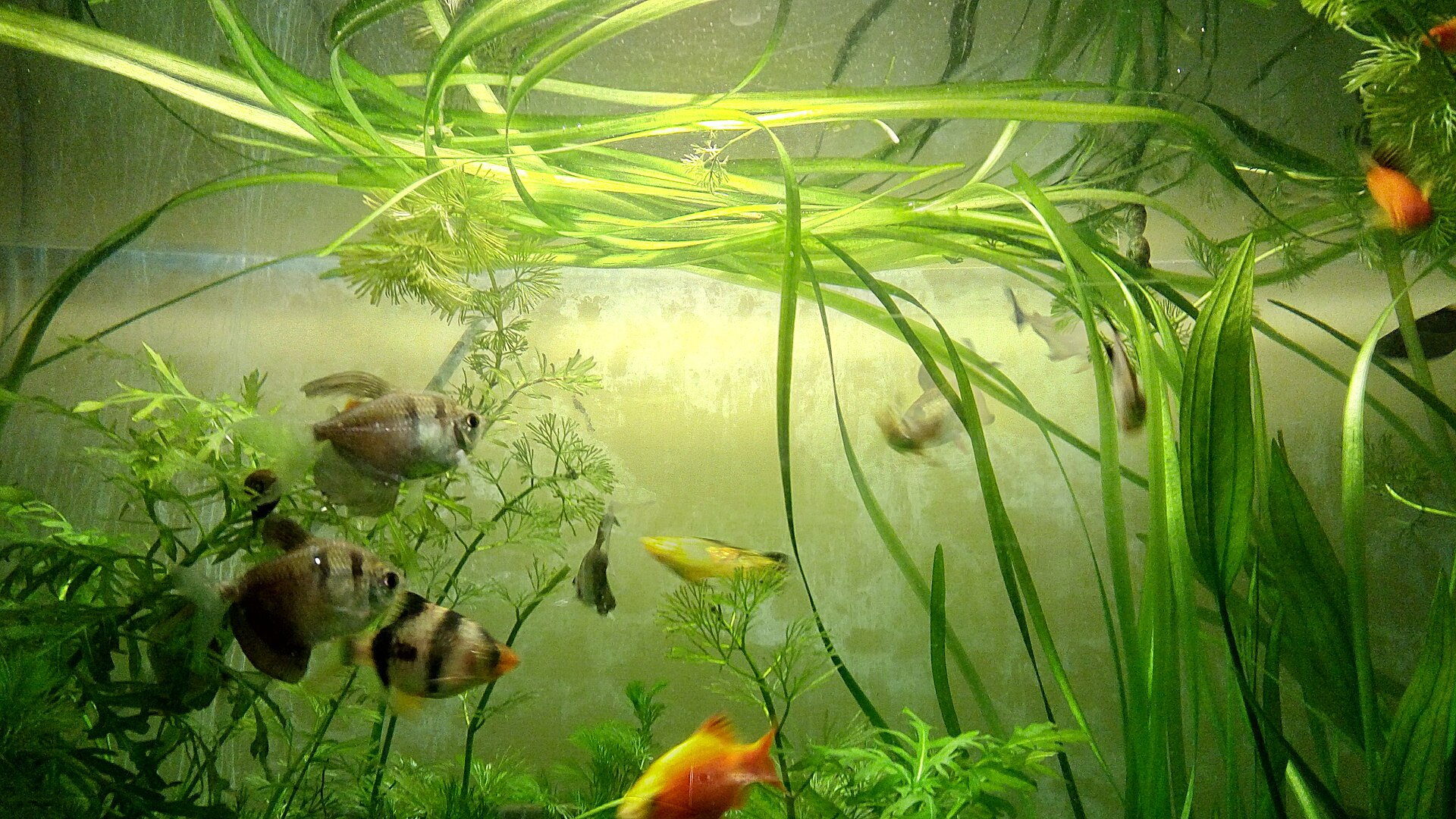
There is a persistent worry among new keepers with hard tap water that plants are simply not going to work for them, that a lush green tank is something reserved for people with soft, acidic water and a cylinder of CO2 bubbling away. I had the same fear when I started, staring at water that measures around 22.5 dGH and assuming everything would sulk. It turned out to be almost entirely unfounded. The great majority of the plants sold in shops grow perfectly well in hard alkaline water, and several of the toughest actively prefer it. This is the list I would hand anyone setting up a low-tech planted tank on water like ours.
Free PDF
Free aquarium water cheat sheet (PDF)
Grab the one-page reference for your tank: target ranges for pH, hardness, ammonia, nitrite and nitrate, plus a plain walkthrough of the nitrogen cycle. No fluff, unsubscribe any time.
Free, unsubscribe any time. The download starts as soon as you sign up.
Do plants really mind hard water?
Mostly, no. The idea that plants need soft water gets muddled up with a separate truth, which is that some plants dislike a lot of dissolved salts. Hardness from calcium and magnesium, the natural sort you get from limestone bedrock, is a different thing from the sodium you might add through certain treatments, and the calcium and magnesium are actually nutrients that plants use. High pH does slightly change which form of carbon is available in the water, but for the undemanding species below it makes little practical difference.
What hard water does rule out is a short list of fussy, soft-water carpeting and stem plants that really do want acidic conditions and injected CO2 to look their best. Skip those and you still have dozens of good options. If you want the broader beginner picture alongside this hard-water angle, my guide to beginner aquarium plants covers the general ground.
Anubias, the plant that refuses to die
If I could only keep one plant in hard water it would be Anubias. It grows from a thick creeping stem called a rhizome, with dark, almost leathery leaves that shrug off conditions that would see off anything softer. The one rule that matters is never to bury the rhizome in the substrate, because it will rot; instead tie or glue it to a piece of wood or a rock and let the roots grip. It grows slowly, which is the price of being so tough, but a slow plant is also one that never outgrows the tank or needs constant trimming. Older leaves sometimes gather a little algae precisely because they sit around for months, and there is more on managing that in my notes on aquarium algae.
The book behind Lagonia
The Hard Water Aquarium
My practical guide to working with hard, alkaline tap water instead of fighting it: reading your water, choosing and setting up the tank, and keeping and breeding the fish that thrive in it, from livebearers to Rift Lake cichlids and shell-dwellers.
Ad · Amazon affiliate links. I earn a small commission on a purchase, at no extra cost to you.
Java fern, the other unkillable epiphyte
Java fern works on the same principle as Anubias and belongs in the same beginner-proof category. It is another rhizome plant, so again it gets fastened to hardscape rather than planted, and it is entirely happy in hard alkaline water at a high pH. You will sometimes see little black bumps or tiny plantlets forming on the undersides of older leaves; that is the plant reproducing, not a disease, and you can pin those leaves down or let the babies drift off and settle. Between Anubias and Java fern you can build a green, structured tank without a single plant going into the gravel.
Vallisneria, which genuinely loves the stuff
Vallisneria is the one plant on this list that does not merely tolerate hard water but positively thrives on the calcium in it. It sends up long grassy ribbons that reach the surface and then trail along it, and it spreads by runners into a dense background jungle surprisingly fast for a low-tech plant. Give it a nutritious substrate or push a root tab in near the crown and it will reward you. Plant it so the white base of the crown sits just at the substrate surface, not buried, or it can rot. It is the plant that finally made my hard-water tanks look properly established, and it asks for very little in return.
Cryptocoryne for the foreground and midground
The Cryptocoryne family gives you lower, bushier plants in greens, browns and reds, and most of them handle hard water without complaint. They are root feeders, so they do best planted in the substrate with a root tab tucked underneath. Be ready for what is known as crypt melt: after planting, the leaves may dissolve into mush and vanish, which looks like a disaster but is simply the plant shedding its old growth to adapt to new conditions. Leave the roots undisturbed and it will push out fresh leaves suited to your tank within a few weeks. Cryptocoryne wendtii is the toughest starting point.
Hornwort, mosses and the easy floaters
For fast growth and instant cover, hornwort is hard to beat. It has no true roots, so you can let it float or wedge the ends into the substrate, and it grows quickly enough to soak up excess nutrients that would otherwise feed algae, which makes it a useful ally in a new tank. Java moss is the equivalent for carpeting and hardscape, an undemanding tangle that grows on anything and gives shrimp and fry somewhere to hide. Floating plants such as Amazon frogbit also do well and shade the tank from above.
Amazon sword for a centrepiece
If you want a single large, dramatic plant, the Amazon sword earns the spot. It tolerates hard water happily and grows into a broad rosette of tall leaves that can fill the back of a tank. It is a heavy root feeder, though, so it wants a decent substrate and regular root tabs pushed in around it; starve it and the leaves go pale and small. Given what it needs, it is one of the most satisfying plants to grow into a proper feature.
An honest word about the chalky crust
Here is the one genuine quirk of growing plants in hard water, and shops rarely mention it. The fast growers, Vallisneria, hornwort and the related Elodea in particular, can pull carbon out of the carbonates dissolved in hard water when the free CO2 runs low. As they do it, they leave behind a whitish, chalky crust of lime on their older leaves. It is completely harmless to the fish and the plant, and it simply tells you the plant is working hard for its carbon. It looks a little untidy, and if it bothers you the answer is more plants competing for light rather than fewer, or a touch less light so growth slows. The slow epiphytes like Anubias and Java fern never do this, which is another mark in their favour. If you want to understand how light and carbon trade off, the CO2 and light page goes into the balance.
Getting them going without CO2
None of these plants need injected CO2, but they do want a few basics to look their best. Keep the light modest, six to eight hours a day on a timer, because too much light on low-tech plants grows algae rather than plants. Feed the root feeders, the crypts, swords and Vallisneria, with root tabs in the substrate, and give the water-column plants and floaters a small weekly dose of an all-in-one liquid fertiliser. Start low and watch the tank: pale new leaves mean feed a little more, while algae creeping in means ease off the light or the ferts. The fertiliser dosing calculator will work out sensible amounts for your tank volume. Above all, be patient, because low-tech tanks establish over months rather than days, and the reward is a green, self-sustaining tank that thrives on exactly the water you were told would hold you back.