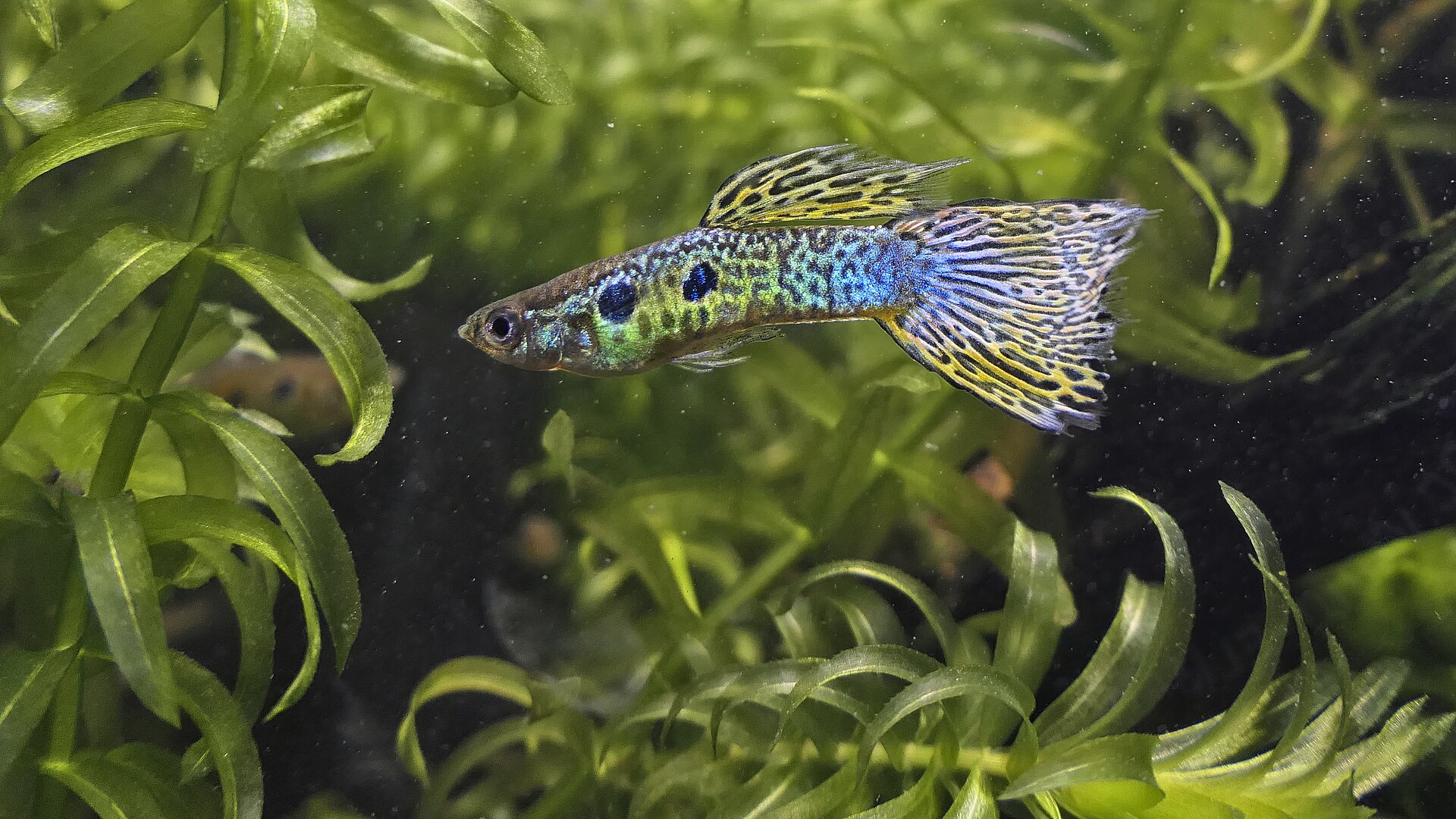
If you have hard, alkaline tap water and you want a small, colourful fish that will not just tolerate it but genuinely prefer it, guppies are one of the easiest recommendations I can make. Poecilia reticulata is the fish that got most of us into the hobby, and there is a good reason it keeps turning up in beginner tanks: it is tough, it breeds without any encouragement, and the males look like someone spilled paint. I have kept them on and off for years, and the tank in my kitchen has run more or less on autopilot for the last two.
Free PDF
Free aquarium water cheat sheet (PDF)
Grab the one-page reference for your tank: target ranges for pH, hardness, ammonia, nitrite and nitrate, plus a plain walkthrough of the nitrogen cycle. No fluff, unsubscribe any time.
Free, unsubscribe any time. The download starts as soon as you sign up.
Why guppies suit hard water so well
Most fishkeeping advice online is written for soft, acidic water, which is why so many beginners with liquid-rock tap water end up fighting their own supply. Guppies flip that problem on its head. They come from Central and South America and the Caribbean, from streams that are often quite mineral rich, and they use those dissolved minerals for healthy scales, fins and, crucially, for the females carrying broods.
The commonly quoted ideal general hardness is around 8 to 12 dGH, but that figure undersells them badly. Guppies handle a GH well into the twenties and beyond, and my tap water sits at roughly 22.5 dGH with a pH comfortably above 7.5. That is exactly the sort of water they want. If your tap is soft you can still keep them, but you may need to add minerals to keep them at their best, which is the opposite of the usual struggle. For once, hard water is the advantage rather than the obstacle. If you are still working out where your water sits, the aquarium water parameters post walks through testing GH, KH and pH.
Tank size and setup
Guppies are small, with males reaching about 3 to 4 cm and the chunkier females around 5 to 6 cm, so people assume they need almost nothing. They do not need a lot, but they do need more than a bowl. I would not start a colony in anything under about 40 litres, and 54 litres or more gives you room for the population growth that is coming whether you plan for it or not.
Filtration should be gentle. Guppies are not strong swimmers and long finned males in particular get pushed around by a fierce outflow, so a sponge filter or a baffled internal is kinder than a powerful hang-on-back unit. Any filter still needs to be cycled before the fish go in; if that word is new to you, read fishless cycling first, because an uncycled tank is the most common way beginners lose their first guppies. A lid matters too, as they will jump given the chance.
Planting helps enormously. Hard water suits a good range of undemanding plants, and fry survival goes up sharply when there is dense cover for them to hide in. Java fern, Anubias, Vallisneria and a floating layer all work in the sort of water guppies like. My aquarium plants for hard water post covers the species that cope without CO2 or soft water.
The book behind Lagonia
The Hard Water Aquarium
My practical guide to working with hard, alkaline tap water instead of fighting it: reading your water, choosing and setting up the tank, and keeping and breeding the fish that thrive in it, from livebearers to Rift Lake cichlids and shell-dwellers.
Ad · Amazon affiliate links. I earn a small commission on a purchase, at no extra cost to you.
Water parameters that keep them healthy
The numbers I aim for, and which match what the reputable care sources agree on, look like this:
- Temperature: 22 to 28 degrees C, with the mid twenties being the sweet spot. Guppies can survive at room temperature, but a small heater keeps them stable and active. The heater calculator will size one for your tank.
- pH: anywhere from about 7.0 to 8.0 is fine, and stability matters far more than a specific figure. Do not chase a “perfect” number by dosing chemicals; a steady 8.0 beats a wobbly 7.2 every time.
- Hardness: moderate to very hard. As above, this is where hard-water keepers win.
- Ammonia and nitrite: zero, always. Nitrate kept under control with water changes.
That last point is the one that actually kills fish. Guppies are hardy, but hardy does not mean immortal, and the usual cause of death is not disease but poor water in an overstocked, under-maintained tank. A weekly change of around 25 to 30 per cent keeps things in order. The water change calculator takes the guesswork out of how much to swap.
Feeding
Guppies are omnivores with a slight lean towards plant matter, and they are not fussy. A good quality flake or small pellet as the staple, crushed a little for the smaller mouths, does most of the work. I vary it with the odd portion of frozen brine shrimp, daphnia or bloodworm a couple of times a week, and any greens I can offer such as a scrap of blanched courgette or the biofilm they graze off plants and glass.
The single most common feeding mistake is simply too much. A guppy’s stomach is roughly the size of its eye, and uneaten food rots into the exact nitrate and ammonia problems you are trying to avoid. I feed once or twice a day, only as much as they clear in a minute or so, and the tank stays cleaner for it. There is more detail in the general feeding aquarium fish guide.
The breeding you did not ask for
Here is the honest warning that every guppy keeper eventually gives. If you buy males and females together, you will have babies. Not might; will. Guppies are livebearers, the females give birth to free-swimming fry rather than laying eggs, and a single mating can fertilise several successive broods because the female stores sperm. Gestation runs to roughly 28 days, and a healthy female can drop twenty to fifty fry at a time, then do it again a few weeks later.
In a bare tank the adults eat most of the fry, which is nature’s own population control. In a well-planted tank a good number survive, and a colony can go from a handful of fish to a crowd inside a few months. That is either the best or the worst thing about guppies depending on your temperament. If you want to manage it, keep only males (they are the colourful ones anyway), or plan where the offspring will go before you start. I wrote more about the whole process in breeding livebearers.
Because of that runaway maths, stocking sense matters more with guppies than with almost anything else. Before you add fish, and certainly before the fry arrive, run the numbers through the stocking calculator; if you are not sure of your tank’s real volume, the volume calculator will give you a proper figure to work from.
Tank mates
In hard alkaline water guppies mix happily with other livebearers such as platies and mollies, all of which share the same taste for mineral rich water. Small peaceful community fish that also cope with hardness make good companions, and a group of shrimp or a few Malaysian trumpet snails will help keep the tank tidy.
Two things to avoid. First, nippy fish; those flowing male tails are an irresistible target for the likes of tiger barbs, and a shredded guppy is a stressed and vulnerable one. Second, keep an eye on the ratio if you house both sexes. Males pester females relentlessly, so a group with two or three females per male spreads the attention and stops any single female being harried to exhaustion. For a wider look at what works in liquid-rock water, the hard water fish post lists my go-to species.
A realistic verdict
Guppies get dismissed as a beginner fish, and they are, but that undersells how genuinely rewarding a well-kept colony is. A planted tank of steadily breeding guppies, the males flashing colour as they display, is a proper little ecosystem that mostly runs itself. Give them a cycled tank, gentle flow, sensible feeding and regular water changes, and hard alkaline tap water does the rest for you. For anyone in a hard-water area wondering what will actually thrive rather than merely survive, this is where I would start.