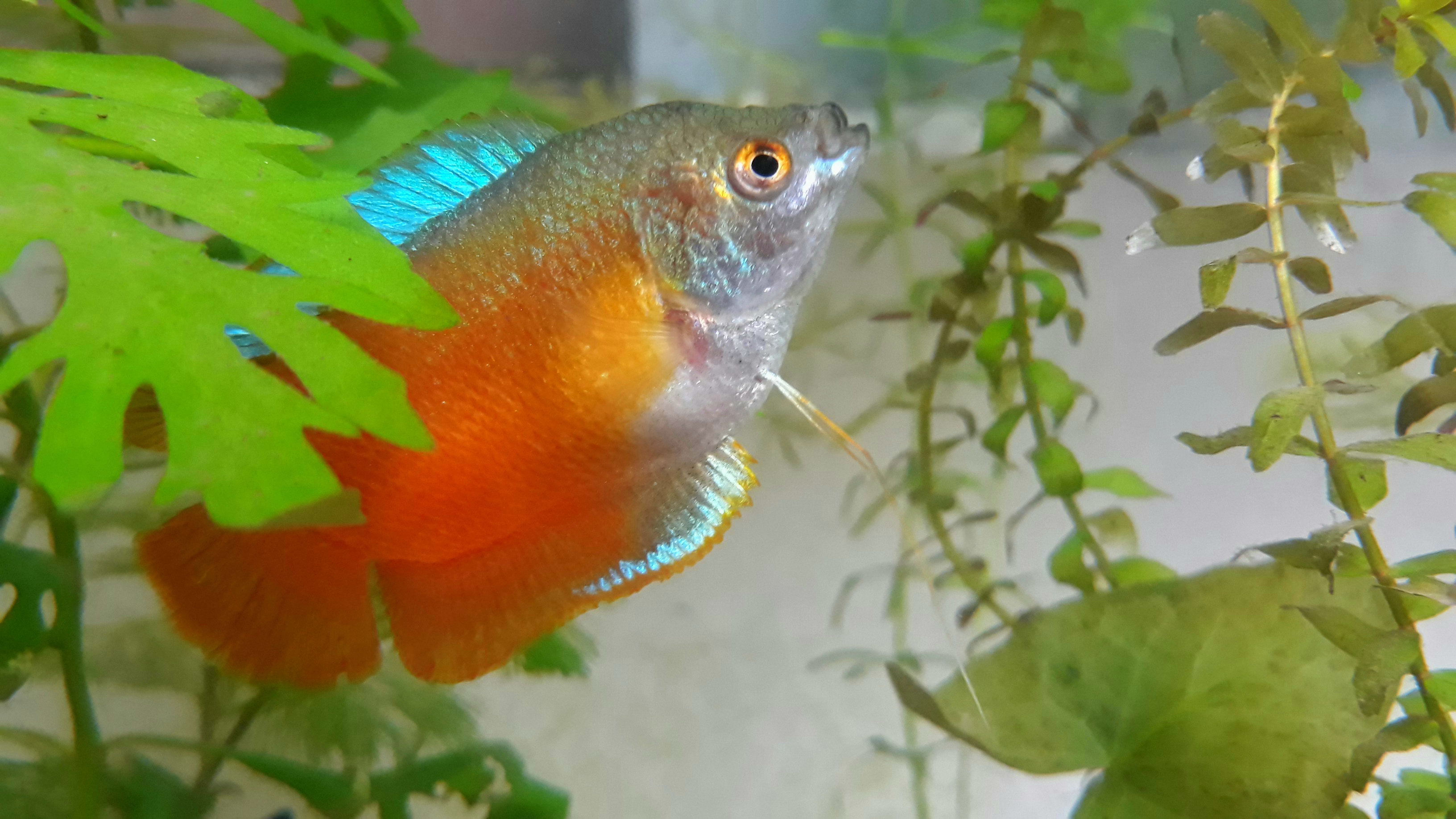
Gouramis are some of the most rewarding fish for a calm community tank, but the one everyone reaches for first, the dwarf gourami, is the one I most often talk people out of. On hard alkaline water like mine, at 22 to 23 °dGH, the choice of species matters twice over: once for how the fish handles the chemistry, and once for how likely it is to arrive already carrying something it will not recover from. Get the species right and gouramis are hardy, characterful and long-lived. Get it wrong and you are in for a slow, frustrating loss.
Free PDF
Free aquarium water cheat sheet (PDF)
Grab the one-page reference for your tank: target ranges for pH, hardness, ammonia, nitrite and nitrate, plus a plain walkthrough of the nitrogen cycle. No fluff, unsubscribe any time.
Free, unsubscribe any time. The download starts as soon as you sign up.
The short answer
For hard water, the three-spot gourami and its colour forms are the toughest and most adaptable. The honey gourami is the best small, peaceful choice and, importantly, it does not suffer the disease that plagues its lookalike. The pearl gourami is a beautiful middle option that tolerates hard water even though it prefers things softer. The dwarf gourami is the one I would avoid, not because of your water alone but because so much of the farmed stock is sick before you buy it.
All gouramis share one quirk: they are labyrinth fish, breathing air from the surface through a special organ. That shapes how you set their tank up, so I will cover it once and it applies to all of them.
The dwarf gourami problem
Dwarf gouramis (Trichogaster lalius) are gorgeous, and that is exactly why they sell. The trouble is a virus. Dwarf Gourami Iridovirus, sometimes called Dwarf Gourami Disease, is widespread in mass-farmed stock. A study of Sydney aquarium shops back in 2006 found around a fifth of imported dwarf gouramis carried it, and there is no cure; it is effectively always fatal. The signs are a fish that loses colour, stops eating and wastes away over a few weeks despite perfect water.
You cannot see it in the shop, and a healthy-looking fish can still be carrying it. On top of that, dwarf gouramis do best in soft, slightly acidic water, below roughly 8 °dGH, which is a long way from my tap. So on hard water you are stacking a disease gamble on top of a chemistry mismatch. I have kept them, lost them the classic way, and stopped buying them. If you adore the look, the honey gourami is the answer.
The book behind Lagonia
The Hard Water Aquarium
My practical guide to working with hard, alkaline tap water instead of fighting it: reading your water, choosing and setting up the tank, and keeping and breeding the fish that thrive in it, from livebearers to Rift Lake cichlids and shell-dwellers.
Ad · Amazon affiliate links. I earn a small commission on a purchase, at no extra cost to you.
Honey gourami: the one I recommend first
The honey gourami (Trichogaster chuna) is a small, mild fish that grows to about 4 to 5 cm. It is hardy, it does not appear to catch the iridovirus that dooms dwarf gouramis, and it has a gentle temperament that suits a peaceful community far better than the pushier species. It prefers softer water on paper, but it adapts well to harder tanks in practice, and mine have been fine on hard tap.
Two things to know when buying. First, honey gouramis are often washed out and grey in shop tanks from stress, and colour up to a lovely amber once settled, so do not judge them by the display tank. Second, they can be timid, so give them planted cover and calm tankmates and they will come out and behave naturally.
Three-spot gourami: the hard-water workhorse
If you want a gourami that genuinely shrugs off hard water, this is it. The three-spot gourami (Trichopodus trichopterus), sold in blue, gold, opaline and marbled forms, is one of the hardiest fish in the trade and adapts to a wide range of conditions, comfortably up to around 20 °dGH and often beyond. On chemistry alone it is the easiest match for my water.
The catch is temperament and size. Three-spots reach 10 to 13 cm and the males in particular can turn semi-aggressive and territorial, especially the blue and opaline forms. They are not a fish for a nano tank or for keeping alongside anything small and slow. In a roomy tank with sturdy tankmates they are superb, but go in with your eyes open about the attitude.
Pearl gourami: beautiful, and hardier than its reputation
The pearl gourami (Trichopodus leerii) is, to my eye, the prettiest of the lot, with its speckled body and orange breeding throat. It is a soft-water fish at heart and colours and breeds best in softer, slightly acidic water, but it tolerates hard water in captivity better than most soft-water species, with tolerance quoted as high as 30 °dGH. It stays more peaceful than the three-spot despite reaching a similar size, which makes it my pick for a larger, calm community on hard tap.
Setting up a gourami tank
Because they breathe air, gouramis need constant easy access to the surface, and they dislike being buffeted. The setup follows from that:
- Gentle flow. These are still-water fish. A raging filter outlet stresses them and makes surface breathing hard. Baffle a strong filter or use a sponge filter. My notes on choosing a filter cover matching flow to fish.
- A calm, slightly warm surface. Keep the water level a little below the tank rim so the air above the surface stays warm and humid; a blast of cold room air on the labyrinth organ can cause problems.
- Plants and cover. Floating plants suit them, giving shade and, for the bubble-nesters, something to anchor a nest under. Hard-water-friendly options are in my hard water plants guide.
- The right tank size. A pair of honey gouramis is happy in a modest tank; a three-spot or pearl needs real length. Check your stocking with the stocking calculator and my how many fish can I keep guide before adding them.
Standard tropical temperatures around 24 to 27 °C suit all of these, so size a heater to the tank with the heater calculator and let it hold steady.
Temperament and tankmates
Most gourami trouble is social, not chemical. Males of the same species often squabble, so unless you are deliberately breeding, one male per species in a tank is the safe rule. Mixing different gourami species in a small tank tends to end in bullying. They can also be nippy towards long fins or slow fish, and the bigger species will eat very small tankmates. Peaceful, similarly sized fish that do not compete for the surface make the best company. On hard water, that lines up nicely with sturdy livebearers and other species from my hard water fish list.
Feeding and everyday care
Gouramis are unfussy eaters and will take good flake, small pellets, and frozen or live foods, which bring out their colour and breeding behaviour. They enjoy hunting at the surface, so floating foods suit them. Do not overfeed; a couple of small feeds a day is plenty, and my feeding guide explains why less is usually more. Keep up regular partial water changes and stable parameters and a healthy gourami will give you years.
What I would do on hard water
Start with honey gouramis if you want small and peaceful, or a three-spot if you want a hardy centrepiece and have the tank length for its attitude; consider a pearl if you want beauty with a milder nature in a larger tank. Skip the dwarf gourami. Buy from a shop where the fish are eating and coloured up, quarantine them using my quarantine routine, give them gentle flow and surface cover, and let hard water be a non-issue for the species that were built to handle it.
The advice here reflects one keeper’s experience on very hard water, not veterinary guidance; individual fish, shops and test kits vary, so treat the hardness figures as guides rather than hard limits.