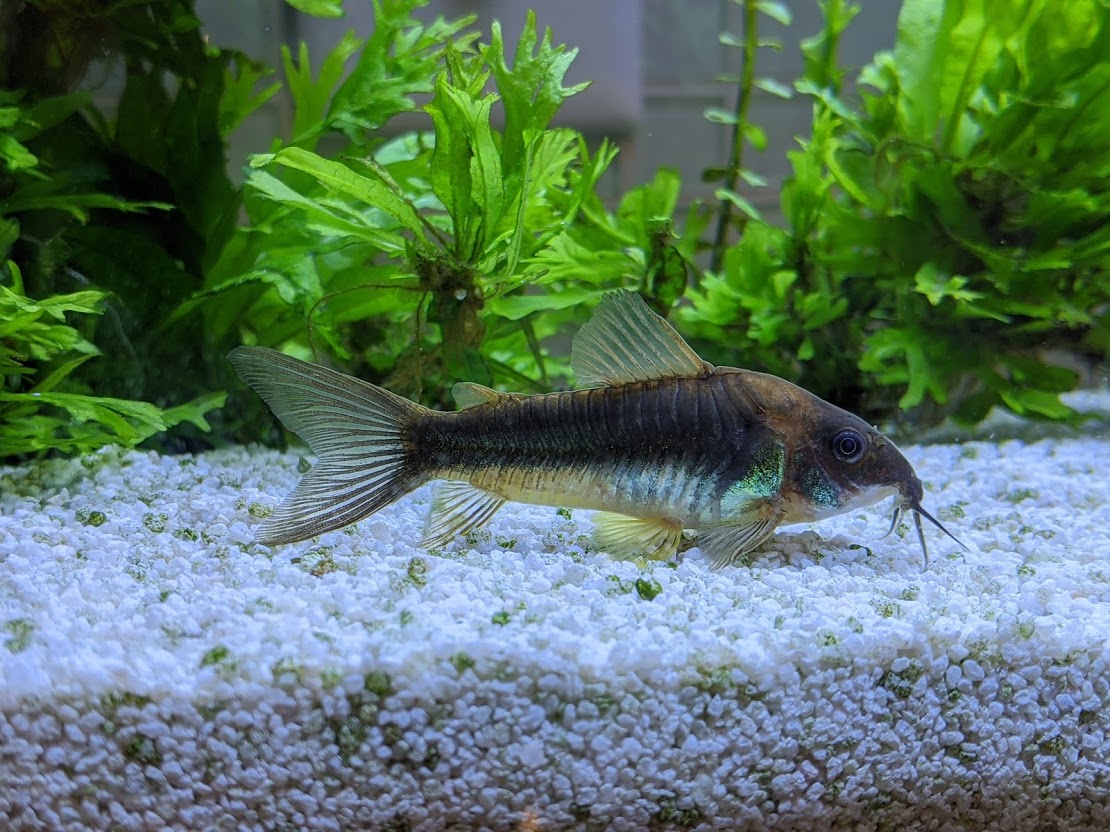
Yes, you can keep corydoras in hard water, but only some of them, and the honest picture is more nuanced than the forums usually let on. On my tap, which runs around 22 to 23 °dGH with a pH near 7.2, I have kept bronze and albino cories for years with no trouble at all. I have also watched more delicate wild-type species sulk and fade in the same water. The species you choose matters far more than any bottle of buffer you might be tempted to buy.
Free PDF
Free aquarium water cheat sheet (PDF)
Grab the one-page reference for your tank: target ranges for pH, hardness, ammonia, nitrite and nitrate, plus a plain walkthrough of the nitrogen cycle. No fluff, unsubscribe any time.
Free, unsubscribe any time. The download starts as soon as you sign up.
The short answer
Tank-bred cories from the hardy end of the family will live long, active lives in hard alkaline water. The commercially farmed bronze (Corydoras aeneus, and its albino form), the peppered cory (Corydoras paleatus) and the sturdy Sterbai are the ones I would put in water like mine without a second thought. What they will not reliably do in very hard water is breed. Spawning is where soft water still earns its keep, and I will come back to that.
If you have a wild-caught fish, or one of the fussier collector species, hard water tips the odds against you before the fish even reaches your tank. That is not a hardness problem so much as a “this animal has never seen water like yours” problem.
Which corydoras actually cope with hard water
The bronze cory is the standout. Reference sources put its captive tolerance as wide as 2 to 30 °dGH, and in practice a tank-bred bronze barely notices where in that range it sits, provided the water is clean and stable. Its native rivers sit lower, roughly 5 to 19 °dGH, but generations of farm breeding have produced a genuinely adaptable fish. The albino cory sold in every shop is the same species, so it carries the same forgiving nature.
Peppered cories are the next safe bet. They are happy across roughly 2 to 15 °dGH and, being a cooler-water southern species, they suit an unheated or lightly heated room better than most. Mine have shrugged off water at the top of that band and beyond.
Sterbai cories deserve a mention because they tolerate warmer tanks than the others, which makes them a sensible companion for Rift Lake or other warm setups, and they are not precious about hardness either.
Where I would be careful:
- Wild-caught anything. These fish are acclimatised to soft, often acidic blackwater. Dropping them into 22 °dGH is a real shock.
- Delicate collector species such as many of the long-nosed and dwarf types. Some tank-bred pygmy cories cope fine; the fancier imports are a gamble on hard water.
- Fish that already look rough in the shop. Sunken bellies, clamped fins or missing barbels mean trouble regardless of your water.
Stability matters more than chasing a number. A cory settled into steady hard water is far better off than one you keep chemically nudging up and down. If you want to understand what your own GH and KH actually mean, I wrote a plain explainer on GH and KH, and there is a wider list of species that thrive on hard tap in my hard water fish guide.
The book behind Lagonia
The Hard Water Aquarium
My practical guide to working with hard, alkaline tap water instead of fighting it: reading your water, choosing and setting up the tank, and keeping and breeding the fish that thrive in it, from livebearers to Rift Lake cichlids and shell-dwellers.
Ad · Amazon affiliate links. I earn a small commission on a purchase, at no extra cost to you.
What hard water does, and what it does not
Here is the part I wish someone had told me early. For a hardy tank-bred cory, high GH is rarely the thing that harms it. The genuine killers are elsewhere:
- Ammonia and nitrite from an uncycled or overstocked tank. Cories are bottom dwellers, so they sit in the worst of it.
- Sharp substrate eroding their barbels. More on that below, because it is the single most common mistake I see.
- Temperature swings and the wrong temperature for the species. Peppered cories cooked in a warm tank do badly; that gets blamed on hardness when heat was the culprit.
- Poor oxygenation. Cories dash to the surface for a gulp of air now and then, which is normal, but constant surface-gulping means the water is short of oxygen.
Get those right and the hardness itself becomes a footnote for the hardy species. If you are still cycling a new tank, sort that first with my fishless cycling walkthrough before a single cory goes in.
Substrate matters more than hardness
If you take one thing from this, take this: keep corydoras over smooth sand or very fine, rounded gravel. They feed by pushing their sensitive barbels into the substrate, sifting for food. Sharp or coarse gravel wears those barbels down, and once they are stubby the fish cannot feed properly and infection often follows. I have seen more cories ruined by bad gravel than by any water reading.
Hard-water keepers sometimes reach for coral sand or crushed shell to hold their pH up. That is fine for the fish chemically, but choose a fine, smooth grade rather than jagged crushed coral. My cories live over plain smooth aquarium sand and their barbels are long and intact. If you are choosing a base for a new tank, my substrate guide covers the trade-offs.
Group size and temperament
Corydoras are shoaling fish and they are miserable kept in ones and twos. Six is the sensible floor, and they visibly relax and forage more as a bigger group. Keep them in a single-species shoal rather than a token pair scattered among other fish.
They are peaceful to the point of being pushovers, so they suit a calm community. They will not bother your other fish and cannot defend themselves against fin-nippers or aggressive cichlids, so pick tankmates accordingly. To sanity-check how many bottom dwellers your tank can carry, run the numbers through the stocking calculator, and my how many fish can I keep piece explains why bottom dwellers still count against your load.
Feeding a bottom-dwelling shoal
The old myth is that cories are a cleanup crew that lives on other fish’s leftovers. They do not. They need their own food to reach the bottom, and in a busy community that means feeding after lights-out or using sinking pellets and wafers that get past the mid-water fish. Mine get sinking catfish pellets, the odd frozen bloodworm, and repashy-style gel food. A cory with a nicely rounded belly is a fed cory; a hollow one is being outcompeted. My general notes on feeding aquarium fish apply here too.
The breeding catch
This is the honest limitation of hard water. Corydoras of the hardy species will live perfectly well on hard tap, but if you want them to spawn, most respond to the trigger of a cool, soft water change that mimics rainfall. In my hard water I have had bronze cories scatter the odd egg, but nothing like the reliable spawning that soft-water keepers report. If breeding is your goal, you will likely need to collect rainwater or cut your tap with RO for the fish involved. For everyday keeping, though, none of that is necessary, and the remineralise calculator is there if you ever do want to build softer water to a target.
What I would do on hard water
Buy tank-bred bronze or albino cories, or peppered if your room runs cool, from a shop where they look plump and active. Quarantine them, because cories are prone to arriving with something, and I run everything through a bare quarantine tank now after learning that lesson the expensive way; my quarantine routine lays it out. Give them smooth sand, a shoal of at least six, real food that reaches the floor, and stable clean water. Do that and hardness will be the last thing on your mind. Chase breeding and you will need softer water, but for a healthy, characterful bottom shoal, my hard tap has never held them back.
Water chemistry and dosing advice here are general guidance from one keeper’s tanks, not veterinary instruction; test kits and individual fish vary, so treat every number as a starting point rather than a rule.