Nitrate is the last stop on the nitrogen cycle, the thing that builds up in the water once your filter is doing its job properly. It will not kill a fish overnight the way ammonia does, so it is easy to ignore, and that is exactly the trap. Let it climb and sit high for weeks and you get stunted growth, dull colour, more algae than you can scrub off, and fry or shrimp that quietly refuse to do well. The fastest way to bring it down is a water change, as long as your tap water holds less nitrate than your tank does. Everything else on this page is really about slowing how quickly it climbs back up again.
I keep tanks on very hard, alkaline tap that already carries roughly 15 ppm of nitrate before it ever reaches a tank. That single fact changes the whole game for me, and it may change it for you too, which is why I put the tap-testing step near the top rather than buried at the end.
Free PDF
Free aquarium water cheat sheet (PDF)
Grab the one-page reference for your tank: target ranges for pH, hardness, ammonia, nitrite and nitrate, plus a plain walkthrough of the nitrogen cycle. No fluff, unsubscribe any time.
Free, unsubscribe any time. The download starts as soon as you sign up.
What nitrate actually is
When fish waste and uncooked food break down, they release ammonia. Your filter bacteria turn ammonia into nitrite, then a second group turns nitrite into nitrate. Ammonia and nitrite are acutely toxic and a healthy cycled tank should read zero for both. Nitrate is the comparatively harmless end product, and nothing in a normal freshwater filter removes it. It simply accumulates until you take it out, which for most of us means the weekly water change. If you are still hazy on that chain, my nitrogen cycle guide walks through it slowly.
The important shift in thinking is this: a stable, well-run tank does not have a nitrate problem because the filter is broken. It has a nitrate reading because the filter is working, and the number just tells you how much waste has piled up since you last changed water.
What counts as high
There is no single magic figure, and anyone who quotes one to two decimal places is guessing. As a working guide:
- Under 20 ppm is comfortable for most community and hard-water fish.
- 20 to 40 ppm is the grey zone. Hardy adults cope, but it is not where you want to sit long term.
- Above 40 ppm and I would act. Sustained readings up here stress fish, feed algae and hold back growth.
- Under 10 ppm is the target if you are raising fry, keeping shrimp colonies, or trying to starve algae.
Two things matter more than the exact number. The first is stability: a tank that holds a steady 30 ppm is kinder than one that swings from 5 to 60 and back every week. The second is the trend. One reading tells you almost nothing; three readings a week apart tell you whether things are drifting.
For a bit of perspective, the drinking water limit for nitrate across the UK, the EU and the WHO guideline is all set at 50 mg/l. That limit exists for human health, not for fish, but it is a useful reminder that tap water is allowed to arrive with a fair amount of nitrate already in it. In farming regions it often does.
The book behind Lagonia
The Hard Water Aquarium
My practical guide to working with hard, alkaline tap water instead of fighting it: reading your water, choosing and setting up the tank, and keeping and breeding the fish that thrive in it, from livebearers to Rift Lake cichlids and shell-dwellers.
Ad · Amazon affiliate links. I earn a small commission on a purchase, at no extra cost to you.
Test your tap water first
This is the step almost everyone skips, and it is the one that decides which methods can even work for you.
Fill a clean glass with cold tap water, let it stand for a few minutes, and test it with the same kit you use on your tank. If your tap reads near zero, water changes will always pull your nitrate down and you have the easy version of this problem. If your tap reads 15, 25 or higher, as mine does, then no amount of water changing will ever get a tank below that tap figure. You would just be swapping high-nitrate tank water for slightly-less-high tap water.
One kit quirk worth knowing: some test kits, particularly older or American ones, measure nitrate-nitrogen (NO3-N) rather than nitrate (NO3). If your kit is the nitrogen sort, multiply the reading by about 4.4 to compare it against the numbers people usually quote. A reading of 10 on an NO3-N kit is really about 44 ppm of nitrate. Read the fine print on the bottle before you panic or relax.
Water changes: the workhorse
Nothing beats a water change for shifting nitrate quickly. A 50 percent change roughly halves the gap between your tank level and your tap level. So if your tank is at 40 and your tap is at 0, a 50 percent change lands you near 20. If your tap is at 15, that same change lands you near 27, and you can never get below 15 by this route.
Regular, moderate changes beat occasional huge ones. I would rather do 30 to 40 percent every week than 80 percent once a month, because the weekly rhythm keeps the number stable and avoids shocking the fish with a sudden swing in temperature or chemistry. My water change calculator will tell you what a given percentage does to your nitrate given your tap reading, which saves a lot of guesswork. If you are unsure how often to change at all, the maintenance schedule guide sets out what I actually do week to week.
Slow the climb: feeding and stocking
Every gram of food that goes in becomes waste, and waste becomes nitrate. The two biggest levers most people never pull are overfeeding and overstocking.
Overfeeding is the usual culprit. Uneaten food rots on the substrate and adds nitrate for nothing. Feed what the fish clear in a couple of minutes, skip a day a week, and watch the readings settle. My feeding guide covers portion sizes properly.
Overstocking is slower to fix but just as real. A tank packed past what its filter and your water-change routine can handle will always run high. If your nitrate refuses to come down no matter what you do, run your setup through the stocking calculator and be honest about whether you are simply keeping too many fish for the volume.
Detritus is the quiet third factor. Mulm trapped under rocks, in the substrate and inside a neglected filter keeps breaking down into nitrate. A gravel vacuum during water changes and a filter rinse every few weeks (in old tank water, never under the tap) removes that reservoir before it feeds the number.
Plants, the route I trust most
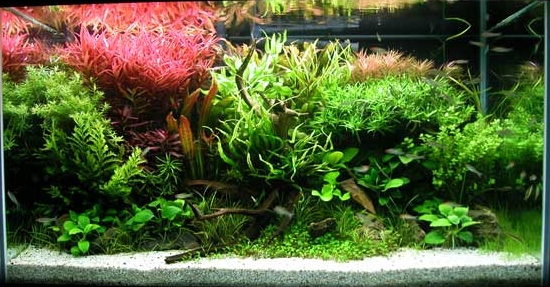
Live plants use nitrate as fertiliser, and a genuinely planted tank is the most reliable long-term nitrate sink I have used. The catch is that it has to be planted properly. A couple of struggling stems will not touch your readings; a tank stuffed with fast growers will. On hard water the workhorses are hornwort, elodea, Vallisneria, Java fern and Anubias, all of which shrug off high pH and hardness. I go into the specifics in the hard-water plant guide.
Fast-growing floating plants are the strongest option of all. Water lettuce, Amazon frogbit and duckweed sit at the surface with their roots in nutrient-rich water and grow at a rate that genuinely drains nitrate. The downside is they block light to plants below and you have to scoop out handfuls every week, but as a nitrate control they work.
One honest warning: dead and dying plant matter rots and adds nitrate, so a planted tank only helps if you keep on top of trimming and removing yellowing leaves. A neglected planted tank can run higher than a bare one.
Media, resins and the gadgets
This is where people spend money hoping to skip the work.
Nitrate-adsorbing resins and pouches do exist, and they do pull nitrate out. They also need replacing or recharging regularly, which gets expensive on anything but a nano tank, and they run out silently. I treat them as a short-term crutch, not a system.
Denitrifying setups that culture anaerobic bacteria to convert nitrate into nitrogen gas are real and used heavily in marine and reef systems. In a normal freshwater tank they are fiddly, slow to establish and rarely worth it when a bucket and a hose do the job.
Nitrate-reducing liquid additives that feed bacteria a carbon source can work but are easy to overdose and can crash your oxygen if you get carried away. I do not use them and would not point a beginner at them.
If your problem is high-nitrate tap water specifically, the honest fix is to cut the tap with a nitrate-free source. That usually means blending in RO water, which strips nitrate along with everything else. I cover whether that is worth the bother in do you need RO water, and the RO mix calculator will work out the blend for you.
What I actually do
On my hard tap sitting near 15 ppm, my routine is boring and it works. Weekly 40 percent water changes with a gravel vacuum, restrained feeding with one fasting day, floating plants in most tanks to mop up the rest, and a filter clean roughly monthly. That holds my nitrate in the low twenties, which for hard-water cichlids, livebearers and shrimp is perfectly fine. I only reach for RO blending on the one tank where I keep something that genuinely wants softer, cleaner water.
I do not chase zero. A tank ticking along steadily at 20 ppm with healthy, growing fish is a success, not a problem to solve.
When high nitrate is not the real problem
If nitrate keeps rocketing between changes despite sensible feeding and stocking, look for a hidden source: a dead fish behind the rocks, a filter that has not been cleaned in months, or a substrate packed solid with mulm. And if fish look ill while nitrate is only moderately high, do not blame the nitrate reflexively. Check ammonia and nitrite first, since those are the acutely dangerous ones, and read why are my fish dying before you start dosing anything.
The numbers here are guides drawn from my own tanks and test kits, not laws. Your water, your kit and your stock will all shift the picture, so test, watch the trend, and let your own readings tell you what your tank needs.