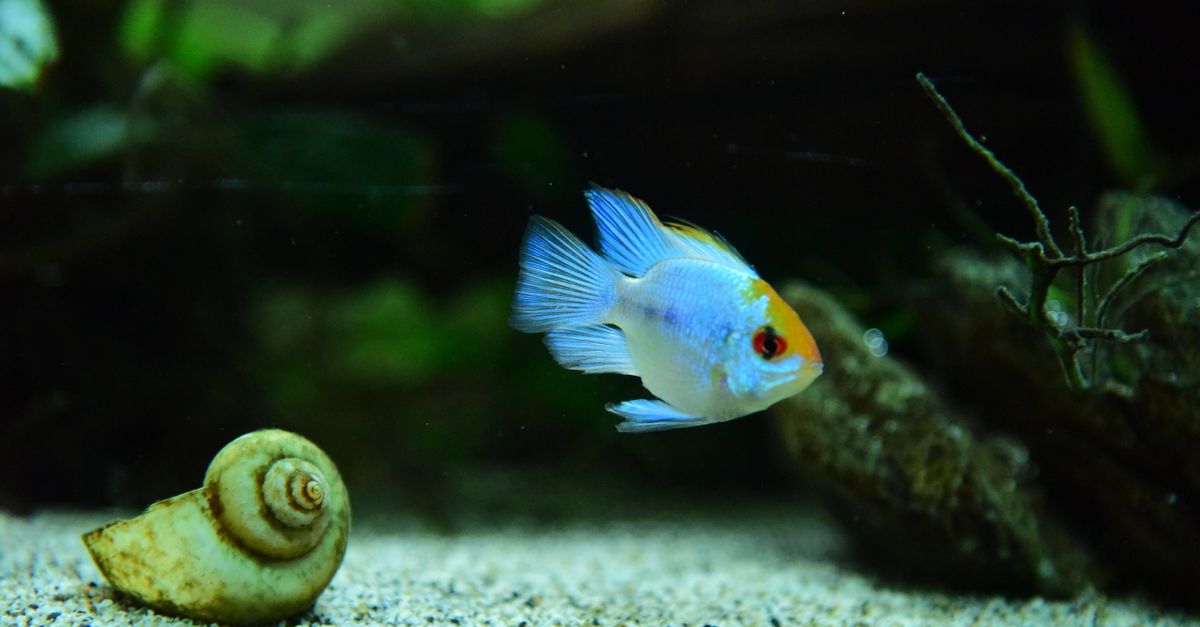
Few things divide fishkeepers like snails. Half the hobby buys them on purpose and the other half is on a forum at midnight asking how to exterminate them. I am firmly in the first camp these days, but I got there the usual way, through the second. Every tank in my fishroom has snails in it, most of them uninvited, and the tanks are better for it. The trick is understanding what a snail population is actually telling you, because a snail boom is a message about your tank, and killing the messenger has never once fixed the message.
Free PDF
Free aquarium water cheat sheet (PDF)
Grab the one-page reference for your tank: target ranges for pH, hardness, ammonia, nitrite and nitrate, plus a plain walkthrough of the nitrogen cycle. No fluff, unsubscribe any time.
Free, unsubscribe any time. The download starts as soon as you sign up.
Where they come from
Pest snails almost always arrive on plants. Bladder snails, pond snails and ramshorns lay small jelly blobs of eggs on leaves and stems, and the eggs are near enough invisible on a bunched plant in a shop tank. Buy plants from any system that houses snails and you will bring eggs home eventually, whatever you do. They also hitch on driftwood, on used equipment, in gravel from another tank, and occasionally in the bag water with new fish.
You can reduce the intake. Tissue-cultured plants, sold in sealed pots on gel, are grown sterile and carry nothing. Dips and bleach treatments for normal plants exist, but they are rough on the plants and they miss eggs often enough that I stopped bothering years ago. My honest position is that trying to keep a planted tank permanently snail free is a fight you re-enter with every purchase, and the prize for winning is a tank that is slightly worse at processing waste.
The part nobody wants to hear: a boom is a symptom
Here is the thing the midnight forum posts never quite land on. Snail populations are set by food supply, almost mathematically. Bladder snails and ramshorns breed continuously when food is abundant and barely at all when it is scarce. A tank with a handful of quiet snails and a tank crawling with hundreds do not differ in the snails. They differ in how much uneaten food, decaying plant matter and mulm the tank is producing.
So a snail explosion is nearly always an overfeeding report, delivered in shells. The snails did not create the excess, they are living on it, and to be fair to them they are converting rotting food into snail rather than into ammonia. If your glass is speckled with baby snails, the productive response is not a bottle of snail killer, it is a hard look at portion sizes, which I have covered in detail in feeding aquarium fish. Cut the input and the population falls back over the following weeks on its own, because snails that cannot find food do not breed and do not last.
The same logic runs through algae problems, and it is no coincidence that heavily fed tanks have both. My algae article makes the same argument from the other direction: the growth is the symptom, the nutrients are the cause.
The book behind Lagonia
The Hard Water Aquarium
My practical guide to working with hard, alkaline tap water instead of fighting it: reading your water, choosing and setting up the tank, and keeping and breeding the fish that thrive in it, from livebearers to Rift Lake cichlids and shell-dwellers.
Ad · Amazon affiliate links. I earn a small commission on a purchase, at no extra cost to you.
What snails actually do for a tank
A modest snail population is quietly useful. They eat uneaten food before it rots, rasp films of algae and biofilm off glass, wood and leaves, eat dead plant matter, and clean up small casualties like a dead shrimp before it can foul the water. Malaysian trumpet snails burrow, turning over the top layer of sand the way worms turn garden soil, which keeps the substrate from compacting and stops pockets of trapped gunk forming. In my hard-water tanks the snails also grow handsome, glossy shells, because shell building takes calcium and my tap water is full of it. Keepers with very soft water often find snails struggle, with pitted and eroded shells, which is one more case of water chemistry choosing your stock for you.
They are not magic. No snail eats fish waste in the sense of removing it; they process food and produce their own waste in turn, so a huge population is itself a bioload. And none of the common ones touch the tougher algae like black beard. They are janitors, not filters.
The ones worth buying on purpose
Nerite snails are the best algae grazers you can buy. They work over glass, rock and wood constantly, they handle the stubborn green spot algae that others ignore, and they cannot reproduce in fresh water because their larvae need brackish conditions. The one honest drawback is that females still lay eggs, hard little white sesame seeds that stick to wood and stone and take some scraping off. You get the grazing without the population, at the price of some decoration.
Malaysian trumpet snails are the substrate crew. Cone shaped, live bearing, active at night, burrowing by day. They keep sand turned and clean. They do breed in fresh water, and plentifully in overfed tanks, so the food-supply rule applies to them as much as to bladder snails.
Ramshorn snails, the coin shaped ones in red, brown or blue, sit somewhere in the middle. Technically a hitchhiker species, but attractive enough that people keep and even sell selected colour lines. Good grazers, easy to manage in a sensibly fed tank.
Mystery snails (apple snails) are the big golf ball ones, more pet than crew, with their own care needs. Fine animals, but buy them as an animal you want, not as a cleaning product.
Controlling numbers without chemicals
If a population has already boomed, the humane and effective sequence is:
- Cut the food. This is the fix. Everything else is a supplement.
- Trap. A slice of blanched courgette or a piece of lettuce weighted to the bottom overnight comes up carrying dozens of snails. Lift, remove, repeat. A jam jar baited the same way also works. A few evenings of trapping takes the visible population down fast.
- Crush a few on the glass when you see them; your fish will eat them happily. Undignified but efficient.
- Vacuum the substrate at water changes to remove the mulm they are living on.
Assassin snails (Anentome helena) are the biological option. They are small, striped, and they eat other snails, working through bladder and trumpet snail populations steadily. They do the job, but think it through: they are slow, they breed slowly themselves, and once the pest snails are gone you own a population of carnivorous snails that then need feeding. I see them as a genuine tool for a tank that keeps re-booming, not a first response.
Snail-eating fish are mostly a trap. Loaches eat snails, but clown loaches grow to 30 cm and need a shoal, and even dwarf chain loaches need a group and bring their own care requirements. Buying a fish you do not otherwise want, to fix a feeding problem you can fix for free, is bad maths. Puffers eat snails too, and then you own a puffer, which is a whole lifestyle.
Why nuking them rarely works
Chemical snail killers, usually copper based, do kill snails. Then the trouble starts. Copper also kills shrimp and is rough on plants and sensitive fish, and it lingers in substrate and silicone. Worse, a mass snail die-off means a tankful of decaying snails all at once, which can throw an ammonia spike at your filter overnight. And because the eggs and a few survivors nearly always come through, while the food supply that drove the boom is untouched, the population is often back within a couple of months. You have taken all the risk and fixed nothing.
The tanks in my room settled into the same pattern once I fed properly: a visible but modest snail crew, working away, numbers flat year on year. That is what a healthy tank looks like. If yours looks different, the snails are not your problem. They are your audit.