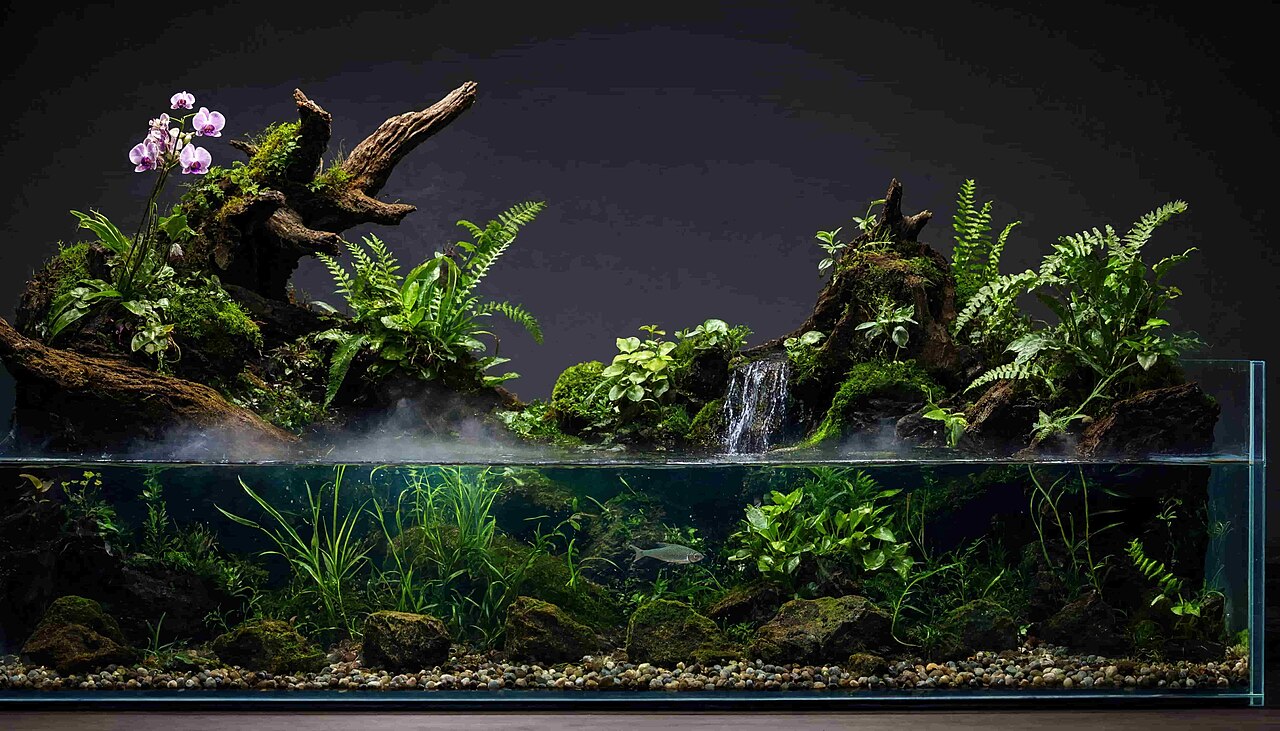
Driftwood will not rescue you from hard, alkaline water. I wish someone had told me that before I spent a weekend boiling a big piece of mopani and watching the pH in my test tube refuse to budge. The short version: driftwood releases tannins, tannins are mildly acidic, and in soft water with little buffering they can pull the pH down a touch. In water like my tap, which runs around 22 to 23 °dGH with a carbonate hardness to match, the buffering swamps the acid long before it reaches the fish. You get the tea-coloured tint and almost none of the pH drop. If that is the whole reason you are buying wood, save your money.
That does not make driftwood useless. It does plenty of good things in a hard-water tank. It just does not do the one thing it is most often sold to do. Here is the full picture, and how I use it now.
Free PDF
Free aquarium water cheat sheet (PDF)
Grab the one-page reference for your tank: target ranges for pH, hardness, ammonia, nitrite and nitrate, plus a plain walkthrough of the nitrogen cycle. No fluff, unsubscribe any time.
Free, unsubscribe any time. The download starts as soon as you sign up.
What tannins actually are
When wood sits in water, it leaches tannins and humic substances, the same group of organic acids that stain a peat bog brown or give black tea its colour. These are weak acids. In a tank with little to resist them, they lower pH gradually and can nudge the water towards the soft, acidic, tea-stained conditions that blackwater fish like wild bettas, Apistogramma and many tetras evolved in.
The staining and the acidifying are two separate effects, and this trips a lot of people up. The brown tint is cosmetic and happens in any water. The pH drop only happens if the water lets it. Those are not the same thing, and seeing the colour change does not mean your pH has moved at all.
Why carbonate hardness wins
The deciding factor is KH, your carbonate hardness, which is the water’s ability to neutralise acid and hold pH steady. I go through the full relationship in GH and KH explained, but the one-line version is that KH is a buffer, and a buffer exists precisely to absorb acids like tannins without letting the pH move.
My tap has a high KH. So do most hard-water supplies, because the calcium and magnesium that make water hard usually arrive alongside carbonates and bicarbonates that make it well buffered. When I drop a tannin-leaching piece of wood into that, the bicarbonate mops up the acid and the pH holds. To actually overwhelm a high KH with wood, you would need an absurd amount of it relative to the water volume, and you would be fighting your buffer every single water change as fresh, fully buffered tap goes back in. It is a losing battle, which is the same reason I tell people to stop chasing pH-down bottles on hard water in why is my aquarium pH high.
On soft water the story flips. Low KH means little to resist the tannins, so a decent amount of wood genuinely can bring the pH down and keep a blackwater tank acidic. If that is your water, driftwood is a real tool. If your water is like mine, it is mostly a decoration that happens to stain.
The book behind Lagonia
The Hard Water Aquarium
My practical guide to working with hard, alkaline tap water instead of fighting it: reading your water, choosing and setting up the tank, and keeping and breeding the fish that thrive in it, from livebearers to Rift Lake cichlids and shell-dwellers.
Ad · Amazon affiliate links. I earn a small commission on a purchase, at no extra cost to you.
What I actually saw in my tanks
I have kept a large spider-wood piece in a hard-water tank for years. The water carries a faint amber cast, which I rather like, and the tannins settle down as the wood ages. My pH sits where my tap and my rockwork put it, a shade above 7.5, and the wood has never moved it in a way my test kit can pick up. Early on I checked obsessively, hoping. It simply did not happen.
The one time wood did anything measurable was a brand-new, oversized chunk of mopani in a small, lightly stocked tank. Even then the drop was tiny and temporary, and it crept back up within a couple of water changes as buffered tap went back in. In a hard-water tank, that is the ceiling. Do not plan your stocking around it.
The things driftwood does do well
So why do I still use it everywhere? Because the pH myth is only one small part of what wood is for.
- It looks right. A good piece of wood is the backbone of most natural layouts. I cover how to position it in aquascaping with rock and wood.
- It gives cover and territory. Shy fish, plecos and shrimp all use the shade and the nooks. My bristlenose pleco rasps on wood daily and genuinely seems to want it.
- It grows the best plants for hard water. Anubias, Java fern and Bucephalandra all attach straight to wood and do not care about the hardness. That pairing is the heart of a low-effort hard-water scape, and I list more options in hard water aquarium plants.
- The tannins themselves are mildly useful. Humic substances have a gentle antibacterial, antifungal quality. I would not call it medicine, but a tank with some tannin in it tends to be a calm one.
None of that depends on the pH moving. You get all of it on hard water.
Preparing wood, and the brown water question
New wood needs a little work before it earns its place.
Most pieces float at first. I either soak them for a week or two in a bucket, changing the water, or boil smaller pieces for half an hour to waterlog them and knock back the first big flush of tannins. Dense woods like mopani and ironwood sink faster; light ones like spider wood and cholla can take weeks, so I weigh them down or wedge them under rock until they stay put.
You may also see a white, slimy fungal film bloom on fresh wood in the first fortnight. It looks alarming and it is completely harmless, a biofilm feeding on sugars in the wood. Nerite snails and shrimp graze it off, and it clears on its own as the wood ages. It is not the same as a bacterial cloudy water bloom, which comes from the water column rather than the wood surface.
If the brown tint bothers you, it is easy to manage. Water changes dilute it, and activated carbon or a chemical resin pad in the filter pulls it out fast. I usually just let it fade over a few months. The staining has no downside for the fish I keep, and soft-water keepers often pay good money in botanicals to get the look I am trying to tone down.
So should you add it?
Add driftwood because you want the look, the plants, the cover and the calmer water it brings. On hard water, all of that is on the table and it is worth having.
Do not add it expecting to soften or acidify your tank. The maths is against you, and the honest move on hard water is to stop fighting the chemistry and keep fish that suit it. If you genuinely need soft, acidic water for a particular blackwater species, wood is a supporting act at best; the real answer is cutting your source water with RO, which I walk through in do you need RO water and you can plan with the RO mix calculator. Before you do any of that, test your KH so you know what you are up against. On most hard-water supplies, the kindest thing you can do is work with the water you have rather than chase a pH that a piece of wood was never going to deliver.