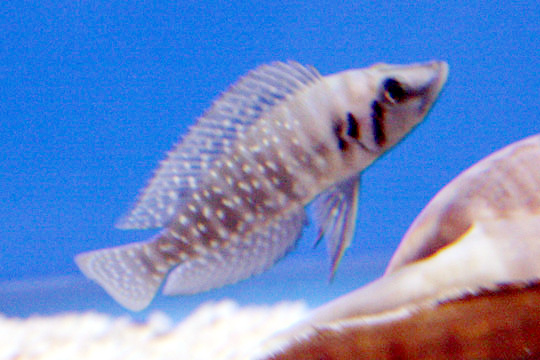
Every few weeks someone tells me their tap water reads pH 8, they have panicked, and they are halfway through emptying a bottle of pH-down into the tank. So let me say the useful thing first: a high pH, on its own, is almost never the problem people think it is. A stable pH of 8 will keep a great many fish in fine health for years. What actually harms fish is a pH that lurches up and down, and chasing a high reading lower is one of the surest ways to cause exactly that lurch. I keep tanks on tap water that runs about 22 dGH and sits firmly on the alkaline side, and I stopped fighting it a long time ago.
Free PDF
Free aquarium water cheat sheet (PDF)
Grab the one-page reference for your tank: target ranges for pH, hardness, ammonia, nitrite and nitrate, plus a plain walkthrough of the nitrogen cycle. No fluff, unsubscribe any time.
Free, unsubscribe any time. The download starts as soon as you sign up.
What a high pH actually means
pH measures how acidic or alkaline the water is. Above 7 is alkaline, and hard tap water tends to sit there because it is loaded with dissolved carbonates and calcium. Those same minerals are what make the water “hard” in the first place, and they do something valuable: they buffer the pH, resisting change and holding it steady. That buffering is measured as carbonate hardness, or KH, and if you want the underlying chemistry I have laid it out in GH and KH explained.
Here is the part that gets lost. A high pH and a high KH usually travel together, and the KH is the thing keeping your pH rock steady. Steady is good. A tank at a constant 8.2 is a far kinder place to live than a tank that someone keeps yanking down to 7 and letting drift back up. Fish tolerate a pH that sits a little outside their ideal far better than they tolerate a moving target.
Why you cannot easily lower it, and why that is a mercy
People reach for a chemical pH-reducer and are baffled when nothing happens. The reason is the buffering above. In hard water, all those carbonates soak up the acid you add and neutralise it, so the pH barely moves. You add more, still nothing, and then the buffer finally exhausts and the pH crashes all at once. That crash is genuinely dangerous. A sudden pH swing stresses fish badly and can kill them faster than the high reading ever would.
So the difficulty of lowering hard-water pH is really a safety feature in disguise. The water is protecting itself from you. Peat, driftwood and almond leaves will tint the water and nudge the pH a fraction, but against water as hard as mine they are cosmetic. The only reliable way to genuinely soften and lower hard tap is to cut it with reverse osmosis water and rebuild it, which I will come back to, and which I weigh up properly in do you need RO water?.
The book behind Lagonia
The Hard Water Aquarium
My practical guide to working with hard, alkaline tap water instead of fighting it: reading your water, choosing and setting up the tank, and keeping and breeding the fish that thrive in it, from livebearers to Rift Lake cichlids and shell-dwellers.
Ad · Amazon affiliate links. I earn a small commission on a purchase, at no extra cost to you.
The one risk worth respecting
I am not going to pretend high pH is entirely free of consequence, because there is a real interaction worth understanding. Ammonia is more toxic at high pH than at low pH. At an acidic pH, most ammonia in the water sits in a relatively harmless ionised form; as the pH climbs, more of it shifts to the toxic free form. So in an alkaline tank, an ammonia spike bites harder and faster than the same spike would in soft, acidic water.
The lesson from that is not “lower your pH”. It is “never let ammonia be present in the first place”. In practice that means the same disciplines I would preach for any tank, just followed properly:
- Cycle the tank fully before stocking, so your filter converts ammonia the moment it appears. My nitrogen cycle guide covers how.
- Do not overstock or overfeed.
- Keep up with water changes so nothing accumulates; the water change calculator helps size them.
Get the biology right and the higher toxicity of ammonia at high pH becomes a non-issue, because there is no ammonia for it to act on. This is the single genuine reason to care about a high reading, and it is solved by good husbandry rather than by chemistry.
Work with the water, do not fake it
The mistake that costs people money and fish is buying the wrong stock and then trying to bend the water to fit. It is backwards. Choose fish that want the water you already have, and the whole hobby gets easier. On hard, alkaline tap you are spoilt for genuinely thriving options rather than merely surviving ones.
Fish that love hard alkaline water:
- Livebearers: guppies, platies, mollies and swordtails all evolved in hard, mineral-rich water and colour up beautifully in it.
- Rift Lake cichlids: the shell-dwellers and Tanganyikans I keep, plus the Malawi mbuna, treat pH 8 as home rather than a hardship.
- Many barbs, danios, rainbowfish and most livebearing oddballs.
I have gathered the strongest choices in my roundup of hard water fish, and if you want to see whether your stocking list balances, run it through the stocking calculator.
Fish that genuinely struggle, and I would rather be honest than sell you a dream: many of the classic blackwater species are adapted to soft, acidic water and never look their best on liquid rock. Wild-caught discus, chocolate gouramis, many of the small tetras and rasboras in their wild form, and several of the dwarf cichlids will hang on but tend to show muted colour, poorer breeding and shorter lives. Some tank-bred lines cope better than their wild ancestors, but the honest position is that hard alkaline water is the wrong home for them. Plants divide the same way, which I cover in hard water aquarium plants.
When you truly do need lower pH
Sometimes there is a real reason. You want to breed a soft-water species, or keep something delicate that will not colour up otherwise. In that case do it properly: start with reverse osmosis water, which is stripped of minerals, and add back a measured amount of hardness to hit your target rather than dosing acid into hard tap and praying. That gives you soft, low-pH water that is actually stable, because you built it on purpose. The RO mix calculator and the remineralise calculator exist for exactly this. It is more work and more cost, and I would only take it on for a species that genuinely warrants it. For a general community, matching stock to tap is the saner path, as I argue in choosing fish for a community tank.
What I actually do
I test my pH now and then to know where it sits, not to control it. It reads a little over 8 in most of my tanks and I leave it exactly there. I have never added a pH adjuster to a display tank, and I never will, because the risk of a swing outweighs any benefit. When I set up a Tanganyikan tank I use an aragonite substrate that helps hold the pH up rather than down, which for hard-water fish is a feature. My water changes go in at tap temperature and tap chemistry, so nothing ever shifts suddenly.
The whole thing comes down to a change of mindset. Stop reading a high pH as a fault to correct and start reading it as a property of your water that decides which fish will flourish. Pick to suit it, keep the tank clean so ammonia never gets a foothold, and a pH of 8 is not a problem to solve. It is simply the water you have, and there is a wonderful range of fish that would call it perfect.
Water chemistry and livestock advice here reflects what has worked in my tanks on very hard tap water; your water, your fish and your test kit may differ, so treat the readings and numbers as starting points rather than rules.