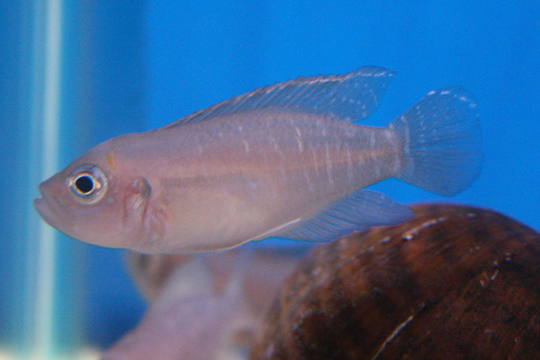
If you have read anything on this site about shell-dwellers, you will have met my multies, a sandy footprint full of little cichlids all shouting at each other over their snail shells. Neolamprologus brevis is the other way to do this. It is still a tiny Tanganyikan that lives in a shell, but it is not a colony fish. A bonded pair takes one patch of sand, settles on a shell, and that is the family. If you want the shell-dweller experience but you have a smaller tank or you simply prefer watching two fish you actually recognise, brevis is the one I point people at.
My tap runs about 22 to 23 dGH, calcium heavy, pH around 7.2 out of the pipe and climbing in a tank with shells and sand in it. That is close to ideal for this fish. Brevis is one of those species where my rock-hard water stops being a problem and starts being the whole point.
Free PDF
Free aquarium water cheat sheet (PDF)
Grab the one-page reference for your tank: target ranges for pH, hardness, ammonia, nitrite and nitrate, plus a plain walkthrough of the nitrogen cycle. No fluff, unsubscribe any time.
Free, unsubscribe any time. The download starts as soon as you sign up.
What a brevis actually is
Neolamprologus brevis comes from Lake Tanganyika, where it lives over sandy bottoms in areas where empty snail shells collect. It tends to sit in slightly deeper, more open sand than some of its cousins, in places with fewer shells scattered about, which is a clue to how it behaves in a tank: it is not fighting a crowd for real estate, it is holding one good shell.
It is a small fish. Males reach about 6 cm, females noticeably smaller at around 4 cm, and that size difference is usually the easiest way to sex a settled pair. The body is stockier than a similis or a multi, with a blunter, almost bulldog face and a scattering of pale spangles along the flanks that catch the light when the fish is in good condition. They are not a flashy fish from across the room. They are a fish you lean in to watch.
The behaviour is the selling point. In the wild, and in the tank, a male and female brevis will often share a single shell, the two of them living in and defending the same home. That is genuinely unusual among shell-dwellers; most of them are one fish, one shell, and they squabble constantly about it. Watching a pair reverse into the same shell tail-first at night still makes me smile after years of keeping them.
Do they suit hard water? Yes, completely
This is a Rift Lake cichlid, so hard and alkaline is exactly right. The numbers I keep them at, and the numbers the species is comfortable across, look like this:
- Temperature: 24 to 26 °C. The wider tolerated range is roughly 23 to 27 °C, but I sit mine in the middle and leave it there.
- pH: 7.5 to 9.0 is the comfortable band. Mine live around 8.0 to 8.3.
- Hardness: happy anywhere from about 8 dGH up to 25 dGH. My 22 to 23 dGH tap lands squarely in that.
If your water is soft, brevis is not off the table, but you would be building hardness up with a mineral salt at every water change, which is an ongoing cost and a bit of a faff. My remineralise calculator will get you to a Tanganyikan target if that is your situation. If your tap is hard like mine, you do not need to touch the chemistry. The one thing worth knowing is that pH straight from my tap sits a little low for a Rift tank at 7.2; a bed of aragonite sand and a pile of shells nudge it up and, more importantly, hold it there, because carbonate hardness is what stops the pH swinging. My GH and KH explainer goes through why that buffering matters more than the headline pH number.
The book behind Lagonia
The Hard Water Aquarium
My practical guide to working with hard, alkaline tap water instead of fighting it: reading your water, choosing and setting up the tank, and keeping and breeding the fish that thrive in it, from livebearers to Rift Lake cichlids and shell-dwellers.
Ad · Amazon affiliate links. I earn a small commission on a purchase, at no extra cost to you.
Tank size and the footprint that counts
Brevis are shell-dwellers, so floor space beats height. A single pair will live in a tank of about 45 x 30 cm, roughly 40 litres, and be perfectly content. I would treat that as the sensible minimum for a pair and nothing else.
That said, brevis are a touch larger and a good deal pushier than multies or similis, so if you want them alongside anything, give them more room than you think. In a tank around 75 litres or more you have space for a pair plus some upper-level fish that stay out of the sand. Do not try to run a big colony of brevis the way you would run multies. They do not work like that. Buy a group of young fish, let a pair form, and be ready to move the others on once the pairing turns the rest of the tank into a war zone.
Work out your real volume before you stock anything, because a nominal tank size and the actual water in it are rarely the same once you allow for sand and glass. My volume calculator does that in a few seconds, and the stocking calculator will keep you honest about how much you are asking the filter to handle.
Sand and shells: get these right and the rest is easy
Two things make or break a shell-dweller tank, and brevis is no exception.
The first is sand, real sand, and enough of it. These fish dig. They excavate around their shell, they bury the entrance, they rearrange the neighbourhood to their liking, and they need a soft, fine substrate to do it without hurting themselves. I run at least 4 to 5 cm of fine sand so a fish can properly dig a pit and part-bury a shell. Gravel is no good here; it is too coarse to move and too sharp to work in.
The second is shells. Escargot shells are the classic choice and the easiest to buy, well cleaned, cheap, and the right size for the fish. Even though a brevis pair will often share one shell, do not put out a single shell and call it done. Give the tank more shells than fish. Spare shells let a fish retreat, give a female somewhere to go if a male turns pushy, and let the pair choose rather than be forced. I go through which shells work, how to prepare them and how many to put down in my guide to the best shells for shell-dwellers.
Feeding
Brevis are little predators. In the lake they pick tiny invertebrates and zooplankton out of the water and the sand, so their food should lean that way. Mine get frozen cyclops, baby brine shrimp, daphnia and finely chopped bloodworm, with a good quality small cichlid pellet or granule as the everyday staple. Tank-bred fish take dry food readily; wild or freshly imported ones may sulk at first and need live or frozen to get going.
Feed small amounts. These are tiny fish with tiny stomachs, and leftover food fouling the sand does more harm in a small shell-dweller tank than a missed meal ever would. My general thinking on portions and frequency is in the feeding guide, and it applies here.
Breeding, which mostly just happens
Give a healthy pair the right water, sand and shells and brevis will breed on their own without any fuss from you. The female lays inside the shell, the eggs hatch in about a day, and the fry are free-swimming roughly a week later. You will not see much of the early action; you will just notice, one day, a scattering of pinhead fry hanging around the shell entrance while both parents patrol like they have something to prove. And they do, because now there is a brood to guard.
Because brevis pair off rather than colonise, they will not fill a tank with fry the way a multies colony quietly does. You get a modest batch, well guarded, and if there is nothing large enough to eat them, some will grow up in the tank alongside the parents. First feed is baby brine shrimp and finely crushed dry food. It is one of the easiest cichlid breedings I know of on hard water, which is a large part of the appeal.
Tankmates and temperament
Here is the honest bit. Brevis are small, but they are not gentle, and they are more of a handful than multies. A settled pair will defend their shell and the sand around it against anything that comes down to their level, including fish several times their size. The trick is to keep the company off the floor.
What works is anything that lives in the water column above them and leaves the sand alone. In a Tanganyikan tank that means open-water schoolers up top and, if the tank is big enough, peaceful rock-dwellers that keep to their own patch. What does not work is another bottom-dwelling digger competing for the same real estate, or a nippy fish that will not leave the pair alone. I would not mix brevis with other shell-dwelling species in anything but a large tank; the shell competition gets ugly fast. My write-up on what can actually live with shell-dwellers goes into the specifics, and most of it applies to brevis with the added note that brevis push back harder.
Quarantine anything new before it goes near an established pair, especially wild-caught Tanganyikans, which can carry the parasites behind bloat. A quarantine period is cheap insurance, and gentle acclimatisation matters when you are moving a fish from a shop’s water into hard, alkaline conditions.
Is a brevis the shell-dweller for you?
If you have hard, alkaline tap water and you want a pair of characterful little cichlids that recognise each other, share a home and raise fry in front of you, brevis is a lovely choice and one of the easiest breeders on water like mine. If you specifically want a busy, shouting colony filling a footprint, keep multies instead; brevis will not give you that. Match the fish to the tank you actually have, give them deep sand and plenty of shells, and this is about as low-stress as fishkeeping gets on rock-hard water.