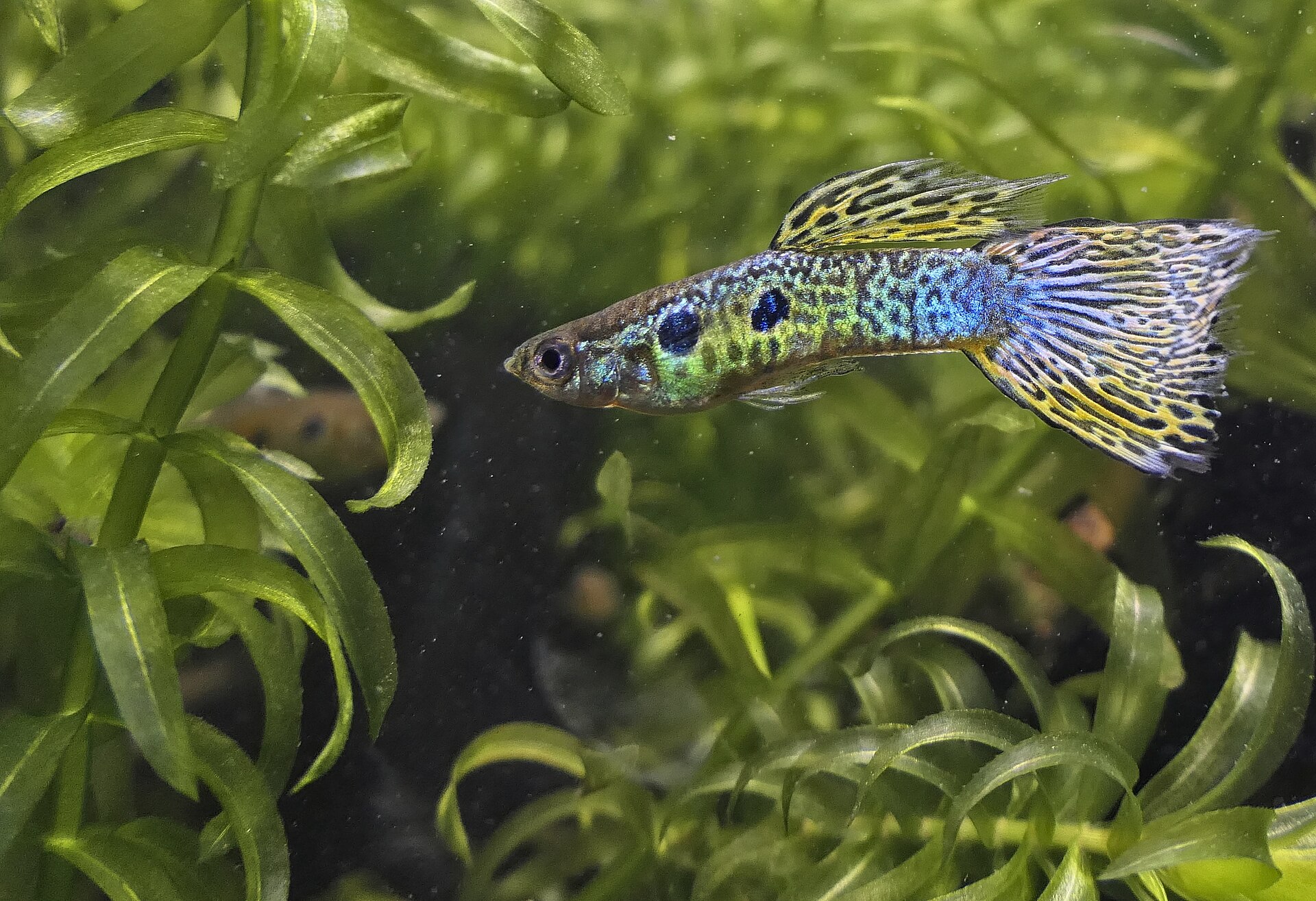
Guppies are hardy in the ways that matter for a beginner, and fragile in a couple of ways nobody warns you about. That is the honest short version. They will forgive a wobbly first month, a slightly late water change and a filter that is not quite up to spec, which is exactly why they earned the reputation. What they will not forgive is soft, mineral-poor water and a tank of sick shop stock, and modern fancy strains are noticeably less bulletproof than the guppies of twenty years ago. I keep livebearers on very hard tap water, and I have watched cheap guppies shrug off things that flattened fussier fish, and I have also watched a batch of pretty fancy ones melt away for no obvious reason. Both things are true. Here is how to tell which guppy you are actually buying.
Free PDF
Free aquarium water cheat sheet (PDF)
Grab the one-page reference for your tank: target ranges for pH, hardness, ammonia, nitrite and nitrate, plus a plain walkthrough of the nitrogen cycle. No fluff, unsubscribe any time.
Free, unsubscribe any time. The download starts as soon as you sign up.
Where the “hardy” reputation comes from
The reputation is not a myth. Guppies breed like weeds, tolerate a wide temperature band, eat almost anything, and cope with a range of water that would stress a lot of tropical fish. A healthy guppy from good stock is genuinely forgiving of a beginner’s mistakes, and that is worth a great deal when you are learning. If your first tank is cycled properly and your water suits them, a small group of guppies is one of the most rewarding starts you can pick.
Two things underpin that toughness. The first is that guppies come from the streams and ditches of northern South America and the Caribbean, water that is often hard and alkaline, and they are built for it. The second is that they are livebearers, so you skip the fragile egg-and-fry stage that catches people out with egg-layers; a female simply drops a batch of fully formed, swimming babies, and some of them survive almost regardless of what you do. That relentless breeding hides a lot of losses and makes the population feel indestructible even when individual fish are not.
Why modern fancy guppies are softer than their reputation
Here is the part the reputation has not caught up with. The plain-coloured feeder guppy and the wild-type guppy are still tough little fish. The elaborate fancy strains, the ones with the big flowing tails and the intense colours, are a different animal in practice. Decades of selective breeding for looks rather than resilience have left many fancy lines genuinely more delicate, and it shows up as weaker fry, higher rates of bent spines, more disease, and less tolerance for anything less than ideal water. The trade in these fish is global and fast, so a batch can pass through several countries and a lot of stress before it reaches your shop tank, sometimes carrying a low-grade infection the whole way.
None of that is a reason to avoid guppies. It is a reason to buy them with your eyes open. When a keeper tells me their guppies “just kept dying”, the cause is very rarely their tank and very often the stock: inbred, immune-worn fish that were half-finished before they were sold. Practical Fishkeeping’s own guppy care guide makes the same point, and hobbyists have argued it out at length on threads like this Fishlore discussion. The fish are as hardy as they ever were in principle; the supply chain and the breeding are what changed.
The book behind Lagonia
The Hard Water Aquarium
My practical guide to working with hard, alkaline tap water instead of fighting it: reading your water, choosing and setting up the tank, and keeping and breeding the fish that thrive in it, from livebearers to Rift Lake cichlids and shell-dwellers.
Ad · Amazon affiliate links. I earn a small commission on a purchase, at no extra cost to you.
The one thing that quietly decides it: your water
This is where I get to lean on my own tanks. My tap runs at roughly 22 to 23 °dH, hard and alkaline, straight from the pipe, and for guppies that is close to a gift. Livebearers want mineral-rich water with a stable pH above 7, and mine gives them that with no effort from me: no remineralising, no buffering, no chasing numbers. The usual “ideal” band quoted for guppies is around 8 to 12 °dH, and my water sits well above that, yet my livebearers colour up, breed and live out full lives in it. Very hard water is one of the few situations where guppies are genuinely easy rather than merely reputed to be.
The mirror image is the trap that catches a lot of people. Those same delicate fancy strains that struggle in imperfect conditions struggle worst in soft, mineral-poor water. A fish bred for hard water, dropped into soft water with no calcium or carbonate buffer, loses the very thing that keeps it steady: a stable pH and the minerals its body runs on. That is when you see the “dropping like flies” stories. If your water is soft, guppies are not the free ride they are sold as, and you will be adding minerals at every water change to keep them right.
If you are not sure what you have, find out before you buy anything. A cheap GH and KH test tells you in five minutes whether guppies are an easy fish for you or a maintenance job, and my guide to fish for hard water puts guppies in context alongside the other livebearers and Rift Lake species that actively want water like mine. Soft-water keepers can still keep guppies well; they just need to remineralise deliberately, and the remineralise calculator takes the guesswork out of hitting a sensible GH.
Buying stock that is actually hardy
Since the stock matters more than almost anything else, this is where to spend your attention. A few habits have saved me a lot of dead fish over the years.
- Watch the shop tank before you point at a fish. Give it a minute. Clamped fins, fish hanging at the surface, cotton-wool patches or one dead body in the tank, and I walk away from the whole tank, not just the obvious casualties.
- Favour plainer, less extreme fish. A simpler tail and a hardier constitution tend to travel together. The most spectacular fancy in the shop is often the most inbred and the least likely to thrive.
- Buy locally bred where you can. A guppy from a nearby hobbyist or a small local breeder has skipped the brutal international supply chain and is usually already living in water like yours. It is the single best upgrade you can make to your odds.
- Quarantine, without exception. Even good-looking stock can carry something. Three or four weeks in a simple bare tank before they meet your other fish has stopped more than one outbreak in my fishroom. My quarantine guide covers the setup.
- Buy a small group, not a pair. Losing one fish from a group of six is a setback; losing one of a pair is half your stock. Groups also settle faster and the females get a break from constant male attention.
So, are they a good beginner fish or not?
For most people, yes, with two honest caveats. If your water is hard, guppies are close to the easy, cheerful, self-breeding fish everyone promises, and I would happily recommend them to anyone starting out. If your water is soft, they are keepable but they are work, and you should know that going in rather than discover it through a run of unexplained deaths. And whatever your water, the fish you buy matters more than the reputation of the species: healthy stock from a good source is hardy, tired fancy stock from a bad one is not, and no amount of careful keeping fully rescues the latter.
Get those two things right, the water and the stock, and the old reputation holds up fine. For the full setup, feeding and breeding picture once you have chosen well, my guppy care guide walks through it, and if the surprise batches of fry start arriving, breeding livebearers explains what to do with them. Before you add the fish at all, the stocking calculator will keep you honest about how many that breeding population can really support, because with guppies the numbers only ever go one way.