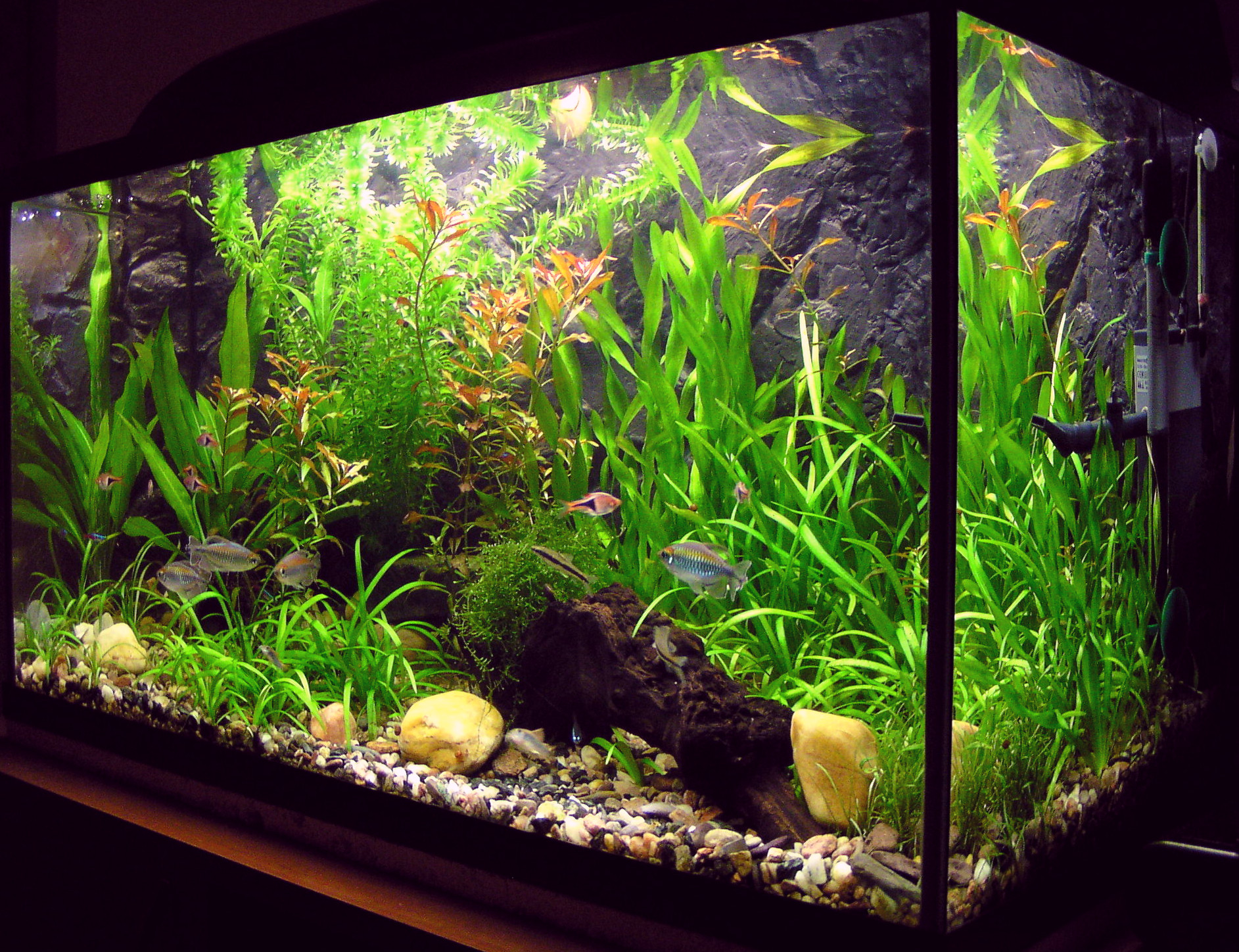
The honest answer to how long your aquarium light should be on is shorter than most people expect: six to eight hours a day for the great majority of tanks, set on a timer, and left alone. Longer does not make fish healthier or colours richer. What it mostly makes is algae. I learned that the hard way in my first year, running a light for ten hours because it looked nice in the evenings, then wondering why the glass went green every week.
Once I understood what the light is actually for, and who in the tank actually needs it, the whole thing got simpler and my tanks got cleaner. Here is how I think about it now.
Free PDF
Free aquarium water cheat sheet (PDF)
Grab the one-page reference for your tank: target ranges for pH, hardness, ammonia, nitrite and nitrate, plus a plain walkthrough of the nitrogen cycle. No fluff, unsubscribe any time.
Free, unsubscribe any time. The download starts as soon as you sign up.
Fish barely need light at all
This surprises people, but light in a fish-only tank is mainly for you, so you can see your fish, and for giving them a steady day-and-night rhythm. Fish do not photosynthesise. They do not get healthier from more hours under the lamp. What they do need is a predictable cycle and a proper stretch of darkness to rest in.
Leaving the light on late into the night, or worse overnight, does the opposite of a favour. Fish rest in the dark, and a tank that never goes properly dark is a stressed tank. If you keep the light on for company in the evening, that is fine, but give the fish eight to ten hours of genuine darkness at some point in every day.
So for a tank with fish and hardscape but few or no live plants, my rule of thumb is six to eight hours, timed to when you are actually home to enjoy it. On my Tanganyikan rockscapes, which are mostly stone and sand with a few tough plants, I run about seven hours in the evening and that is all they get.
Planted tanks: enough, but not more
Plants are the ones that genuinely need the light, and here duration is only half the story. What a plant gets is intensity multiplied by time. You cannot rescue a weak, dim light by running it for twelve hours; you will grow algae long before you grow better plants, because algae is quicker to exploit light than any plant is.
For a low-tech planted tank without added carbon dioxide, which covers most home setups, six to eight hours is the sweet spot. A new tank should start lower, around five or six hours, and creep up over the first six to eight weeks as the plants root and start to grow. Flood a freshly planted, biologically immature tank with long, bright light and you are almost inviting an algae bloom while the plants are still too weak to compete.
High-tech tanks with strong lighting and injected carbon dioxide can push to eight or even ten hours, because the plants have the light, the carbon and usually the fertiliser to use every minute of it. But that is a deliberate, balanced system, not a default. If you are not dosing carbon dioxide, you do not need those hours.
The good news for anyone on hard water is that the plants which cope best with our conditions are also the ones happy on a modest photoperiod. Anubias, Java fern, most crypts and Vallisneria are low-light, slow-and-steady plants that do fine on six or seven hours. I go through the hard-water-friendly list in hard water aquarium plants, and there is a broader starter set in beginner aquarium plants.
The book behind Lagonia
The Hard Water Aquarium
My practical guide to working with hard, alkaline tap water instead of fighting it: reading your water, choosing and setting up the tank, and keeping and breeding the fish that thrive in it, from livebearers to Rift Lake cichlids and shell-dwellers.
Ad · Amazon affiliate links. I earn a small commission on a purchase, at no extra cost to you.
Long light is an algae lever, so use it
If there is one setting I would tell a struggling beginner to change first, it is the photoperiod. Algae thrives on long hours, inconsistent timing and spare nutrients. Cutting the light back is the cheapest, fastest lever you have, and it costs nothing.
When one of my tanks starts to green up, the first thing I do is drop the light to six hours and hold it there for a couple of weeks while I sort out the other causes, usually overfeeding or a skipped water change. It is far more effective than any bottle of algae remover. My full approach to the various types is in aquarium algae, and the specific misery of a green-water bloom, which is often a light-and-nutrient problem, is covered in why is my aquarium water green.
A word on sunlight while we are here: keep the tank out of direct sun. A few hours of sunlight through a window will heat the water, swing the temperature and feed algae far more aggressively than any lamp. Consistent artificial light you control beats free sunlight you do not.
Put it on a timer
The single best thing I ever did for my tanks was to stop switching the light on and off by hand. Fish and plants both prefer a steady, predictable cycle, and I am not reliable enough to give them one. A cheap plug-in timer costs very little and takes the decision away from me entirely. Set it once, and dawn and dusk happen at the same time every day whether I am home or not.
There is a nice side benefit: a timer stops the accidental long days that creep in when you forget to switch off before bed. It also caps your running costs, since the light is only ever drawing power for the hours you actually set. If you want to see what your lighting and heating add up to on the electricity bill, I built a running cost calculator for exactly that.
The siesta method, honestly
You will read about the “siesta” schedule, where you split the photoperiod into two blocks with a dark gap in the middle, say four hours on, a three or four hour break, then four hours on again. The idea is that the midday dark lets carbon dioxide levels recover and denies algae the long continuous run of light it likes.
My honest take, having tried it, is that it can help in a tank that is fighting algae, and it does no harm, but it is not essential and the results are mixed. If your tank is healthy on a straight seven-hour block, leave it. If you are battling algae and have already trimmed feeding and stepped up water changes, a siesta is worth a fortnight’s experiment. It fits neatly on the same timer, just with two on-periods programmed.
A simple schedule to start from
Treat these as starting points, not rules. Every tank and every light is different, so watch your own plants and glass and adjust.
- Fish-only or mostly-hardscape tank: 6 to 8 hours, timed to your evenings.
- Low-tech planted, no added carbon dioxide: start at 5 to 6 hours on a new tank, build to 7 to 8 as it matures.
- High-tech planted with carbon dioxide: 8 to 10 hours, but only as part of a balanced, fertilised system.
- Any tank with an algae problem: drop to 6 hours, hold two weeks, fix feeding and water changes, then reassess.
None of this needs to be complicated. Pick a number in the six-to-eight range, put it on a timer, give your fish a proper night, and adjust down if the glass greens up. Getting the light right is one of the quiet fundamentals that sits alongside a sensible maintenance schedule: dull to set up, and the difference between a tank that fights you and one that mostly looks after itself.