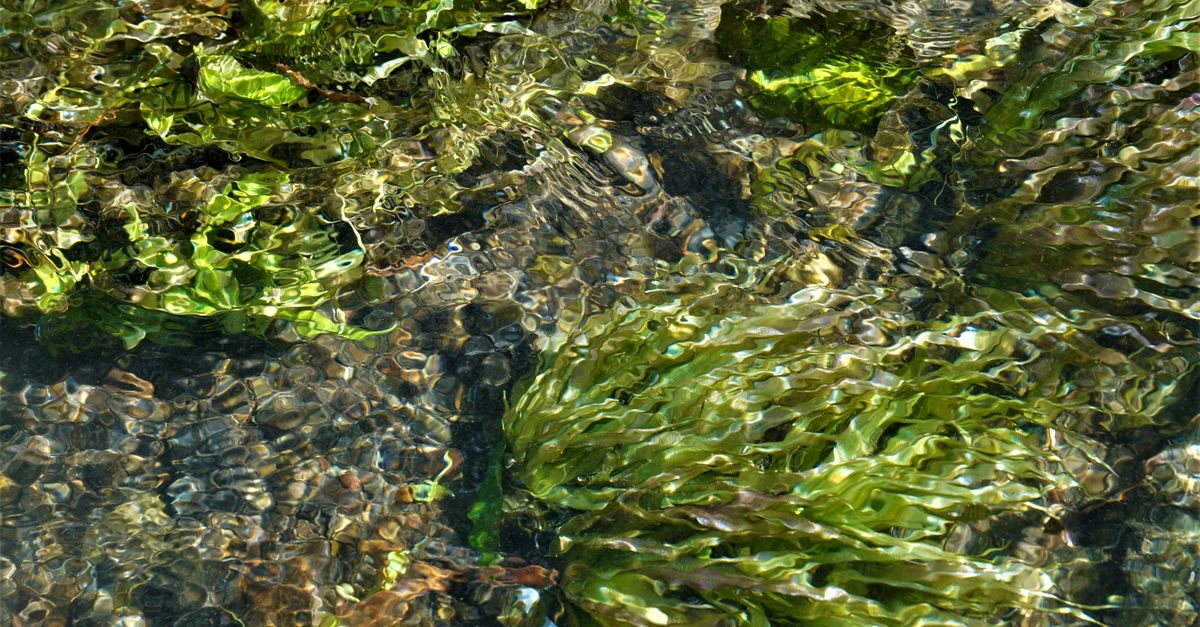
Every tank I have ever run has grown algae. The lovingly scaped planted tank, the bare quarantine tub, the shrimp bowl on my desk, all of them. So before anything else, let go of the idea that algae means you have failed. It does not. Algae is what happens when light and nutrients are available and nothing else is using them fast enough. The trick is not eradication, because eradication is impossible. The trick is identification. Each common type of algae points to a specific imbalance, and once you can read the signs, you can fix the cause rather than endlessly scrubbing at the symptom.
Free PDF
Free aquarium water cheat sheet (PDF)
Grab the one-page reference for your tank: target ranges for pH, hardness, ammonia, nitrite and nitrate, plus a plain walkthrough of the nitrogen cycle. No fluff, unsubscribe any time.
Free, unsubscribe any time. The download starts as soon as you sign up.
Why algae grows in the first place
Algae needs the same things your plants need: light, carbon dioxide and nutrients. In a balanced tank, healthy plants take up most of what is on offer and algae scrapes by on the leftovers. When something tips out of balance, algae gets its opening. Too much light for the nutrients available, too many nutrients for the light, unstable CO2, a build-up of organic waste. Any of these gives algae an advantage, because algae adapts faster than plants do.
Light is the biggest lever by a wide margin. Most algae outbreaks I have seen, in my own tanks and in other people’s, trace back to lights running too long or too bright. Eight hours a day is plenty for most planted tanks, and six is a sensible starting point if you are fighting an outbreak. If your light has no timer, buy one this week. A cheap plug timer has fixed more algae problems than any bottle of “algae remover” ever will. Those bottles treat the symptom, often harm shrimp and filter bacteria along the way, and the algae comes straight back because the cause never went anywhere.
Fast-growing plants are your other great ally. A tank stuffed with hungry stems and floaters leaves very little for algae to eat. If your tank is sparsely planted, adding a handful of beginner plants like hornwort, water sprite or frogbit does more for algae control than any gadget.
With that principle in place, here are the usual suspects, how to recognise them, and what actually works against each.
Diatoms, the brown dust of new tanks
If your tank is under three months old and everything is developing a dusty brown coating, you have diatoms. They film over the glass, the substrate, the decor and slow-growing plant leaves, and they look far worse than they are. Diatoms thrive in new tanks where silicates are leaching from fresh substrate and sand, and where plants have not yet settled in enough to compete.
The honest advice: mostly wait. Diatoms are the classic new-tank algae and they fade on their own as the tank matures, usually within a few weeks to a couple of months. Wipe them off the glass with a cloth or algae pad during water changes, rinse off the worst-affected decor, and carry on. They wipe away easily, which is one way to tell them apart from tougher green algae.
Otocinclus catfish and nerite snails both graze diatoms enthusiastically. A word of caution on otos though: they are sensitive fish that do badly in immature tanks, which is exactly when diatoms appear. If the tank is very new, let it settle first and add nerites in the meantime. Nerites are tough, they cannot breed in freshwater, and they will polish brown film off glass and hardscape better than almost anything.
The book behind Lagonia
The Hard Water Aquarium
My practical guide to working with hard, alkaline tap water instead of fighting it: reading your water, choosing and setting up the tank, and keeping and breeding the fish that thrive in it, from livebearers to Rift Lake cichlids and shell-dwellers.
Ad · Amazon affiliate links. I earn a small commission on a purchase, at no extra cost to you.
Green spot algae
Green spot algae shows up as small, hard, circular green dots on the glass and on the leaves of slow growers like anubias. Individually the spots are tiny. Left alone they merge into a crust that an ordinary algae pad barely touches.
Green spot algae is strongly associated with high light combined with low phosphate. It is one of the few algae where the fix can genuinely mean adding a nutrient rather than removing one. If you run a brightly lit planted tank and dose a fertiliser that skimps on phosphate, this is the algae you will get. Check what you are actually adding against what the tank needs with a fertiliser dosing calculator, and consider whether your photoperiod or intensity has crept up.
For removal, you need something with an edge. A razor blade or a proper glass scraper takes it off glass tanks; use a plastic scraper on acrylic. On anubias leaves, a fingernail shifts light cases, and badly encrusted old leaves are better trimmed off. A small amount of green spot on the glass of a bright tank is normal and I would not chase it to zero.
Green dust algae
Green dust algae is the fine green film that turns your glass hazy between water changes. It wipes off easily, then reappears within days, which drives people mad. It is caused by free-swimming spores, and it has a life cycle, which gives you two workable strategies.
The first is patience. If you leave green dust completely alone for three to four weeks, the spores mature, the film thickens and eventually it dies back and releases spores that can then be removed in one go. Wipe the glass thoroughly, do a large water change and physically remove the loosened film rather than letting it drift around the tank. I have done this and it does work, though staring through green glass for a month tests your nerve.
The second is simply to accept it as maintenance. Wipe the glass once a week just before your water change, keep your photoperiod modest, and green dust stays a minor chore rather than a problem. In most of my tanks that is the deal I have settled for.
Hair and thread algae
Hair algae is the fine green wispy stuff that tangles around plants, moss and hardscape, sometimes in strands several centimetres long. Thread algae is much the same thing in coarser form. Both tell you the same story: there is more light and nutrient in the water column than your plants can use, and the spare capacity is being taken.
Common triggers are overdosing fertiliser, overfeeding, too long a photoperiod, or a tank where plant mass is too low for the light running over it. New tanks with strong lights and three small plants are prime candidates.
Attack it on two fronts. First, manual removal: an old toothbrush twirled in the strands winds hair algae up like spaghetti and pulls surprising amounts out in one session. Do this before a water change so the fragments get siphoned away. Second, fix the inputs. Cut the photoperiod back, review your fertiliser dosing, feed a little less, and if the tank is thin on plants, add more fast growers so the algae has competition.
Amano shrimp are genuinely useful here. They are one of the few clean-up animals that will actively eat hair algae, and a group of them working over a moderate outbreak makes a visible difference. They will not out-eat a tank that is still producing hair algae faster than they graze, so sort the balance too.
Black beard algae
Black beard algae, usually shortened to BBA, grows as short tufty brushes in dark green, grey or black. You will find it on leaf edges, on hardscape, on filter outlets and along the substrate line. It is tough, it clings hard, and no fish reliably eats mature tufts, though Siamese algae eaters will pick at young growth.
BBA is most strongly linked to low or fluctuating CO2, along with a build-up of organics. In injected tanks it appears when CO2 levels swing during the day, often because the drop checker looks fine at lights-on but the level sags later, or because flow does not distribute the gas evenly. If you inject, check your levels against a CO2 calculator using your KH and pH, and aim for a steady concentration through the whole photoperiod rather than a high peak. In low-tech tanks, BBA often follows poor maintenance: dirty filters, deep mulm, decaying leaves. A stable low-tech tank with no CO2 at all can be almost BBA-free, because stability matters more than the absolute level.
For treatment, remove what you can physically. Trim affected leaves rather than trying to save them; a leaf covered in BBA is not coming back to glory. Hardscape can be pulled out and scrubbed, or dosed in place. Spot treatment works well: liquid carbon (glutaraldehyde products) or 3% hydrogen peroxide applied directly onto the tufts with a syringe, with filters off for a few minutes, turns BBA red or grey within days, at which point shrimp will often finish it off. Keep doses modest and away from sensitive plants like mosses and vallisneria. Then fix the CO2 stability and clean the filter, or it returns.
Blue-green algae, which is not algae at all
Blue-green algae forms slimy blue-green or dark green sheets that coat the substrate, drape over plants and peel away in whole mats. The giveaway is the smell: musty, earthy, unmistakable once you have met it. This one is not a true algae. It is cyanobacteria, a photosynthesising bacterium, and that is why the usual algae remedies do nothing to it.
It favours areas with poor flow, often the front strip of substrate against the glass, and it is associated with dirty substrates and stagnant corners. Because it can fix its own nitrogen, starving the tank of nitrate does not stop it and can actually make it worse relative to your plants.
The reliable cure is a blackout. Remove as much of the slime as you can by siphon, do a big water change, clean the filter, then cover the whole tank with blankets or cardboard so no light gets in at all, for three to four days. No peeking, no feeding; your fish will be fine. Cyanobacteria collapses without light much faster than plants suffer. When you uncover, do another large water change, siphon out the dead remains and improve the flow across the area where it grew. Done properly, one blackout usually clears it. If it keeps returning, look at your substrate hygiene and circulation, because something there is feeding it.
Green water
If the water itself has turned green, you are dealing with free-floating single-celled algae rather than anything growing on a surface, and the approach is different. I have covered that in detail in the guide to cloudy or green water, so I will not repeat it here beyond saying that blackouts, UV clarifiers and daphnia all work, and that it usually follows a light or nutrient spike.
What clean-up crews actually do
Every algae article recommends a clean-up crew, so let me be straight about what they can and cannot do. Otos graze diatoms and soft films. Nerite snails handle films and spots on hard surfaces. Amano shrimp eat hair algae and general soft growth. Siamese algae eaters pick at young BBA and thread algae, though they grow large and get lazy with age. All of these are useful, and I keep several of them.
None of them fixes an imbalance. A grazer in a tank that is producing algae faster than it can eat is a mop in a room with a burst pipe. Buy them because they suit your tank and help with maintenance, not as a cure. And never buy an animal purely as a treatment for a problem you have not diagnosed, because that is how people end up with a 15 cm plec in a 60 litre tank that still has algae.
A bit of algae is fine
Last thing, and I mean it. A mature, healthy tank has some algae. A little green film on the back glass, a few spots on old anubias leaves, a soft fuzz on the wood that the shrimp graze all day. That is a functioning ecosystem, not a failure. The tanks I have enjoyed most were never spotless. Chase the outbreaks, fix the imbalances behind them, and let the background algae be part of the scenery.