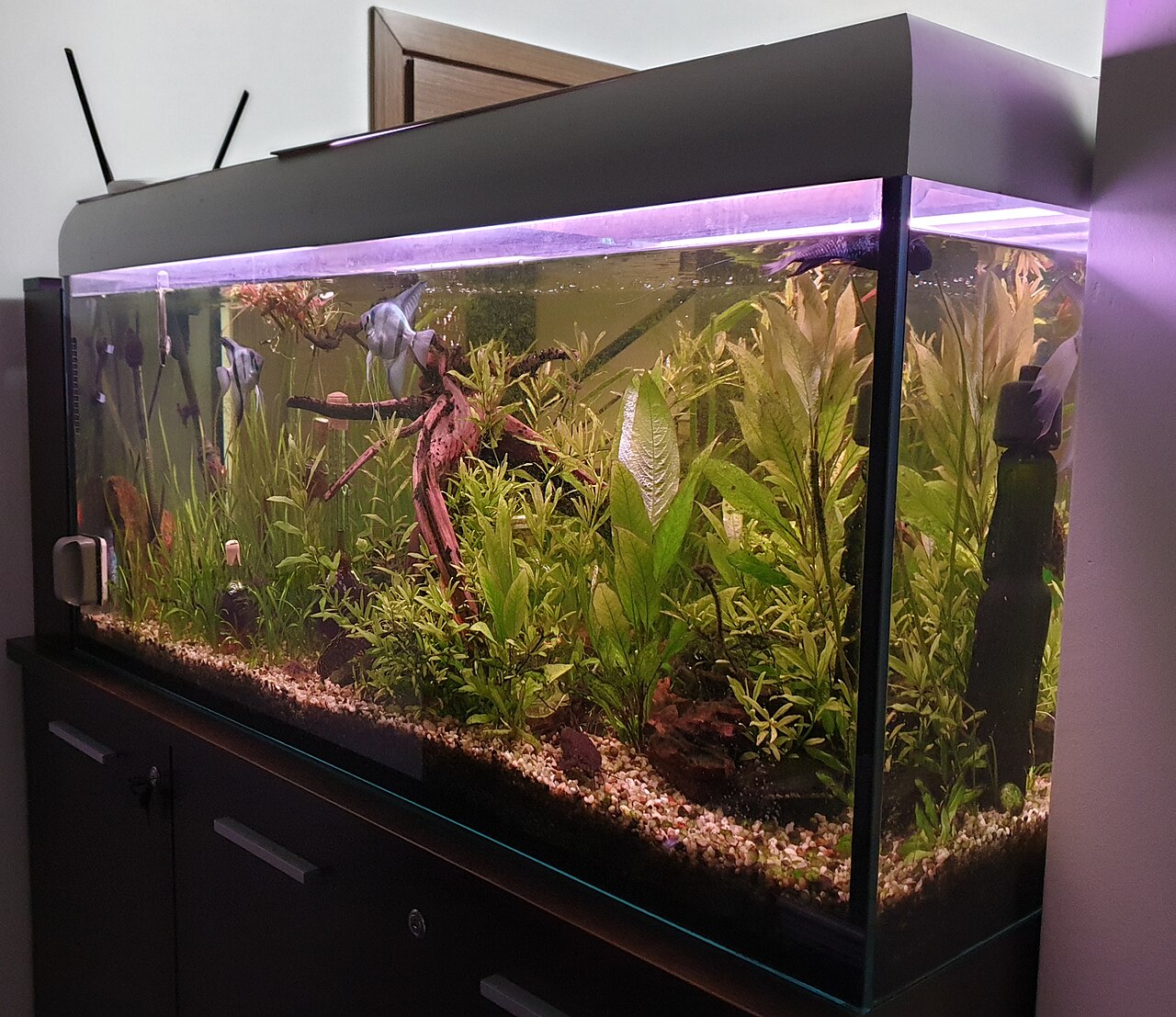
If your test kit shows ammonia, act today, not at the weekend. The single most effective thing you can do is a big water change with clean, dechlorinated, temperature-matched water, assuming your tap reads lower than your tank. Everything else here is about buying time and stopping it happening again. And there is one detail the general guides skip that matters a great deal on water like mine: hard, alkaline tap makes the same ammonia reading far more toxic than it would be in soft, acidic water. If you keep fish on hard water, read the pH section below before you do anything else.
Free PDF
Free aquarium water cheat sheet (PDF)
Grab the one-page reference for your tank: target ranges for pH, hardness, ammonia, nitrite and nitrate, plus a plain walkthrough of the nitrogen cycle. No fluff, unsubscribe any time.
Free, unsubscribe any time. The download starts as soon as you sign up.
What a reading above zero actually means
The only safe ammonia level is zero. There is no “a little is fine” band to aim for. Any colour on the test above pure yellow means the tank is producing ammonia faster than the filter is removing it, and the fish are breathing it.
Here is the part that trips people up. Your liquid test kit measures total ammonia, which is two things added together: ammonium (NH4+), which is relatively harmless, and free ammonia (NH3), which burns gills and is the form that kills. The split between the two is not fixed. It shifts with pH and, to a lesser degree, temperature. So a reading of 0.5 ppm can be a mild irritation in one tank and a lethal dose in another, depending entirely on the water it sits in.
Why hard, alkaline water makes ammonia far more dangerous
This is the bit that is genuinely different for us. As pH climbs, more of that total ammonia exists as the toxic free form. At an acidic pH around 6.5, the overwhelming majority is locked up as safe ammonium. At a pH near 8, a much larger slice is the free ammonia that does the damage. Warmer water nudges it the same way.
My tap runs about 7.2, and plenty of hard-water tanks sit higher once Rift Lake rock and buffering come into play. That means a reading a soft-water keeper could shrug off for a day is one I treat as urgent. The number on the bottle is the same; the danger behind it is not.
If you want to see this for yourself rather than take my word for it, put your total ammonia reading, your pH and your temperature into the ammonia calculator. It works out how much of your reading is the toxic free fraction. Do it once and the reason hard-water keepers cannot be relaxed about ammonia becomes obvious.
The book behind Lagonia
The Hard Water Aquarium
My practical guide to working with hard, alkaline tap water instead of fighting it: reading your water, choosing and setting up the tank, and keeping and breeding the fish that thrive in it, from livebearers to Rift Lake cichlids and shell-dwellers.
Ad · Amazon affiliate links. I earn a small commission on a purchase, at no extra cost to you.
What high ammonia does to a fish
Ammonia poisoning shows up in the behaviour before it shows up as deaths. Watch for fish hanging at the surface and gasping, since damaged gills cannot pull oxygen properly. Gills may look red, inflamed or ragged. You might see clamped fins, listlessness, a fish sitting on the bottom, loss of appetite, and colours going dark or dull. In a bad spike you can lose fish within hours. In a slow, grinding low level you get stunted growth, constant stress and a tank that never quite thrives, which is its own kind of harm even when nothing dies. If fish are already dying, work through why fish die in a new or troubled tank alongside this page.
The two reasons your ammonia is high
Almost every case falls into one of two buckets, and the fix is slightly different for each.
The first is a tank that was never cycled, or is still cycling. A new filter has not yet grown enough bacteria to convert ammonia, so it accumulates. This is the classic new-tank problem, and the real cure is patience plus water changes while the nitrogen cycle establishes. If you are setting up and have not added fish yet, do it properly with fishless cycling and you avoid this entirely.
The second is an established tank that has crashed. Something killed or overwhelmed the bacteria, or the ammonia load suddenly jumped. Common culprits: a dead fish rotting behind the rockwork, serious overfeeding, a filter that stopped running for a few hours, filter media rinsed in chlorinated tap water, a big overstocking event, or a course of medication that knocked back the bacteria. Cloudy water at the same time often points to a bacterial bloom, which I cover in cloudy aquarium water.
What to do right now
Work through these in order. None of it is exotic, and that is rather the point.
- Test the tank, then test your tap. You need both numbers. If your tap water itself contains ammonia (chloramine, covered below), you need to know before you do a water change, because you could be adding the problem back in.
- Do a large water change. Fifty per cent is a sensible starting point, with fresh water dechlorinated and matched to tank temperature. Dilution is the fastest way to drop the free ammonia the fish are breathing. Repeat daily, or twice daily in a bad case, until the reading falls. The water change calculator and the volume calculator help you get the amounts right rather than guessing.
- Stop feeding, or cut right back. Less food in means less ammonia out. A healthy fish loses nothing by not eating for a day or two, and in a spike it is one of the kindest things you can do.
- Use an ammonia detoxifier as a stopgap. A water conditioner that locks ammonia into its non-toxic form will protect the gills while you sort out the cause. It does not remove ammonia and it does not replace water changes; it buys you a few hours rather than fixing anything. Be aware some detoxified ammonia still shows on a liquid test, so do not panic if the number lingers after dosing.
- Protect the filter. Do not rip out and scrub the media, do not replace all of it at once, and never rinse it under the tap. The bacteria living in that sponge are the thing that will actually end this. Rinse media gently in old tank water only if it is genuinely clogged.
- Add surface movement. Ammonia stress and low oxygen go together, and warm hard water already holds less oxygen than cool water does. Angle a filter return at the surface or add an airstone so the fish can breathe while they recover.
If the cause was a stalled cycle, the water changes hold the fish safe while the bacteria catch up over the following days. If it was a crash, fix the trigger (remove the dead fish, cut the food, restart the filter) and the mature bacteria usually recover quickly.
When your tap is the culprit: chloramine
Many water companies now treat supply with chloramine rather than plain chlorine. Chloramine is chlorine bonded to ammonia. A good dechlorinator breaks that bond, which neutralises the chlorine but releases the ammonia into your bucket. In a cycled tank the filter deals with that small amount within hours and you never notice. In an uncycled tank, or a big water change on a struggling one, it can add to your problem. If your tap tests positive for ammonia, use a conditioner that states it detoxifies chloramine and ammonia, and lean on smaller, more frequent changes rather than one enormous one.
What is not worth your money
Ammonia-removing filter pads and resins have a place in an emergency, but they exhaust quickly and become a crutch, and some interfere with a cycle you are trying to establish. They are not a substitute for water changes and a working filter. And please do not reach for pH-down to “make the ammonia safer” by dropping pH. Fighting the pH of hard, heavily buffered water is a losing game that ends in unstable swings, which stress fish far more than a steady high pH ever did. I wasted money learning that lesson years ago.
Stopping it coming back
Once the tank is stable, the prevention is dull and reliable. Do not overstock; run a realistic plan through the stocking calculator before you buy, remembering that filtration and oxygen set the real ceiling. Feed less than you think, since uneaten food is pure ammonia in waiting; my feeding guide covers portions. Keep a mature filter mature by cleaning it gently and rarely. And hold to a steady routine of water changes, which is the backbone of the whole hobby and the thing that quietly prevents most of these crises. My maintenance schedule lays out what I actually do week to week.
A closing note on livestock. Ammonia poisoning damages gills and internal organs, and a fish that looks recovered may be weakened for weeks. Go gently afterwards: keep feeding light, keep the water pristine, and do not add new fish to a tank that has just been through this until it has been stable and reading zero for a good while. The figures here are working guides from my own hard-water tanks, not fixed laws. Tanks, test kits and individual fish all vary, so watch your own animals and let what you see steer what you do.