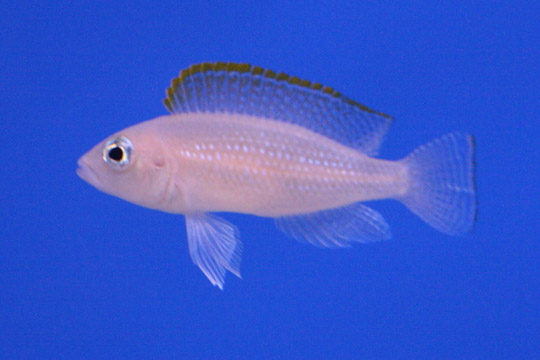
If you want a shell-dwelling cichlid that does not spend its whole life picking fights, the caudopunk is the one I point people towards. Neolamprologus caudopunctatus (you will also see it written as Lamprologus caudopunctatus, and sold as the caudopunk) is a small Lake Tanganyika cichlid that hovers in the water like a little kite, breeds readily, and asks for nothing my hard tap water cannot already give it. It is calmer than a colony of multies and a good deal more forgiving than a bad-tempered Lamprologus ocellatus. If you are choosing a first Tanganyikan, this is a species I keep coming back to.
Free PDF
Free aquarium water cheat sheet (PDF)
Grab the one-page reference for your tank: target ranges for pH, hardness, ammonia, nitrite and nitrate, plus a plain walkthrough of the nitrogen cycle. No fluff, unsubscribe any time.
Free, unsubscribe any time. The download starts as soon as you sign up.
What it actually is
Caudopunctatus comes from the rocky, sandy transition zones of Lake Tanganyika, where it lives around scattered shells and small crevices rather than in the dense shell beds the true shell-dwellers occupy. That background matters, because it shapes everything about how the fish behaves in a tank. It is not an obligate shell-dweller. It will happily take an escargot shell as a nest, but it is just as content spawning in a gap under a rock or in a small cave. Think of it as a shell-dweller with a broader mind.
The body is a soft pearly grey with a warm yellow wash along the dorsal fin, and the eyes carry a blue sheen that catches the light when the fish turns. Males reach around 5.5 to 6cm, females stay smaller at roughly 4cm, so even a mature pair has a tiny footprint. Sexing young fish is guesswork, but by adulthood the size difference and the slightly heavier head on the male usually give it away.
Water: my hard tap is already right
This is where hard-water keepers have an unfair advantage. Caudopunctatus wants hard, alkaline, mineral-rich water: pH comfortably in the high 7s to high 8s, and plenty of carbonate hardness to hold that pH steady. My tap runs at about 22 dGH straight from the cold kitchen line, and while it leaves the tap nearer pH 7.2, the pH settles higher and more stable once the tank has an aragonite-based substrate buffering it. That is exactly the environment this fish evolved in.
I keep mine at:
- Temperature 24 to 26°C
- pH 7.8 to 8.8 (mine sits around 8.2 in the tank)
- Hardness high, straight tap is fine; no softening, no additives
- Nitrate kept low with regular water changes
If your tap is soft, you would need to remineralise to reach these numbers, and you can work out a target mix with the remineralise calculator. For those of us on liquid rock, none of that applies. Fill the bucket, dechlorinate, done. If you are still getting to grips with what your hardness readings mean, my guide to GH and KH walks through it, and the water parameters overview covers the rest.
The book behind Lagonia
The Hard Water Aquarium
My practical guide to working with hard, alkaline tap water instead of fighting it: reading your water, choosing and setting up the tank, and keeping and breeding the fish that thrive in it, from livebearers to Rift Lake cichlids and shell-dwellers.
Ad · Amazon affiliate links. I earn a small commission on a purchase, at no extra cost to you.
Tank size and setup
A single pair is genuinely happy in a tank of around 60 to 80 litres, which for a Tanganyikan cichlid is remarkably modest. If you want a small group, or you want to watch several pairs stake out territories, give them more floor space rather than more height: something in the 120 to 200 litre range with a long footprint lets two or three pairs settle without constant border disputes. Work out what your tank actually holds with the volume calculator before you stock, because the printed litres on the box are usually optimistic.
The setup is simple and it should be:
- Sand. A fine sand bed a few centimetres deep. They sift and dig, and sharp gravel damages their gills and mouths. An aragonite or coral-based sand does double duty by holding the pH up.
- Shells. Several per fish, scattered across the sand. Escargot shells are ideal. I cover which shells work and how many in my guide to the best shells for shell-dwellers.
- Rock. A few flat stones and a small pile or two. Unlike pure shellies, caudopunctatus genuinely uses rockwork, and a low cave often becomes the preferred nest over any shell.
- Open water. Leave swimming room in the middle. This fish spends far more time up in the water column than a multi does, hovering and darting after food, so a tank crammed with rock to the surface wastes the very behaviour that makes it charming.
A gentle sponge or small internal filter is plenty. They are not messy fish and they dislike strong current.
Temperament: the reason I recommend it
Here is the honest comparison. A colony of multifasciatus is wonderful, but it is a swirling, busy, sometimes squabbling little society, and ocellatus can be a genuine thug that will not tolerate its own kind in a small tank. Caudopunctatus sits at the calm end of the shell-dweller spectrum. A pair defends a modest territory around the nest and otherwise gets on with life. They rarely draw blood, and they leave mid-water and upper-level fish almost entirely alone.
That said, calm does not mean pushover. During spawning a pair becomes properly territorial within their patch of sand, and in too small a tank a dominant fish can bully a weaker one relentlessly. The fix is space and sightlines, not hope. Break the floor into visual zones with rock so a chased fish can get out of sight.
Tankmates
The safe rule with any shell-dweller is to keep the bottom to them and use the upper water for company. Caudopunctatus follows the same logic I set out in my piece on multi tankmates: pick fish that occupy a different layer and share the hard, alkaline water.
Good company in a large enough Tanganyikan tank includes a shoal of Cyprichromis, which live in the open upper water and never trouble the sand, or a pair of Julidochromis working the rocks. I would keep other sand-level Neolamprologus out of a small tank, both to avoid territorial clashes and because closely related species can hybridise. In a dedicated species tank a single well-bonded pair, left to it, is the most rewarding way to see their full behaviour. My Tanganyika tank setup guide covers building a community around them, and the stocking calculator will keep you honest about numbers.
Feeding
Caudopunctatus is a zooplankton feeder in the lake, so it is built to chase small items in open water, not to graze algae. I feed a good quality micro-pellet or small flake as the everyday staple, and a few times a week I add frozen cyclops, daphnia or baby brine shrimp. Small, frequent feeds suit them better than one big meal, and watching a pair dart up to pick food out of the current is half the fun.
Do not overfeed. It is the fastest route to poor water and, in Tanganyikans generally, to bloat. Feed what they clear in a couple of minutes and skip a day now and then.
Breeding, which mostly happens on its own
Getting caudopunctatus to breed is less a project than a consequence of keeping them well. Give a compatible pair good water, a few shells and a cave, and they will get on with it. The female lays inside the chosen nest, the male fertilises and guards the perimeter, and both parents tend the site. The first sign is usually the adults becoming noticeably more defensive around one particular shell or stone.
When the fry become free-swimming they cloud around the nest in a tight little shoal, and the parents shepherd them with real diligence. I leave the fry with the parents; in a species tank they raise them without any intervention from me. Feed the fry crushed flake and, if you have it, freshly hatched brine shrimp, and they grow steadily. A settled pair will spawn again every few weeks, and you will soon have a small tribe of juveniles working the sand.
The only thing to manage is success. Fry accumulate, territories tighten, and eventually you need to move some youngsters on. That is a nicer problem than most.
Is it the right shell-dweller for you?
If you keep hard, alkaline water and you want a shell-dwelling cichlid that is easy to please, calm with tankmates, active up in the water rather than sulking in a shell, and quick to breed, caudopunctatus earns its place. It gives you the full charm of the Tanganyikan shellie world without the shell-bed aggression that catches beginners out. On liquid-rock tap like mine it is close to a fish that keeps itself, which is exactly why I keep pointing people towards it. If you are weighing it against the classic shellies, my shell-dwelling cichlids piece and the similis care guide are the natural next reads.
Livestock advice here is what has worked in my tanks on very hard water; your fish, your water and your test kit may differ, so treat the numbers as starting points rather than rules.